Why Europe Calls It Unfair Competition
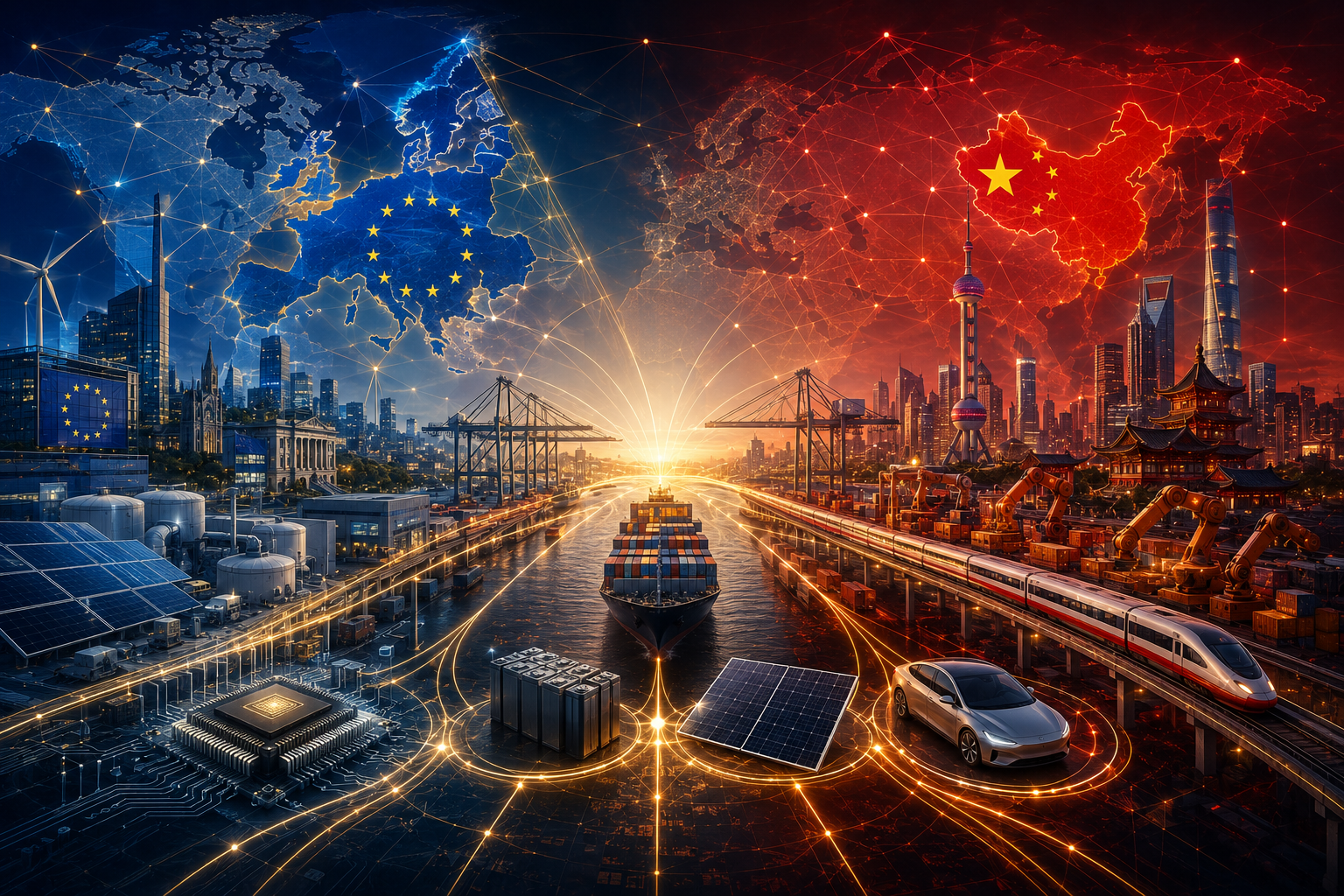
What happens when two different economic systems compete in the same market?
For decades, European policymakers largely assumed that economic competition followed a common set of rules. Companies would compete. Markets would allocate resources. Consumers would decide which products succeeded. The role of governments was to create fair conditions under which competition could take place.
Yet China’s rise has challenged many of these assumptions. The debate is often framed around subsidies, anti-dumping measures or state aid. But beneath these technical disputes lies a more fundamental question.
What happens when companies operating within different economic systems compete in the same market?
Increasingly, this is the question confronting Europe. The debate is not simply about trade. It is about the interaction of two different models of economic development.
The Rules Were Never Designed For This
Much of the global trading system was built during an era when governments and markets were viewed as relatively distinct. The World Trade Organization sought to reduce barriers to trade and create a predictable framework for international competition.
The underlying assumption was relatively straightforward. Companies compete. Governments regulate. Markets determine outcomes. For much of the post-Cold War period, many policymakers assumed that economic convergence was inevitable.
As countries became wealthier, they were expected to adopt increasingly similar institutional arrangements centred around private capital, market competition and limited state intervention.
China challenged that assumption. Rather than converging toward the Western model, it developed a different path to modernity. Markets expanded. Private enterprise flourished. Yet the state retained a significant role in shaping economic outcomes.
As we have seen throughout this series, Chinese companies often operate within ecosystems influenced by industrial policy, state-directed capital, local government involvement and long-term strategic planning.
The result is neither a traditional market economy nor a traditional command economy. It is something different. And that creates challenges for institutions originally designed around other assumptions.
The Solar Shock
Europe’s solar industry offers one of the clearest examples. During the early years of the renewable energy transition, European companies played a significant role in developing solar technologies. Yet as Chinese manufacturing capacity expanded, prices fell dramatically.
From a global perspective, this produced enormous benefits. Solar power became cheaper. Deployment accelerated. The energy transition gained momentum.
Yet many European manufacturers struggled to survive. The debate that followed was revealing. Some observers focused on subsidies. Others focused on production scale. But the deeper issue was that European firms and Chinese firms were operating within very different industrial environments. One side competed primarily as companies. The other competed as part of a larger ecosystem.
Electric Vehicles and the New Debate
The debate surrounding electric vehicles follows a similar pattern. European manufacturers operate within highly competitive markets. They must satisfy shareholders, manage profitability and respond to regulatory requirements.
Chinese manufacturers face many of the same pressures. Yet they also benefit from ecosystems built over decades through industrial policy, infrastructure investment, coordinated supply chains and long-term strategic planning.
This does not automatically mean Chinese companies are more efficient. Nor does it automatically mean they are less efficient. It means their competitive environment is different.
This distinction sits at the centre of current debates surrounding tariffs, anti-subsidy investigations and industrial policy.
Beyond Subsidies
One reason these debates are often difficult is that subsidies alone do not explain what is happening. European policymakers frequently focus on direct state support. Yet the Chinese model operates through multiple interconnected layers.
State banks. Provincial governments. Research institutions. Industrial clusters. Infrastructure investment. Long-term planning.
Viewed individually, each component may appear manageable. Viewed collectively, they create an ecosystem capable of accelerating industrial development on a remarkable scale. The challenge for Europe is that ecosystems compete differently than companies.
The Return of Economic Geography
For decades, efficiency was the dominant principle of globalisation. Production moved to wherever costs were lowest. Supply chains stretched across continents. Economic geography appeared increasingly irrelevant.
Today, governments are asking different questions. Where are critical technologies produced? Who controls supply chains? Who owns key infrastructure? What happens during geopolitical tensions or economic crises?
Economic geography is once again becoming strategic geography. Questions once viewed as commercial are increasingly viewed as matters of national resilience and economic security.
The European Dilemma
Europe now faces a profound strategic dilemma. How does it compete with a state-directed system without becoming one?
If Europe maintains a strict commitment to market neutrality, it risks losing strategically important industries to competitors operating within more coordinated ecosystems.
Yet if Europe embraces extensive industrial intervention, large-scale subsidies and strategic protectionism, it risks weakening some of the principles that have long defined the European economic model. This is not simply an economic challenge. It is an institutional one.
“Europe’s challenge is not simply how to compete with China. It is how to compete with China without becoming China.”
The debate is no longer merely about protecting industries. It is about defining what kind of economic system Europe wants to remain.
A Global Shift
The significance of this debate extends far beyond Europe. Many countries are reconsidering the relationship between markets, governments and strategic industries.
The United States has introduced major industrial initiatives such as the CHIPS Act and the Inflation Reduction Act. These programmes reflect a growing recognition that semiconductors, energy systems and advanced manufacturing have strategic importance beyond their immediate commercial value.
When Washington launched large-scale support programmes for critical technologies, it signalled something important. Concerns about industrial capacity, technological sovereignty and strategic resilience are no longer uniquely Chinese concerns. They are becoming defining features of twenty-first-century economic policy.
Competition Between Architectures
One way to understand the current situation is to stop thinking about it as competition between companies. Increasingly, it is competition between architectures.
One architecture places greater emphasis on market allocation, shareholder discipline and regulatory neutrality. The other combines market competition with strategic coordination, industrial planning and state involvement.
Both produce strengths. Both produce weaknesses. Both generate innovation. But they operate according to different principles.
The friction we see today often emerges where these architectures meet. Perhaps the most important question is no longer whether China is breaking the rules.
The question is whether the rules were designed for a world in which multiple economic architectures could succeed simultaneously.
Conclusion
European policymakers do not speak about unfair competition simply because Chinese companies are successful. They do so because Chinese firms often operate within a different economic architecture.
The debate is therefore not ultimately about subsidies, tariffs or trade disputes. It is about what happens when two different models of economic development compete within the same global market.
Understanding that distinction is essential for understanding the future of economic competition—not only between Europe and China, but across the international economy itself.
Next in the Series
If two fundamentally different economic systems can succeed at the same time, what does this mean for the future of the global economy?
Is China’s hybrid model an historical exception—or does it represent an alternative path to modernity?
In the final article of this series Understanding China’s State Model, we examine whether China is merely participating in the global economic order, or whether it is gradually helping to shape a new, multipolar architecture for the twenty-first century.
Credit
Altair Media Asia / AI-generated illustration
Caption
The debate between Europe and China is not simply about tariffs, subsidies or market access. It reflects a deeper encounter between two distinct economic architectures—one centred on market allocation and regulatory neutrality, the other combining market competition with strategic coordination, industrial planning and long-term state involvement.
