What APE 2026 reveals about Asia’s emerging control over the physical infrastructure of intelligence
Technological power rarely announces itself with grand declarations. More often, it accumulates quietly — in supply chains, standards committees, research clusters and industrial exhibitions that appear mundane to outsiders. Only in hindsight do such gatherings reveal themselves as early indicators of structural change.
The Asia Photonics Expo (APE) 2026, held in Singapore’s Marina Bay Sands, could easily be mistaken for another industry trade show: booths displaying lasers, optical modules, sensors and precision components; engineers discussing bandwidth and tolerances; procurement teams negotiating future supply agreements. Yet beneath the surface, something more consequential was visible. The exhibition floor did not merely display products. It displayed an emerging architecture of power.
In the 21st century, control over computation increasingly depends on control over the physical channels through which information flows. Silicon may still execute instructions, but photons move the data that makes modern intelligence possible. The shift from electrons to light is not incremental — it marks a transition from the digital era’s logic to a new infrastructure regime defined by energy efficiency, speed and scale.
“The convergence of photonics and semiconductors will be the defining shift for the industry, especially as AI and high-performance computing impose new demands on data mobility, energy efficiency and system integration.”
— Ang Wee Seng, Executive Director, Singapore Semiconductor Industry Association (SSIA)
His observation captures a growing consensus across Asia’s technology ecosystem: the bottleneck of the AI age is no longer primarily computational but physical. Training models requires vast data movement within and between data centers, and traditional copper interconnects are approaching their thermal and spectral limits. Optical connections, once considered specialized components, are becoming the default backbone of high-performance computing.
The Trade Show That Wasn’t Just a Trade Show
APE 2026 gathered more than four hundred exhibitors from across Asia, Europe and North America. But scale alone does not explain its significance. What distinguished the event was the breadth of applications represented: telecommunications infrastructure, semiconductor manufacturing, sensing technologies, autonomous mobility, medical devices and defense-relevant systems.
Photonics is not a single industry. It is a platform technology — a foundational layer upon which multiple sectors depend simultaneously. This makes it strategically different from consumer electronics or software markets. Advances in optical communication affect cloud computing; breakthroughs in sensing influence robotics and surveillance; innovations in laser manufacturing reshape industrial production.
Seen through this lens, the expo functioned less as a marketplace and more as a convergence point for interdependent infrastructures. Companies were not simply selling components; they were positioning themselves within future systems whose boundaries extend far beyond any single application.
Singapore as the Neutral Node
The choice of Singapore as host city is itself revealing. The island state has spent decades cultivating a role as a neutral hub in a fragmented geopolitical landscape. Politically stable, economically sophisticated and geographically central to Southeast Asia, it offers a rare environment where Western multinationals, Chinese firms, Japanese manufacturers and regional startups can operate in close proximity.
Singapore’s Research, Innovation and Enterprise (RIE) 2030 plan commits tens of billions of dollars to advanced technologies, including semiconductors and photonics. Crucially, this investment is not limited to research funding. It integrates universities, state-linked investment funds, multinational corporations and local industry into a coordinated ecosystem.
Integrated photonics has become a cornerstone of this strategy.
“Integrated photonics is the next engine of innovation for Singapore’s semiconductor sector. It is no longer a niche research field but the physical layer enabling the next generation of chips.”
— Dr. Patrick Lo Guo-Qiang, Senior Fellow, Technology Development, GlobalFoundries
This framing moves photonics from the periphery to the center of technological planning. Rather than treating optical technologies as components within larger systems, Singapore is positioning them as the systems’ enabling substrate. Combined with its dense network of subsea cables, data centers and financial institutions, the city-state functions increasingly as a switching node in global information flows — a place where data, capital and technology intersect.
Photonics as the Physical Backbone of AI
Public narratives about artificial intelligence focus heavily on algorithms, models and graphics processors. Yet the true constraints on AI expansion are increasingly physical: energy consumption, heat dissipation and data transfer speeds. Massive models require enormous internal bandwidth, moving data across racks, buildings and continents.
Copper wiring, long the standard for electronic interconnects, faces fundamental limits. Electrical resistance generates heat, signal degradation restricts distance and bandwidth ceilings cap performance gains. Optical transmission circumvents many of these constraints by carrying information as light rather than electrical current.
This transition is not merely technical. It redefines the economics of computing infrastructure. Data centers optimized for optical interconnects can achieve higher performance per watt, a critical factor as energy availability becomes a limiting resource for AI deployment worldwide.
Asia’s policymakers and industry leaders increasingly treat this shift as a matter of digital sovereignty. Control over optical components, fabrication processes and supply chains determines who can scale advanced computing systems independently.
In this sense, AI runs on data — but data runs on light.
New Ecosystems Beyond the West
The geography of technological production is also evolving. The widely discussed “China-plus-one” strategy — diversifying manufacturing beyond mainland China — is reshaping Southeast Asia into a distributed high-tech corridor rather than a collection of isolated production sites.
Vietnam and Malaysia are rapidly expanding capabilities in semiconductor packaging and testing, including photonics components that require extreme precision. Thailand is investing heavily in automotive applications, integrating lidar sensors and optical systems into next-generation vehicles. Hong Kong’s research institutions continue to bridge finance, academia and advanced manufacturing across the Greater Bay Area.
These developments are not signs of fragmentation but of deliberate redundancy. By distributing production across multiple jurisdictions, companies and governments aim to reduce vulnerability to sanctions, supply disruptions or geopolitical shocks.
The automotive sector illustrates this dynamic clearly.
“Photonics plays an irreplaceable role in data acquisition, transmission and processing, making it essential for intelligent driving. Our participation in APE 2026 is intended to lay a solid foundation for the long-term development of automotive photonics in Southeast Asia.”
— Yonghai Du, Chief Innovation Officer, HKPC & General Manager, APAS R&D Centre (Hong Kong)
Autonomous systems depend on sensors capable of perceiving the environment with high precision in real time — a task for which optical technologies are uniquely suited. As mobility platforms become data platforms, the boundaries between automotive engineering, telecommunications and computing infrastructure blur.
Industry, State and Capital Converging
One of the most striking differences between Asian and Western innovation models lies in the alignment of public policy, industrial strategy and financial capital. In many Western economies, technological progress is often portrayed as the product of entrepreneurial initiative supported by venture funding. Government intervention tends to be reactive or fragmented.
In contrast, several Asian economies treat strategic technologies as matters of national planning. Singapore’s RIE framework, Japan’s industrial policies, South Korea’s chaebol-state partnerships and China’s long-term technology programs all reflect a willingness to coordinate across sectors.
Capital flows accordingly. Rather than speculative investment seeking short-term returns, funding often follows infrastructure commitments and policy signals. When governments designate photonics as a priority, universities expand programs, corporations invest in capacity and financial institutions allocate resources.
Even Western companies benefit from this momentum. Rising revenues in Asia for firms such as IPG Photonics suggest that global demand is increasingly anchored in regions where large-scale industrial deployment is underway.
From Manufacturing Hub to Infrastructure Architect
For decades, Asia was described primarily as the world’s manufacturing base — efficient, cost-competitive and export-oriented but dependent on Western design and innovation. That narrative is becoming obsolete.
Today, Asian actors are not merely assembling devices; they are shaping standards, designing systems and orchestrating supply chains. Control over production networks translates into influence over technological trajectories. Decisions about which components are prioritized, which interfaces become standard and which capabilities are scaled can determine the global direction of innovation.
Photonics, as a foundational technology embedded in everything from telecommunications to defense systems, amplifies this influence. Whoever controls its development controls the speed and structure of future digital infrastructure.
Western observers are increasingly aware of this shift.
“Without targeted investment and strategic recognition, we risk losing our lead to global competitors. Photonics is no longer emerging — it is a critical technology in a booming market.”
— Eelko Brinkhoff, CEO, PhotonDelta
His warning underscores a widening perception gap. While Asian governments treat photonics as core infrastructure, Western debates often remain focused on short-term market incentives or fragmented subsidy programs.
The Meaning of APE 2026
Viewed in isolation, APE 2026 was an impressive industry event showcasing technical achievements and commercial opportunities. Viewed in context, it was something else: a snapshot of a region reorganizing around the physical foundations of intelligence.
The exhibition floor revealed an ecosystem in which universities, startups, multinational corporations and state institutions operate not as competitors alone but as components of a larger machine. Products on display were less important than the relationships and capabilities they represented.
In the 20th century, geopolitical power was closely tied to control over oil reserves and shipping routes. In the 21st century, it may depend just as much on control over optical networks, semiconductor supply chains and energy-efficient computing infrastructure.
APE 2026 did not announce this transition. It simply made it visible.
What appeared to be a trade show was, in reality, a demonstration of architectural control — a preview of a world in which the ability to generate, guide and process light becomes a central determinant of economic competitiveness, military capability and technological sovereignty.
The quiet hum of laser equipment and optical instruments in Singapore was therefore not merely the sound of industry. It was the sound of a new infrastructure taking shape — one that will underpin the next phase of the global digital order.
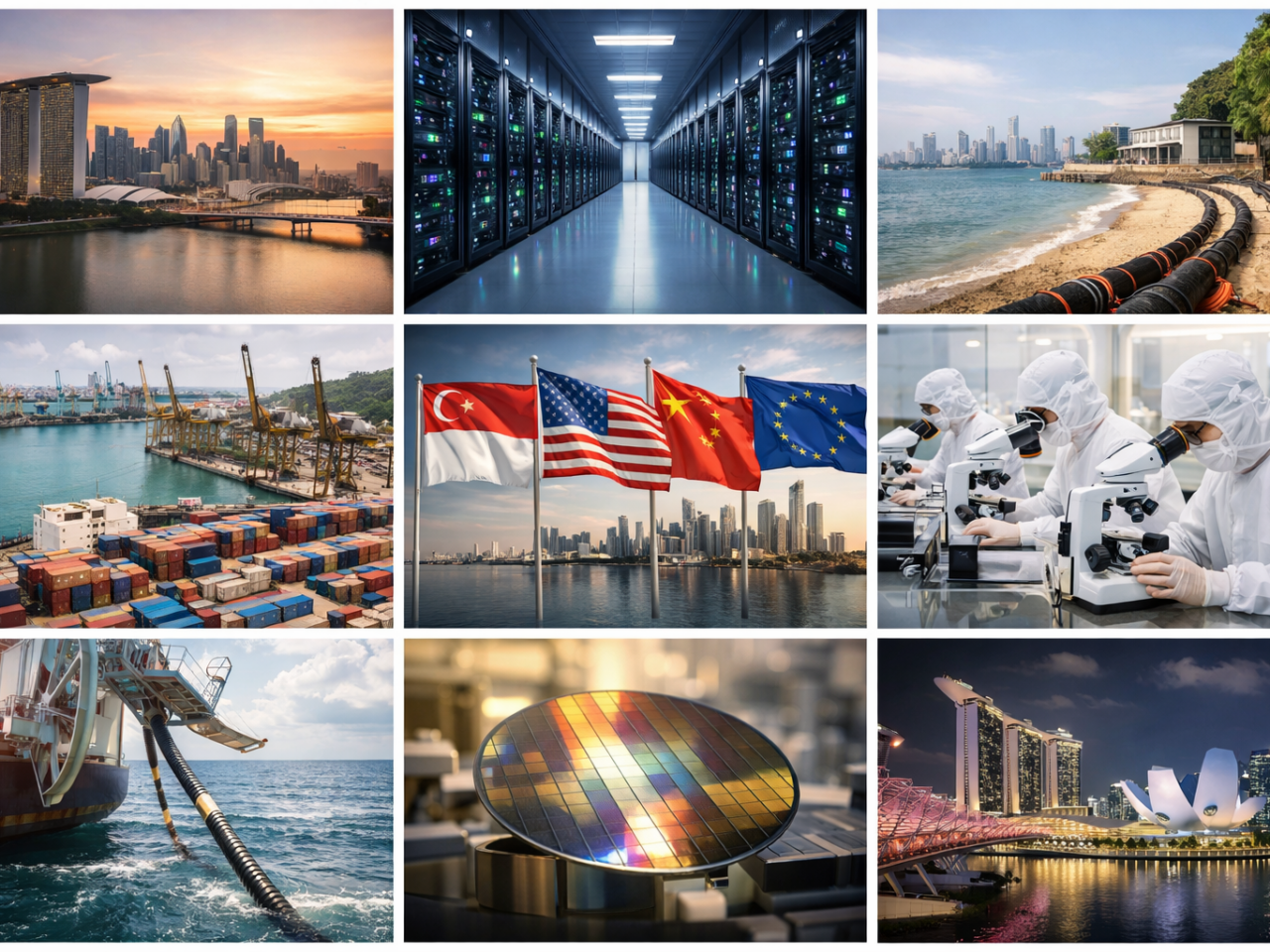
Image credit: Altair Media / AI-generated composite
Description: Artistic representation of the emerging photonics ecosystem in Asia, illustrating the convergence of data centers, semiconductor fabrication, mobility, space systems and optical networks.
The Age of Light — Meaning, Machines and the Physics of Intelligence explores how control over photonics, networks and energy is reshaping global power.
The book argues that the next technological era will be defined not by software alone, but by the physical infrastructure of intelligence.
Available worldwide via Amazon (Kindle Edition).
https://www.amazon.co.jp/dp/B0GMXLX56T