Posted by Altair Media on March 15, 2026 · Leave a Comment

Why the rewiring of supply chains is creating a more complex and resilient manufacturing geography across the Indo-Pacific
For three decades, the prevailing logic of global trade appeared almost self-evident. Design in California, source components across East Asia and assemble in China. Efficiency—measured in lower labour costs, faster shipping and integrated production clusters—became the defining principle of globalisation.
That system reshaped the world economy. China became the central node of global manufacturing, absorbing intermediate components from across Asia before exporting finished goods to Europe and North America. Supply chains stretched across continents but converged in a single industrial ecosystem along China’s eastern seaboard.
Today that map is being redrawn. Yet the shift is not a retreat from globalisation, nor a simple decoupling of economic blocs. Instead, supply chains are being rewired—extended, diversified and rebalanced—as governments and corporations seek resilience in an era defined by geopolitical tension, pandemic disruption and technological rivalry.
“The shift we are seeing is not a flight from China, but an expansion of the Chinese ecosystem. Vietnam and Thailand are not replacing Chinese factories; they are becoming the finishing schools for goods whose journey still begins in the Pearl River Delta.”
— Dr. Deborah Elms, Head of Trade Policy, Hinrich Foundation
Her observation captures the paradox of the current moment. China remains the world’s largest manufacturing base, yet the geography of production is becoming more distributed. Rather than dismantling supply chains, multinational firms are multiplying them.
From Efficiency to Resilience
The turning point came during the early 2020s. The pandemic exposed the vulnerability of tightly optimised supply chains, while geopolitical tensions—most visibly between the United States and China—introduced political risk into corporate strategy.
For decades, companies prioritised just-in-time efficiency: minimal inventories, highly concentrated production, and frictionless logistics. But the disruptions of recent years—from port closures to semiconductor shortages—revealed the fragility of this model.
In response, companies have adopted a new doctrine: resilience through diversification. Instead of relying on a single manufacturing hub, firms increasingly distribute production across several countries. The goal is not to replace China but to ensure that shocks in one location do not halt global supply.
The result is a more complex system—one that trades some efficiency for strategic redundancy.
The Logic of China+1
This new approach has come to be known as China+1. The strategy recognises China’s unparalleled industrial ecosystem—its supplier networks, logistics infrastructure and skilled workforce—while acknowledging the risks of excessive dependence.
Rather than withdrawing entirely, companies add alternative manufacturing locations elsewhere in Asia.
Vietnam has emerged as one of the primary beneficiaries. Electronics assembly lines around Hanoi and Ho Chi Minh City now produce smartphones, computers and consumer devices destined for global markets. Thailand has expanded its role in automotive supply chains, while Malaysia remains a critical node in semiconductor packaging and testing.
At the same time, China itself continues to move up the value chain, focusing on advanced manufacturing, robotics and electric vehicles.
Southeast Asia’s Expanding Factory Belt
The most visible transformation is occurring across Southeast Asia. Over the past decade, the region has quietly evolved into an integrated production corridor linking multiple specialised economies.
Vietnam has become a key electronics manufacturing centre, attracting investment from global technology firms seeking to diversify assembly operations. Indonesia, by contrast, is leveraging its vast reserves of nickel—an essential ingredient in electric vehicle batteries—to position itself at the centre of the emerging EV supply chain.
Further west, India is pursuing its own industrial ambitions.
“India is no longer just a service economy trying to build things. Through ‘Make in India’ and massive infrastructure spending, it is positioning itself as the only scale-alternative to China for complex electronics.”
— Piyush Goyal, Minister of Commerce and Industry, India
New semiconductor initiatives, smartphone manufacturing clusters and logistics corridors are part of an effort to transform India into a major manufacturing hub. The strategy is ambitious and its success remains uncertain, but the direction is unmistakable: the geography of production is broadening.
What is emerging across Asia is not a single factory but a network of industrial zones, each specialising in different segments of global value chains.
Infrastructure: The Hidden Layer of Trade
Beneath these shifting production patterns lies a less visible but equally important transformation: the expansion of logistics infrastructure.
Modern supply chains depend not only on factories but on the systems that connect them. Ports, shipping lanes, freight railways and digital customs systems form the arteries through which global trade flows.
Asia hosts many of the world’s busiest maritime hubs. Singapore, Shanghai, Busan and Shenzhen have evolved into sophisticated logistics platforms capable of handling vast volumes of container traffic. Their efficiency has become a strategic asset in the global competition for trade.
Digitalisation is reshaping these networks as well. Electronic customs systems, blockchain-based cargo tracking and integrated port logistics are gradually replacing the paper-based processes that once dominated international trade.
Together, these developments are transforming trade infrastructure into a form of strategic economic architecture.
The Geopolitics of Supply Chains
Yet supply chains are no longer purely economic systems. They have become instruments of geopolitical competition.
Governments increasingly view certain industries—semiconductors, batteries, rare earth minerals and pharmaceuticals—as matters of national security. Policies designed to protect or localise these industries have proliferated across major economies.
Export controls on advanced semiconductor technology, for instance, have reshaped investment decisions across the technology sector. Similarly, subsidies for domestic battery production in the United States and Europe have encouraged companies to diversify their sourcing of critical minerals.
“Supply chains are becoming longer and more opaque, not shorter. By adding links in Southeast Asia or Mexico to bypass tariffs, we have created a system that is perhaps more politically acceptable, but logistically more fragile.”
— Lars Jensen, CEO, Vespucci Maritime
His warning highlights a fundamental tension. Efforts to reduce geopolitical risk can inadvertently increase logistical complexity.
A More Fragmented Globalisation
The result is a new phase of globalisation—one that is neither fully global nor purely regional. Instead, the world economy is evolving toward multi-regional supply networks, in which production is distributed across several interconnected hubs.
Asia sits at the centre of this transformation.
East Asia remains the core of high-value manufacturing. Southeast Asia is emerging as a flexible production frontier. India is attempting to build a new industrial base capable of competing at scale. And across the Indo-Pacific, maritime routes continue to carry the majority of global trade.
Rather than weakening Asia’s role in the global economy, the rewiring of supply chains may ultimately reinforce it.
The New Geography of Trade
What emerges from this rearrangement is a world in which manufacturing is less concentrated but more interconnected. Supply chains no longer converge in a single national hub; they form intricate networks spanning multiple economies.
For businesses, this complexity represents both risk and opportunity. Diversification offers protection against disruption, but it also requires new investments in logistics, coordination and technology.
For governments, the challenge is even greater. Economic policy now intersects with trade strategy, industrial development and geopolitical alignment.
Globalisation has not ended. But it is evolving into something more layered, more strategic and more geographically dispersed.
Asia—home to the world’s busiest ports, fastest-growing manufacturing hubs and most dynamic trade agreements—lies at the heart of that transformation.
The factory of the world is no longer a single country. It is a web of industrial ecosystems stretching across the Indo-Pacific, connected by shipping routes, digital logistics and shifting alliances.
And as global supply chains continue to be rewired, that web is becoming the operational backbone of the twenty-first-century economy.
This article is part of the Trade section of Altair Asia, which examines the networks, infrastructure and agreements shaping Asia’s role in the global trading system.
Photo credit
Image: AI-generated illustration (DALL·E / OpenAI)
Caption
Container ships and terminals in Singapore, one of the world’s busiest maritime trade hubs. As global supply chains diversify across Asia, ports and logistics networks are becoming critical infrastructure in the new geography of trade.
Posted by Altair Media on February 27, 2026 · Leave a Comment

From Call-Center Superpower to Strategic Tech State
At 2:17 a.m. in Quezon City, the floor lights never dim. Rows of cubicles glow electric blue, reflecting off headsets, coffee cups and laminated scripts that few agents consult anymore. For two decades, this nocturnal machinery powered one of the most successful service economies in the developing world. While the West slept, the Philippines spoke — soothing angry customers, troubleshooting routers, resetting passwords, processing insurance claims. The country became, quite literally, the voice of global capitalism after dark.
Tonight, the phones still ring, but less often. Many calls are intercepted upstream by conversational AI, resolved in seconds by software trained on millions of past interactions. Agents now monitor dashboards instead of conversations, stepping in only when the algorithm hesitates or a customer demands a human. Between calls, some workers complete online modules on data annotation or prompt engineering — skills that did not exist when they were hired.
A few hours north, beyond the traffic-choked arteries of Metro Manila, survey markers outline a different future. New Clark City — envisioned as a clean, climate-resilient metropolis — is being wired for hyperscale connectivity, automated logistics and energy systems designed to power data centers rather than office towers. The Philippines is attempting something audacious: to transform itself from the world’s back office into a node of the AI economy.
Read More
Category: Analysis, Featured Headlines, Finance, Society & Culture, Technology · Tags: Artificial Intelligence, ASEAN, BPO industry, digital transformation, Future of Work, Geopolitics, outsourcing, Philippines
Posted by Altair Media on February 21, 2026 · Leave a Comment

How lidar, augmented reality and optical sensing are turning mobility and cities into strategic infrastructure
The race for artificial intelligence is usually described in terms of compute — faster chips, larger models, denser data centers. But intelligence without perception is inert. A system may calculate brilliantly and still fail in the physical world if it cannot see, measure and respond in real time.
Large language models can pause for a second before answering a question. An autonomous vehicle navigating a crowded intersection does not have that luxury. In the physical world, latency is not a user-experience issue; it is a safety constraint. Physics does not negotiate with software.
The next phase of AI is therefore not about thinking faster in the cloud, but about sensing faster on the ground. The shift from compute to perception marks a structural transition — from intelligence as abstraction to intelligence embedded in matter.
“AI is essentially a brain in a box. Without high-performance sensing like lidar and photonics, it has no way to interact safely or intelligently with the physical world. Perception is the bridge between digital intelligence and physical reality.”
— Austin Russell, CEO & Founder, Luminar Technologies
Russell’s observation underscores a simple reality: the intelligence revolution cannot scale beyond data centers without a sensory revolution. Photonics — the generation, transmission and detection of light — is becoming the infrastructure of machine perception.
The Latency of Reality
In software, delays are inconvenient. In autonomous systems, they are catastrophic.
A lidar pulse travels at the speed of light, mapping surroundings in three dimensions within microseconds. Optical sensors capture depth, velocity and spatial orientation in ways cameras alone cannot reliably achieve. The tighter the latency between sensing and action, the safer and more capable the system becomes.
This “latency of reality” introduces a new competitive metric: sensing at the speed of light. Cities that deploy dense optical sensor networks, manufacturers that integrate photonics into robotics and militaries that embed advanced optical detection into platforms gain a decisive edge.
As semiconductor scaling approaches thermal and physical limits, photonics emerges not as a complement but as a necessity.
“We are reaching the thermal and physical limits of silicon. Photonics is not just an upgrade; it is the fundamental infrastructure that will allow AI to scale from data centers into the very fabric of our smart cities.”
— Dr. Young-Kai Chen, Program Manager, Microsystems Technology Office, DARPA
The implication is profound: compute may train models, but photonics allows them to inhabit space.
Lidar and the Spatial Map of Power
Lidar — light detection and ranging — has become the emblem of machine perception. By emitting laser pulses and measuring their return time, lidar systems construct high-resolution 3D maps of the environment. In autonomous vehicles, this enables precise obstacle detection and navigation. In industrial contexts, it allows robotic systems to operate with micrometer accuracy.
But lidar is not merely a commercial feature. It is situational awareness embedded in hardware. Control over lidar supply chains, optical chip fabrication and integration standards determines who can deploy autonomous fleets at scale.
This is where the geopolitics of perception begins. If a nation depends on foreign suppliers for critical optical sensing components, its mobility systems — civilian or military — rest on external infrastructure. Dependence in perception translates into vulnerability in action.
The Cognitive HUD
Augmented reality head-up displays (AR-HUDs) may appear less dramatic than lidar, yet they represent a subtler shift. By projecting information directly onto the windshield, AR-HUDs transform the driver’s field of vision into an interface.
Navigation cues, hazard alerts and contextual data are layered onto physical space. The windshield becomes the last major surface of the vehicle to be digitized — and with it, the boundary between perception and software dissolves.
This transformation has philosophical implications. The physical world is no longer simply observed; it is annotated, filtered and potentially curated by the software provider. Control over the AR interface becomes control over attention.
In a fully sensorized vehicle, perception is distributed between machine and human. The machine “sees” through lidar and optical sensors; the human “sees” through augmented overlays. Together, they form a cognitive stack — a layered system in which light mediates both action and awareness.
Robotics and Optical Precision
Beyond mobility, photonics reshapes industrial production. Machine vision systems rely on optical sensors to detect microscopic defects, guide robotic arms and maintain precision in semiconductor fabrication.
Manufacturing has shifted from labor-intensive assembly to precision-driven automation. Optical feedback loops enable robots to adapt in real time, compensating for environmental variability and material inconsistencies.
This has strategic implications. Nations capable of integrating advanced photonics into robotics reduce dependence on labor cost advantages and strengthen domestic manufacturing resilience. Industrial autonomy increasingly rests on optical infrastructure.
As automation spreads, supply chains reorganize around ecosystems dense in sensor expertise, optical chip integration and advanced materials science. Perception becomes a production asset.
The Sensorized City
The city itself is evolving into a perceptual system. Traffic flows are monitored through optical sensors; environmental conditions are measured through distributed photonic networks; public spaces are mapped and analyzed in real time.
“The city of the future is an operating system where the interface is no longer a screen, but the physical environment itself, rendered in real-time through a grid of optical sensors.”
— Carlo Ratti, Director, MIT SENSEable City Lab
In such a city, infrastructure does not merely support activity; it observes and modulates it. Streets, intersections and buildings become nodes in a continuous feedback loop.
The benefits are tangible: reduced congestion, improved safety, optimized energy consumption. Yet the same infrastructure can serve surveillance and control. Optical sensing grids blur the boundary between service and oversight.
The “sensorized city” is therefore not only a technological achievement but a governance question. Who owns the data generated by the streets? Who defines access? Who sets the standards?
The Glass Curtain
In the 20th century, geopolitical competition was framed by physical barriers — the Iron Curtain. In the 21st, a subtler division may emerge: a Glass Curtain.
Those who control optical sensors, lidar systems and fiber backbones determine what is visible within their territory — and what is not. The management of perception becomes a strategic lever.
“The nation that leads in optical sensing and photonic integration will not only control the future of autonomous transport but will possess a decisive advantage in situational awareness, both in civil infrastructure and on the battlefield.”
— Thierry Breton, former European Commissioner for the Internal Market
Dependence on foreign optical systems could render states effectively blind in their own environments. If critical sensing technologies are imported, autonomy is compromised at the most fundamental level: perception.
Dual-Use and the High Ground
Autonomous delivery vans and reconnaissance drones share more than algorithms. Both depend on the ability to map and interpret space in three dimensions.
Optical sensing is inherently dual-use. Civilian smart-city grids and military surveillance systems draw on overlapping technologies. The same lidar innovations that enable safer roads enhance battlefield awareness.
In this context, photonics represents the “high ground” of the 21st century. Mastery of light-based sensing confers advantages across domains — commercial, industrial and military.
From Compute to Perception
Artificial intelligence began as a computational arms race. But as models mature, the decisive terrain shifts outward — from server racks to streets, factories and cities.
If AI is the brain, photonics is the sensory system of the machine age. The future will not be defined solely by who trains the largest models, but by who deploys the densest, fastest and most sovereign perceptual infrastructure.
The race is no longer only about who computes fastest. It is about who sees first — and who controls what is seen.
In the age of light, perception becomes power.
Image credit: Altair Media / AI-generated montage
Caption: In the age of light, perception becomes infrastructure — and infrastructure becomes power.
Further reading
The Age of Light — Meaning, Machines and the Physics of Intelligence explores how photonics, energy systems and physical infrastructure are reshaping artificial intelligence and global power in the 21st century.
Available worldwide on Amazon (Kindle Edition);
https://www.amazon.com/dp/B0GMXLX56T
Posted by Altair Media on February 16, 2026 · Leave a Comment
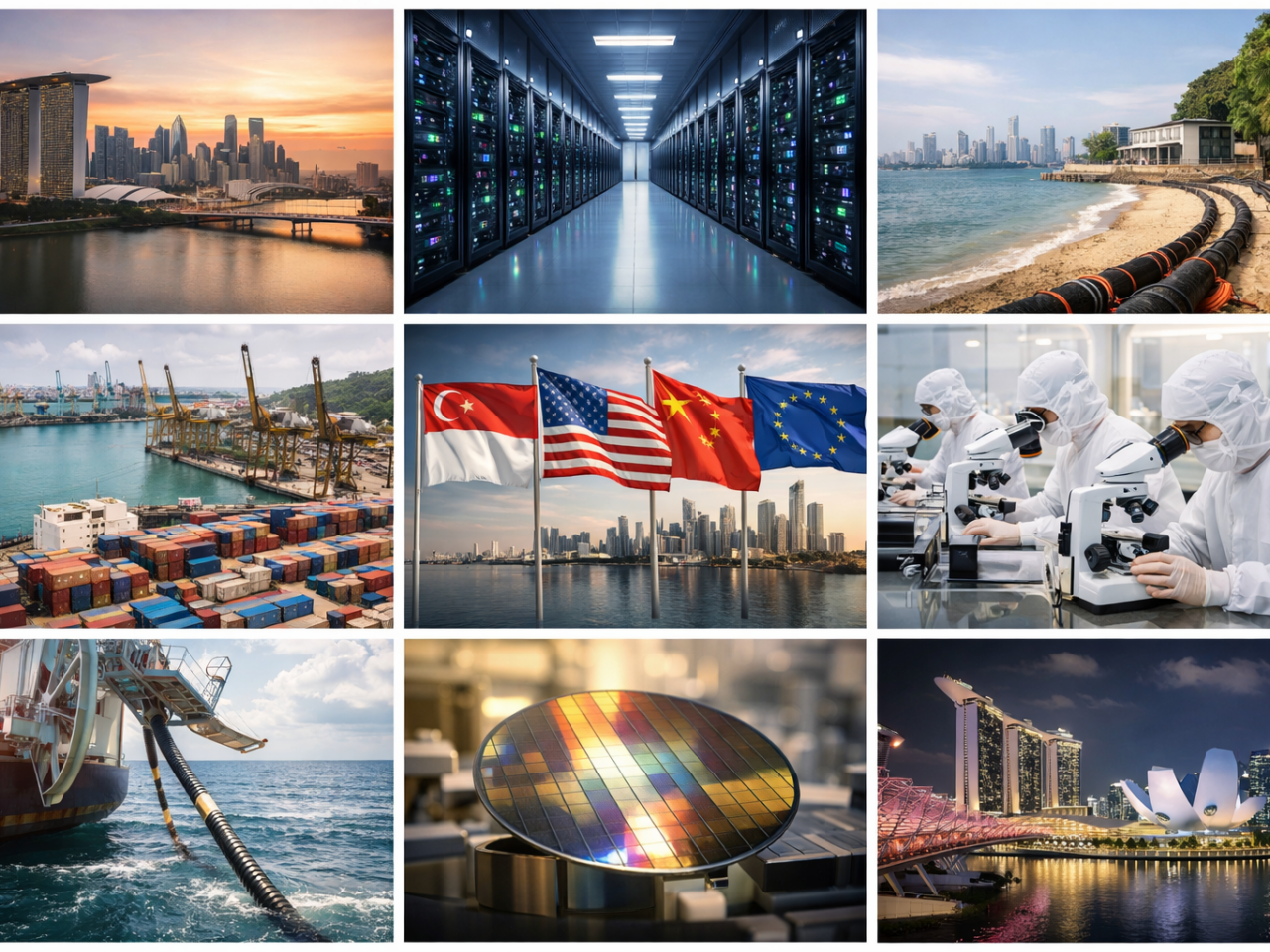
How a city-state engineered itself into the switching point of 21st-century infrastructure power
In the industrial age, power belonged to those who controlled territory, resources and sea lanes. In the digital age, it belongs increasingly to those who control connectivity. Geography still matters — but it matters differently. Not as mass, but as density. Not as land, but as linkage.
Singapore embodies this shift more clearly than almost any other state. Small in territory, limited in natural resources and surrounded by larger powers, it has redefined sovereignty not through scale but through centrality. It has engineered itself into a node — a place through which capital, data, technology and trust must pass.
“We are a little red dot in a vast ocean. If we are not exceptional, we are not relevant. If we are not relevant, we do not exist.”
— Lee Hsien Loong, Senior Minister of Singapore
This existential logic has shaped the city-state’s development for decades. But in the era of artificial intelligence, semiconductor geopolitics and photonics-driven infrastructure, it has taken on a new architectural dimension. Singapore is no longer merely a trading hub. It is designing itself as an operating system for global technological flows.
Read More
Category: Analysis, Featured Headlines, Geopolitics, Technology · Tags: AI geopolitics, Digital Sovereignty, Global Supply Chains, photonics infrastructure, RIE 2030, semiconductor ecosystem, Singapore strategy, subsea cables
Posted by Altair Media on January 30, 2026 · Leave a Comment

How Huawei, Ericsson and Nokia Are Shaping Asia’s Telecom Future
In 2026, Asia’s telecommunications landscape has shifted dramatically. The conversation is no longer about who can deploy the most 5G towers, but about who controls the “brains” of the network. Autonomous AI-driven systems, massive data flows and the need for sovereign infrastructure have redefined the competitive arena. Governments and operators are not merely investing in connectivity; they are investing in control, resilience and intelligence at the edge.
The stakes are high. Cities with millions of residents are increasingly dependent on networks capable of self-management. Data surges during large-scale events, unexpected traffic spikes and complex enterprise demands are now the norm rather than the exception. Operators that cannot anticipate, respond and optimize in real time risk losing relevance in a market where uptime and intelligence define competitive advantage.
Asia’s telco landscape has never been more complex. A combination of technological ambition, geopolitical pressure and urban expansion has forced both operators and equipment providers to rethink how networks are designed, deployed and governed. The rise of AI agents in network cores, the emergence of sovereign cloud requirements and the acceleration of 5G-Advanced (5G-A) rollouts are creating a strategic race where the prize is not just connectivity, but autonomy.
“In 2026, connectivity is a commodity; intelligence is the product. A network that cannot autonomously respond to a sudden data tsunami in a megacity is simply not competitive in Asia.”
– Max Zheng, Independent Telecom Expert / Technical Consultant
Read More
Category: Analysis, Economy, Featured Headlines, Technology · Tags: 5G-Advanced (5G-A), AI Agents, Ericsson, Huawei, Nokia, Smart Cities & Connectivity, Sovereign AI, Telecom Asia 2026
