Friday, July 24, 2026

Across Asia, governments are building increasingly digital states. As cloud infrastructure, AI and digital public services become part of national governance, Meridian Exchange 2026 explores how digital sovereignty is evolving into a question of resilience, trust and long-term state capacity.
Read More
Sunday, May 10, 2026

As Asia accelerates the deployment of connected infrastructure, IoT is evolving from consumer technology into a new layer of geopolitical power. The future of digital influence may depend less on screens and platforms — and more on who controls the systems sensing the physical world.
Read More
Wednesday, April 8, 2026

Huawei’s 2025 results reveal not a comeback but a transformation: from global tech vendor to architect of a sovereign digital ecosystem. Under pressure from sanctions, it has built parallel systems in chips, AI, and mobility—reshaping the geopolitical technology order.
Read More
Monday, February 16, 2026
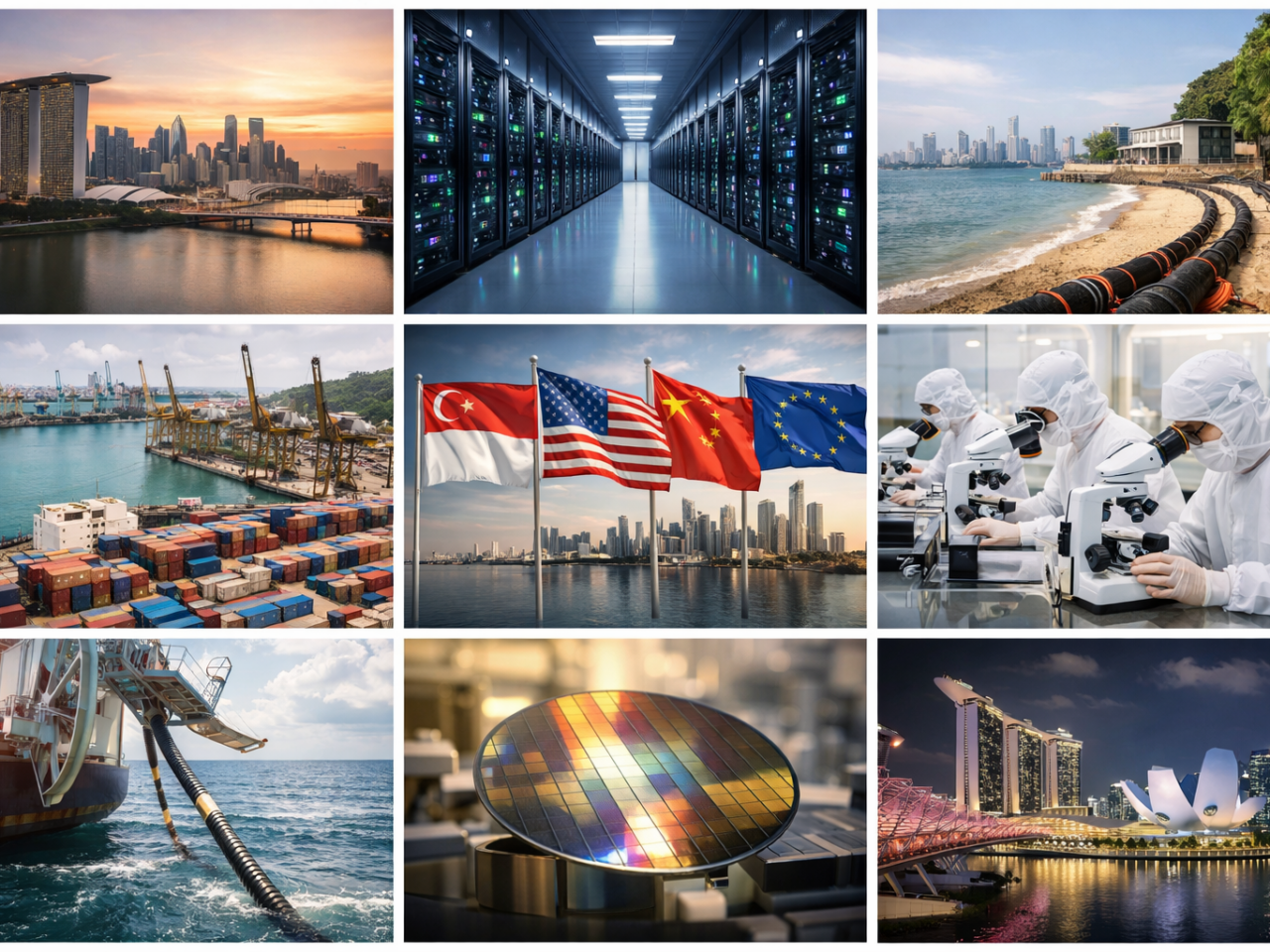
Singapore has transformed from maritime chokepoint to digital switching hub. By aligning policy, capital and advanced photonics infrastructure, the city-state positions itself as a neutral node in a fragmented world — where connectivity, density and trust increasingly define geopolitical power.
Read More
Sunday, February 15, 2026

What appeared to be a conventional industry expo in Singapore revealed something far more consequential: a region aligning industry, capital and state power around photonics — the physical backbone of artificial intelligence, data infrastructure and future economic competitiveness in the emerging global order.
Read More
Wednesday, February 11, 2026

Artificial intelligence is usually discussed as software. Faster models. Bigger datasets. Smarter algorithms. But what if the real shift is not in the code — but in the physics?
Read More
Wednesday, February 11, 2026

The quiet transition of Niranth Amogh from Huawei to Nokia may appear, at first glance, as an individual career decision within the global telecom industry. In reality, it signals a deeper geopolitical realignment taking shape inside the architecture of 6G. As standards become instruments of power rather than technical coordination, the Asia-Pacific region has emerged as the decisive battleground where influence is exercised not through markets or mandates, but through the control of protocols, procedures and technical language.
Read More
Wednesday, January 7, 2026

For decades, European power was defined through markets, regulation and industrial capacity. Culture existed alongside that project — respected, supported, but rarely treated as strategic. That distinction has collapsed. In an age of geopolitical tension, platform dominance and accelerating artificial intelligence, culture and media have become infrastructure. They shape trust, legitimacy and collective orientation. Creative Europe sits precisely at that intersection, even if it is seldom described in those terms.
Read More
Monday, January 5, 2026

In discussions about Europe’s digital future, attention often gravitates toward regulation, artificial intelligence breakthroughs or geopolitical competition. Less visible, but equally influential, are the organisations that operate in the space between industry, institutions and long-term strategy. DIGITALEUROPE is one of those actors — not a technology company, not a political body, but a connective force shaping how Europe’s digital transformation is framed and governed.
Read More
Sunday, January 4, 2026

As the new working year begins, conversations across boardrooms and timelines will once again be dominated by artificial intelligence, automation and the next wave of digital disruption. These themes matter. Yet beneath the noise of software updates and AI agents, a far more physical reality is unfolding — one that may shape Europe’s future just as profoundly.
Read More
