Photonics as the Eyes of Machines
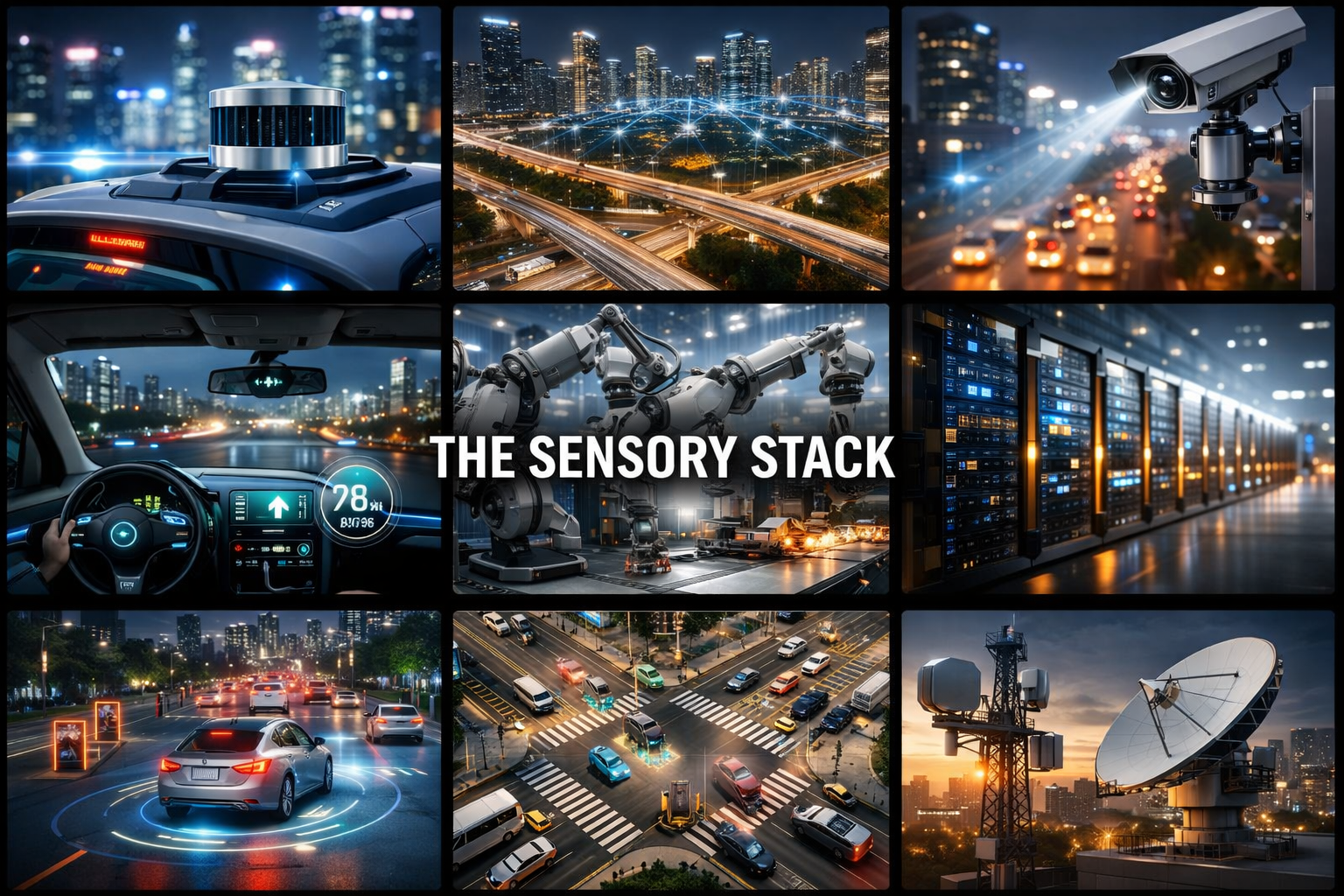
How lidar, augmented reality and optical sensing are turning mobility and cities into strategic infrastructure
The race for artificial intelligence is usually described in terms of compute — faster chips, larger models, denser data centers. But intelligence without perception is inert. A system may calculate brilliantly and still fail in the physical world if it cannot see, measure and respond in real time.
Large language models can pause for a second before answering a question. An autonomous vehicle navigating a crowded intersection does not have that luxury. In the physical world, latency is not a user-experience issue; it is a safety constraint. Physics does not negotiate with software.
The next phase of AI is therefore not about thinking faster in the cloud, but about sensing faster on the ground. The shift from compute to perception marks a structural transition — from intelligence as abstraction to intelligence embedded in matter.
“AI is essentially a brain in a box. Without high-performance sensing like lidar and photonics, it has no way to interact safely or intelligently with the physical world. Perception is the bridge between digital intelligence and physical reality.”
— Austin Russell, CEO & Founder, Luminar Technologies
Russell’s observation underscores a simple reality: the intelligence revolution cannot scale beyond data centers without a sensory revolution. Photonics — the generation, transmission and detection of light — is becoming the infrastructure of machine perception.
The Latency of Reality
In software, delays are inconvenient. In autonomous systems, they are catastrophic.
A lidar pulse travels at the speed of light, mapping surroundings in three dimensions within microseconds. Optical sensors capture depth, velocity and spatial orientation in ways cameras alone cannot reliably achieve. The tighter the latency between sensing and action, the safer and more capable the system becomes.
This “latency of reality” introduces a new competitive metric: sensing at the speed of light. Cities that deploy dense optical sensor networks, manufacturers that integrate photonics into robotics and militaries that embed advanced optical detection into platforms gain a decisive edge.
As semiconductor scaling approaches thermal and physical limits, photonics emerges not as a complement but as a necessity.
“We are reaching the thermal and physical limits of silicon. Photonics is not just an upgrade; it is the fundamental infrastructure that will allow AI to scale from data centers into the very fabric of our smart cities.”
— Dr. Young-Kai Chen, Program Manager, Microsystems Technology Office, DARPA
The implication is profound: compute may train models, but photonics allows them to inhabit space.
Lidar and the Spatial Map of Power
Lidar — light detection and ranging — has become the emblem of machine perception. By emitting laser pulses and measuring their return time, lidar systems construct high-resolution 3D maps of the environment. In autonomous vehicles, this enables precise obstacle detection and navigation. In industrial contexts, it allows robotic systems to operate with micrometer accuracy.
But lidar is not merely a commercial feature. It is situational awareness embedded in hardware. Control over lidar supply chains, optical chip fabrication and integration standards determines who can deploy autonomous fleets at scale.
This is where the geopolitics of perception begins. If a nation depends on foreign suppliers for critical optical sensing components, its mobility systems — civilian or military — rest on external infrastructure. Dependence in perception translates into vulnerability in action.
The Cognitive HUD
Augmented reality head-up displays (AR-HUDs) may appear less dramatic than lidar, yet they represent a subtler shift. By projecting information directly onto the windshield, AR-HUDs transform the driver’s field of vision into an interface.
Navigation cues, hazard alerts and contextual data are layered onto physical space. The windshield becomes the last major surface of the vehicle to be digitized — and with it, the boundary between perception and software dissolves.
This transformation has philosophical implications. The physical world is no longer simply observed; it is annotated, filtered and potentially curated by the software provider. Control over the AR interface becomes control over attention.
In a fully sensorized vehicle, perception is distributed between machine and human. The machine “sees” through lidar and optical sensors; the human “sees” through augmented overlays. Together, they form a cognitive stack — a layered system in which light mediates both action and awareness.
Robotics and Optical Precision
Beyond mobility, photonics reshapes industrial production. Machine vision systems rely on optical sensors to detect microscopic defects, guide robotic arms and maintain precision in semiconductor fabrication.
Manufacturing has shifted from labor-intensive assembly to precision-driven automation. Optical feedback loops enable robots to adapt in real time, compensating for environmental variability and material inconsistencies.
This has strategic implications. Nations capable of integrating advanced photonics into robotics reduce dependence on labor cost advantages and strengthen domestic manufacturing resilience. Industrial autonomy increasingly rests on optical infrastructure.
As automation spreads, supply chains reorganize around ecosystems dense in sensor expertise, optical chip integration and advanced materials science. Perception becomes a production asset.
The Sensorized City
The city itself is evolving into a perceptual system. Traffic flows are monitored through optical sensors; environmental conditions are measured through distributed photonic networks; public spaces are mapped and analyzed in real time.
“The city of the future is an operating system where the interface is no longer a screen, but the physical environment itself, rendered in real-time through a grid of optical sensors.”
— Carlo Ratti, Director, MIT SENSEable City Lab
In such a city, infrastructure does not merely support activity; it observes and modulates it. Streets, intersections and buildings become nodes in a continuous feedback loop.
The benefits are tangible: reduced congestion, improved safety, optimized energy consumption. Yet the same infrastructure can serve surveillance and control. Optical sensing grids blur the boundary between service and oversight.
The “sensorized city” is therefore not only a technological achievement but a governance question. Who owns the data generated by the streets? Who defines access? Who sets the standards?
The Glass Curtain
In the 20th century, geopolitical competition was framed by physical barriers — the Iron Curtain. In the 21st, a subtler division may emerge: a Glass Curtain.
Those who control optical sensors, lidar systems and fiber backbones determine what is visible within their territory — and what is not. The management of perception becomes a strategic lever.
“The nation that leads in optical sensing and photonic integration will not only control the future of autonomous transport but will possess a decisive advantage in situational awareness, both in civil infrastructure and on the battlefield.”
— Thierry Breton, former European Commissioner for the Internal Market
Dependence on foreign optical systems could render states effectively blind in their own environments. If critical sensing technologies are imported, autonomy is compromised at the most fundamental level: perception.
Dual-Use and the High Ground
Autonomous delivery vans and reconnaissance drones share more than algorithms. Both depend on the ability to map and interpret space in three dimensions.
Optical sensing is inherently dual-use. Civilian smart-city grids and military surveillance systems draw on overlapping technologies. The same lidar innovations that enable safer roads enhance battlefield awareness.
In this context, photonics represents the “high ground” of the 21st century. Mastery of light-based sensing confers advantages across domains — commercial, industrial and military.
From Compute to Perception
Artificial intelligence began as a computational arms race. But as models mature, the decisive terrain shifts outward — from server racks to streets, factories and cities.
If AI is the brain, photonics is the sensory system of the machine age. The future will not be defined solely by who trains the largest models, but by who deploys the densest, fastest and most sovereign perceptual infrastructure.
The race is no longer only about who computes fastest. It is about who sees first — and who controls what is seen.
In the age of light, perception becomes power.
Image credit: Altair Media / AI-generated montage
Caption: In the age of light, perception becomes infrastructure — and infrastructure becomes power.
Further reading
The Age of Light — Meaning, Machines and the Physics of Intelligence explores how photonics, energy systems and physical infrastructure are reshaping artificial intelligence and global power in the 21st century.
Available worldwide on Amazon (Kindle Edition);
https://www.amazon.com/dp/B0GMXLX56T
