The Party Behind the State
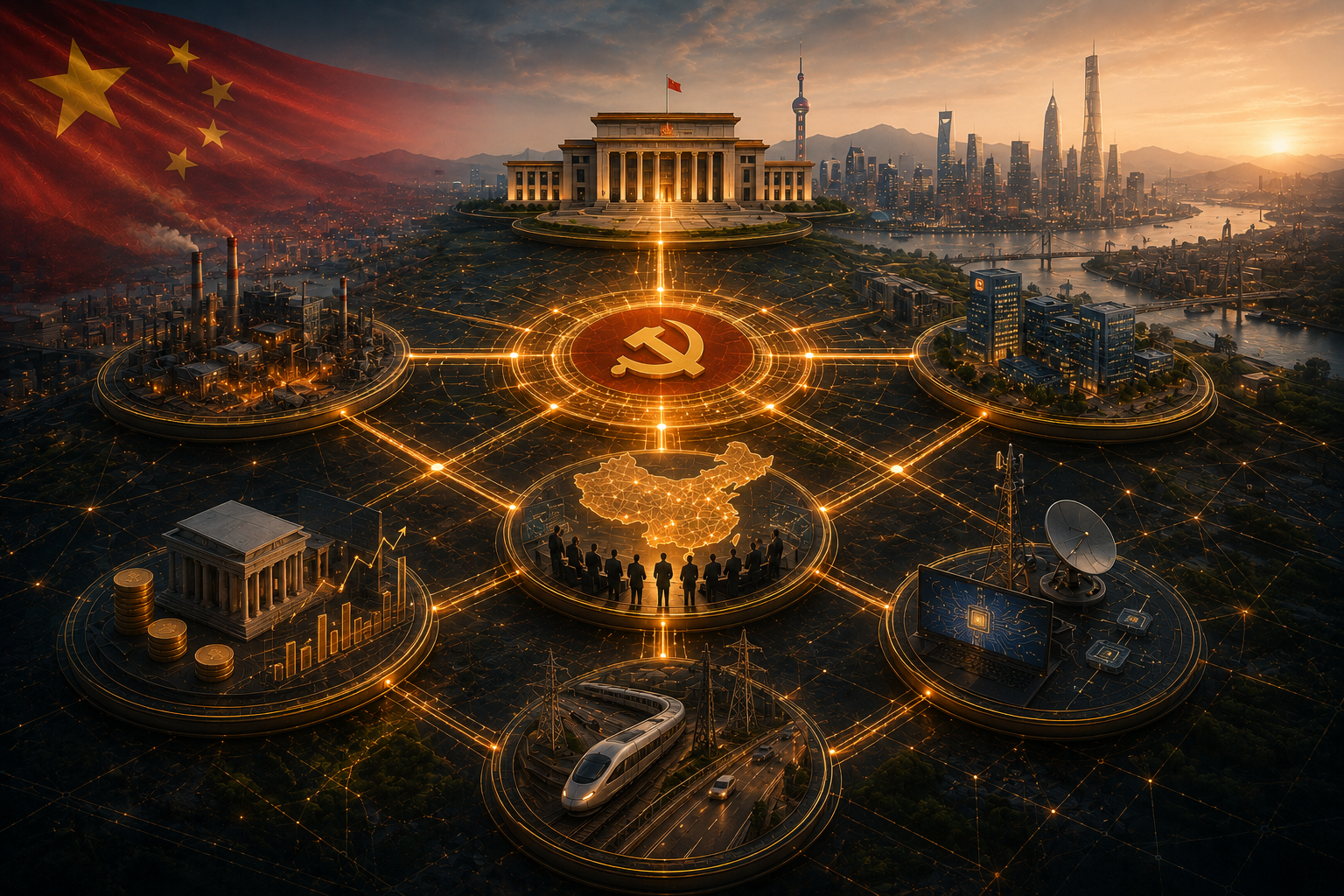
Why understanding China requires looking beyond government institutions
Many Europeans assume that governments and political parties perform separate functions. Political parties compete in elections. Governments make policy. Businesses operate within the rules established by the state.
In China, the relationship is different. To understand how decisions are made, it is not enough to study ministries, regulations or companies. It is also necessary to understand the role of the Chinese Communist Party.
The Party does not sit outside the state. Nor does it sit entirely above it. Instead, it is woven throughout the institutions that shape economic and political life. Understanding modern China therefore requires understanding not only the state, but also the Party behind it.
“In China, the Party is not simply a political organisation. It is also a coordinating institution.”
A Different Institutional Architecture
One reason China can be difficult for outsiders to understand is that many Western assumptions do not easily apply. In Europe, we often distinguish between:
- Government
- Political parties
- Public administration
- Business
These institutions interact, but they remain distinct.
China’s system evolved differently. Rather than operating as a separate institution, the Party often functions as connective tissue across the system. It links ministries, local governments, state-owned enterprises, financial institutions and strategic industries.
The objective is not necessarily direct control over every decision. The objective is alignment across multiple layers of governance.
One way to think about the Party is as a kind of institutional nervous system. It helps ensure that organisations operating in different sectors remain connected to broader national priorities.
The Role of Party Committees
One example is the presence of Party committees. These committees exist throughout government institutions, state-owned enterprises, universities and many large organisations.
For Western observers, this can appear unusual. Yet their purpose is not primarily day-to-day management. Instead, they help align organisations with broader national priorities.
When policymakers identify strategic objectives such as technological development, energy security or industrial upgrading, Party structures help communicate and coordinate those priorities across different parts of the system.
This creates a level of organisational alignment that is often difficult to achieve in more fragmented governance systems.
State-Owned Enterprises
The role of the Party is particularly visible within state-owned enterprises. Many of these organisations operate commercially. They compete. They invest. They seek profits. Yet they also serve strategic purposes.
Some manage critical infrastructure. Others operate in energy, telecommunications, transportation, finance or defence. Because these sectors are viewed as strategically important, Party structures often remain involved in leadership appointments and long-term direction.
The objective is not merely commercial performance. It is also alignment with national priorities.
Leadership, Appointments and Incentives
Another important difference concerns leadership selection. In many Western economies, senior executives are primarily accountable to shareholders or boards of directors.
In China, leadership appointments within state-owned enterprises and key institutions frequently involve Party processes as well. This creates a different relationship between economic and political authority.
From a Western perspective, this may appear as political influence. From a Chinese perspective, it is often viewed as a mechanism for ensuring coordination across strategically important sectors.
Equally important is how performance is measured. In many Western organisations, executives are evaluated primarily on financial results. In China, senior officials and leaders of strategic organisations may also be evaluated against broader policy objectives.
Economic growth. Industrial development. Technological progress. Environmental targets. Infrastructure delivery. These factors can all influence career advancement.
In this sense, the Party functions not only as a political institution, but also as a nationwide performance management system.
Local Governments and Development
The Party’s influence is not confined to Beijing. It also extends through provincial and municipal structures. As discussed in the previous article, local governments play a major role in economic development.
Party structures help connect local initiatives with broader national objectives. This creates a system in which local experimentation can coexist with national coordination.
Cities may compete. Provinces may pursue different strategies. Yet they continue to operate within a larger framework of national priorities. This combination of decentralised experimentation and central coordination has become one of the defining characteristics of China’s development model.
Many local governments therefore behave less like traditional municipalities and more like development organisations tasked with achieving strategic objectives.
Coordination as Infrastructure
One of the most overlooked aspects of China’s system is the role of coordination itself. Roads move goods. Power grids move electricity. Financial systems move capital. Party structures help move priorities through the system.
In that sense, coordination becomes a form of infrastructure.
The Party provides a mechanism through which long-term priorities can be communicated and reinforced across multiple institutions simultaneously. Whether one views this positively or negatively, it remains one of the defining characteristics of the Chinese model.
Why This Matters
For many years, foreign observers focused primarily on Chinese companies. Alibaba. Huawei. BYD. Tencent. CATL. Yet looking only at companies often provides an incomplete picture.
Many of the decisions shaping China’s economic development occur within a broader institutional architecture where Party structures, government institutions, financial organisations and businesses remain interconnected.
The Party’s coordinating role has also become increasingly visible in China’s technology sector, where questions of data governance, platform power and national resilience have gained strategic importance.
Understanding China therefore requires moving beyond individual firms and examining the relationships between these institutions.
Conclusion
Who governs China? The answer is more complex than simply “the government”. The Chinese Communist Party plays a central role in connecting political authority, economic development and long-term national strategy. Its influence extends across state institutions, state-owned enterprises and many other organisations that shape economic life.
To understand modern China, it is therefore not enough to study markets, companies or government ministries in isolation.
It is necessary to understand the institutional architecture that connects them. And at the centre of that architecture stands the Party.
Next in the Series
If a single institution helps coordinate capital, state enterprises and local governments, does that strengthen innovation or constrain it?
In part five of the serie Understanding China’s State Model, we examine China’s innovation ecosystem and explore how strategic coordination intersects with intense market competition to produce advances in sectors ranging from artificial intelligence and semiconductors to electric vehicles and advanced manufacturing.
Credit
Altair Media Asia / AI-generated illustration
Caption
The Chinese Communist Party operates as more than a political organisation. Embedded across government institutions, state-owned enterprises and strategic sectors, it functions as a coordinating layer that helps align economic activity with long-term national objectives.
