The Shenzhen Paradox
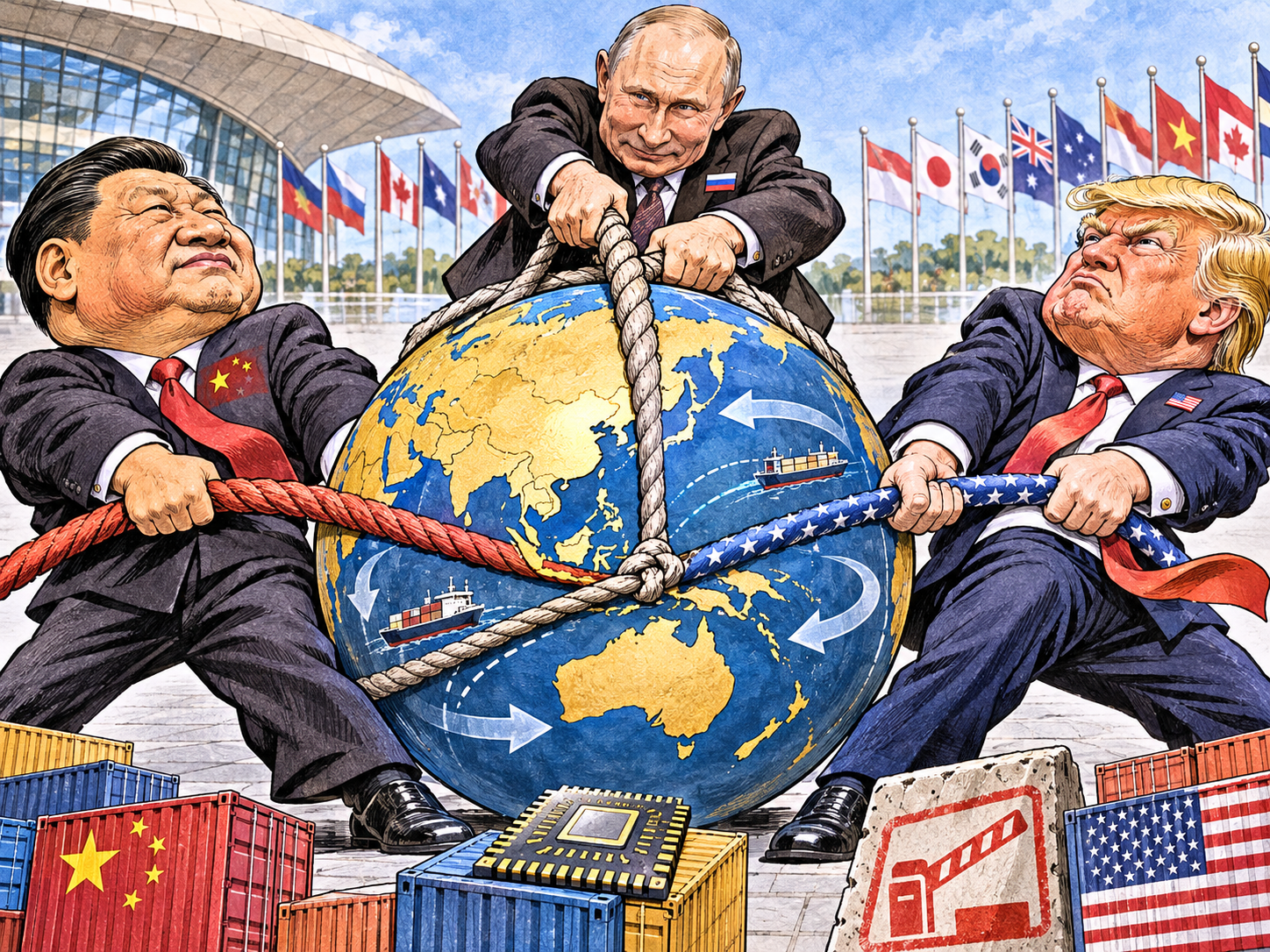
Can Asia-Pacific Integration Survive the Politics of Economic Control?
Shenzhen was built on the logic of economic interdependence. At this week’s APEC summit, that logic is being tested. Governments are calling for open trade while tightening control over advanced technologies, computing power and critical materials. For economies caught between Washington and Beijing, the central question is no longer whether integration creates prosperity, but who determines the conditions for participating in it.
The Chinese city hosting the 2026 Asia-Pacific Economic Cooperation (APEC) summit is itself a powerful symbol of globalisation. Shenzhen’s transformation from a manufacturing centre into one of the world’s leading technology hubs was made possible by international investment, interconnected supply chains and access to global markets.
Yet the economic foundations of that transformation are being challenged by a different political reality. As regional leaders discuss openness, innovation and cooperation, governments are introducing new restrictions on the technologies and resources that make modern economic integration possible.
The contradiction extends far beyond the relationship between China and the United States. It raises a fundamental question about the future of the Asia-Pacific economic order.
🟥 Is economic integration becoming a political illusion?
China has placed economic openness at the centre of its 2026 APEC presidency. Under the theme Building an Asia-Pacific Community to Prosper Together, the summit seeks to strengthen trade, innovation and regional cooperation at a time when the international economic environment is becoming less predictable.
There are compelling reasons to maintain that ambition. According to APEC’s latest regional economic outlook, published on 15 November, the region is projected to grow by 3.4% in 2026, supported by investment in technology and continued trade activity. Although growth is expected to moderate to 3.1% in 2027, the Asia-Pacific remains an important engine of global economic expansion. Its manufacturing networks, semiconductor industries and digital infrastructure are deeply connected across national borders.
However, economic performance tells only part of the story. The Pacific Economic Cooperation Council’s State of the Region 2026–2027 report identifies protectionism and trade wars as the most serious risks to regional growth. Based on responses from more than 500 members of the regional policy community, the survey reveals growing concern about the political conditions under which international commerce now operates.
The paradox is therefore not that economic integration has stopped working. On the contrary, its continued contribution to growth demonstrates how valuable it remains. The problem is that governments increasingly treat the connections supporting that growth as potential sources of strategic vulnerability.
This creates a widening distance between the language of regional cooperation and the policies pursued by individual economies. Political leaders continue to defend the benefits of openness while placing new conditions on participation in strategically important markets.
The tension: Asia-Pacific economies continue to prosper through integration, even as the political foundations of that integration become more fragmented.
🟥 When did access to technology become the new trade barrier?
The contradiction became particularly visible on 16 November, just before the Shenzhen leaders’ summit, when the United States announced additional export controls on advanced semiconductor technology.
The new measures introduce licensing requirements for covered advanced chips destined for Singapore, Malaysia, Thailand, Indonesia and Brazil. They also address access to American advanced computing capabilities through data centres located outside the United States. Washington argues that tighter controls are needed to prevent sensitive technology from reaching restricted users through intermediaries or remote computing arrangements.
The distinction is important because artificial intelligence is changing the relationship between technology, infrastructure and geography. Traditionally, semiconductor restrictions concentrated on the physical movement of components across borders. Today, an organisation can obtain access to substantial computing power without owning or importing the processors that provide it. A company operating in one country may depend on advanced AI infrastructure physically located in another.
The American rules seek to close part of that gap between the location of technology and the identity of those ultimately benefiting from it. They do not amount to a comprehensive prohibition on legitimate investment, and the framework includes exemptions and licensing arrangements for qualifying activities. Nevertheless, the measures introduce additional regulatory uncertainty into investment decisions involving some of the region’s most valuable infrastructure.
For investors and governments, the consequences reach beyond semiconductor procurement. The commercial attractiveness of a data centre may now depend on the nationality and ownership of its customers, the origin of its equipment and the regulatory permissions governing access to computing capacity.
This changes the strategic meaning of digital infrastructure.
A facility built in Southeast Asia may contribute to domestic economic growth, create employment and support a wider technology ecosystem. Yet the advanced capabilities operating inside it can remain subject to decisions made in Washington, even when the infrastructure itself is located thousands of kilometres away.
The tension: Digital infrastructure may be geographically distributed, but control over its most advanced capabilities remains concentrated.
🟥 Can Southeast Asia remain economically independent between Washington and Beijing?
For Southeast Asia, the emerging technology restrictions create a particularly difficult balancing act. The region has attracted substantial international investment by offering access to growing markets, competitive infrastructure and an alternative to concentrating global technology operations in either China or the United States.
Singapore and Malaysia illustrate both the opportunities and the vulnerabilities of this position. Singapore has established itself as an international technology and financial centre, while Malaysia has become a major destination for data centre investment. Both economies benefit from their ability to connect international capital, advanced technology and regional demand.
The latest American restrictions now require these relationships to be reconsidered. On 18 November, Singapore confirmed that it would pursue practical arrangements with Washington to preserve trusted access to advanced US technologies. Malaysia’s investment and trade minister, Johari Abdul Ghani, similarly emphasised that data centre operators must comply with American regulations, while seeking clarification about licensing requirements and the provision of computing services to third parties.
These responses reveal a broader challenge that extends beyond individual companies. A Malaysian data centre may be financed by international investors, operate American semiconductor technology, provide services to Chinese customers and rely on infrastructure governed by domestic authorities. Each connection creates economic value, but also introduces a potential source of regulatory or political pressure.
Southeast Asian governments are therefore not simply choosing between Washington and Beijing. Their objective is to preserve the advantages of cooperation with both while protecting their ability to make independent economic decisions.
That ambition remains achievable in important areas, including infrastructure development, investment policy and regional trade. However, the more advanced the technology involved, the harder it becomes to separate domestic economic choices from the strategic priorities of external powers.
The question is no longer whether Southeast Asia can attract investment from competing geopolitical blocs. It is whether those investments can provide lasting economic autonomy when access to essential technologies remains conditional.
The tension: Southeast Asia can diversify its economic relationships, but diversification does not automatically deliver technological independence.
🟥 Does China’s vision of openness resolve regional dependencies or create different ones?
In his address to the APEC CEO Summit on 18 November, President Xi Jinping presented economic openness as a foundation for future prosperity. He called for support for the multilateral trading system, stable international supply chains and further progress towards a Free Trade Area of the Asia-Pacific.
The message carries considerable economic weight. China remains a central participant in regional manufacturing networks, an important consumer market and a major provider of industrial equipment, infrastructure and technological capabilities. For many Asia-Pacific economies, maintaining productive relations with Beijing is not simply a diplomatic preference but an economic necessity.
At the same time, China’s commitment to openness must be considered alongside its capacity to exercise strategic influence through critical supply chains. The country’s position in rare-earth processing and other essential materials gives it considerable leverage over industries ranging from electric vehicles and renewable energy to advanced electronics and defence technologies.
Export restrictions introduced during 2025 demonstrated how access to strategically important materials could become part of wider trade negotiations. Beijing’s decision in November 2026 to extend the suspension of certain expanded export controls until January 2027 has provided additional breathing space, but it has not removed the underlying dependencies.
The comparison with Washington requires care. American semiconductor restrictions and Chinese controls on strategic materials operate through different mechanisms and reflect distinct political and industrial priorities. They should not be treated as identical policies. Yet both demonstrate how concentrated control over essential economic resources can influence the choices available to other countries.
For smaller Asia-Pacific economies, this creates a difficult calculation. American technology may be indispensable for advanced computing, while Chinese manufacturing capacity and materials remain essential to industrial production. Replacing either relationship would involve substantial economic costs, and developing alternative capabilities requires time, capital and technical expertise.
The most important question is therefore not which major power offers the more convincing vision of economic openness. It is whether regional economies can establish sufficiently diversified and predictable access to the resources on which their future growth depends.
The tension: Economic openness offers opportunities for cooperation, but strategic dependencies continue to give major powers influence over who can benefit from it.
🟥 What can APEC still achieve when strategic competition defines the boundaries?
The Shenzhen summit also raises an important institutional question. If economic integration is becoming conditional, what role can APEC realistically play in protecting the region’s ability to cooperate?
Its influence should not be measured solely by its capacity to negotiate major trade agreements or resolve geopolitical disputes. APEC operates through consensus and voluntary, non-binding commitments, which limits its ability to challenge decisions taken on national security grounds. Yet the same flexible structure allows its 21 member economies to cooperate on practical economic priorities despite their considerable political differences.
This may become increasingly important as regional integration enters a more fragmented phase. During preparations for the Shenzhen summit, APEC officials advanced initiatives involving paperless trade, electronic bills of lading, digital customs procedures and cooperation on artificial intelligence. These measures attract less diplomatic attention than negotiations between Washington and Beijing, but they address some of the practical obstacles facing companies operating across borders.
Improving the compatibility of digital trade systems can reduce administrative costs, strengthen transparency and make cross-border transactions more accessible. Cooperation on technical standards and regulatory practices may also help smaller economies participate in emerging industries without having to develop every institutional capability independently.
Artificial intelligence adds another dimension. For many developing economies, the challenge is not merely gaining access to advanced computing power, but acquiring the skills, institutional capacity and infrastructure needed to use it productively. Regional cooperation on education, digital capabilities and technology adoption could therefore help distribute the economic benefits of innovation more widely.
None of these initiatives can guarantee access to restricted American semiconductors or remove dependence on Chinese critical materials. Nor can APEC compel its largest members to subordinate national security interests to regional trade objectives.
But that does not make practical cooperation insignificant. At a time when strategic competition is narrowing the space for ambitious international agreements, incremental progress on common standards, trade facilitation and technological capabilities may become a more valuable form of integration.
The real test for APEC is whether such cooperation produces measurable benefits for businesses and societies, rather than merely reaffirming the principles of openness in successive summit declarations.
The tension: APEC cannot remove the geopolitical boundaries surrounding economic integration, but it can still help economies cooperate more effectively within them.
The Altair Signal
The Shenzhen summit reveals a structural transformation in the Asia-Pacific economic order. Globalisation is not necessarily retreating: trade continues, investment remains substantial and regional economies are developing new technological capabilities. What is changing is the political framework governing access to the resources that make integration possible.
Semiconductors, computing infrastructure, critical materials and strategic markets are no longer governed primarily by commercial demand and economic efficiency. National security considerations, export controls and political relationships now play a decisive role in determining who can participate and under what conditions.
For economies positioned between Washington and Beijing, the challenge is particularly demanding. They must preserve the economic advantages of international cooperation while reducing their exposure to decisions made beyond their borders. Technological capabilities, diversified partnerships and stronger regional institutions will all matter, but none offers a simple route to complete independence.
The central question emerging from Shenzhen is therefore not whether Asia-Pacific economies still believe in integration. It is whether they can preserve meaningful economic autonomy within a system where the instruments of integration double as instruments of geopolitical power.
Image credit
Illustration: Altair Media / AI-generated editorial cartoon.
Image caption
The great geopolitical tug-of-war: Xi Jinping, Donald Trump and Vladimir Putin compete for influence over an interconnected global economy. As APEC leaders meet in Shenzhen, the struggle for technological supremacy, trade access and strategic resources exposes the growing tension between economic integration and geopolitical power.
