The End of Automatic Growth
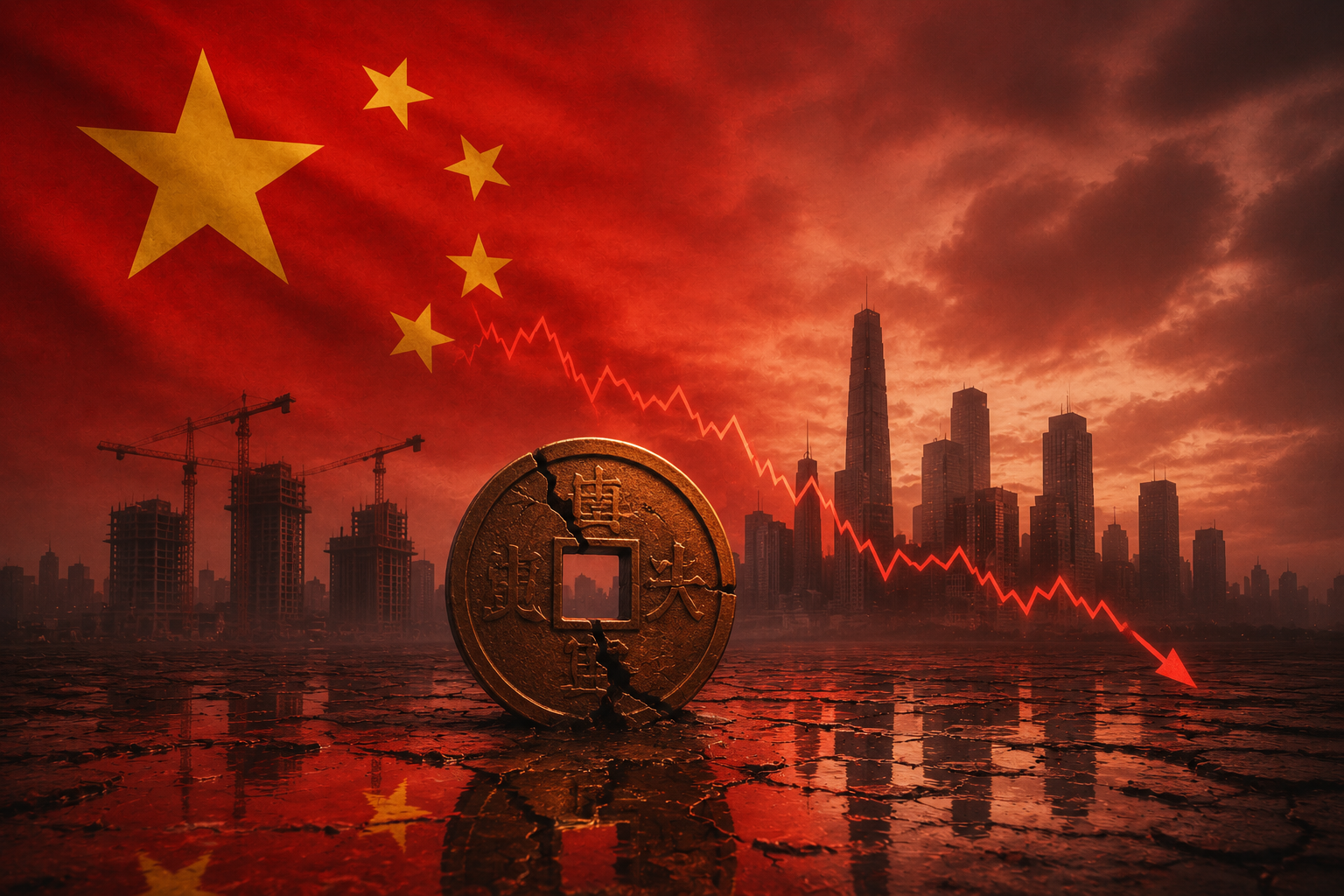
The quiet signals behind China’s slowing momentum
China remains one of the world’s largest industrial powers, yet beneath the language of resilience and stability, quieter economic signals are beginning to emerge. The issue is not sudden collapse, but the gradual disappearance of automatic momentum that once seemed almost permanent.
For decades, China’s economic model appeared nearly unstoppable. Urbanisation accelerated, exports expanded, construction boomed and local governments financed growth through land development and infrastructure. Growth itself became part of the national psychology. But today, Beijing increasingly faces a different challenge: not how to accelerate expansion, but how to manage deceleration without undermining confidence.
The Problem With Deflation
In many economies, inflation is seen as the primary danger. In China, the greater concern has quietly become the opposite.
Prices across multiple sectors have shown persistent weakness, while domestic consumption remains subdued. Deflation may sound beneficial to consumers at first glance, but structurally it can become deeply destabilising. When households expect prices to fall further, they delay purchases. Consumption slows, companies lower prices again, investment weakens and economic hesitation spreads through the system.
The Chinese government has responded with targeted subsidies and trade-in programmes designed to stimulate spending on electronics, appliances and electric vehicles. But these policies increasingly resemble attempts to preserve momentum rather than generate new confidence.
“The challenge is no longer how to sustain rapid expansion, but how to prevent psychological stagnation.”
This distinction matters. China still possesses enormous manufacturing capacity, advanced infrastructure and technological ambition. Yet the economic atmosphere surrounding growth has changed. The certainty that tomorrow would automatically become larger than today is beginning to weaken.
The Long Shadow of Real Estate
Few sectors symbolised China’s rise more clearly than property development.
For years, real estate functioned not only as an economic engine, but also as a social contract. Apartments represented savings, family security and upward mobility. Entire local government financing systems became dependent on land sales and construction activity. That system is now under pressure.
Large developers such as Evergrande and Country Garden accumulated enormous debts during the expansion years, while vast numbers of unfinished housing projects damaged public confidence. Construction activity continues to weaken, investment remains under pressure and many households have become far more cautious about spending.
The consequences reach beyond housing itself. Because a significant share of middle-class wealth was tied to property, the slowdown has reshaped consumer behaviour across the wider economy.
For younger generations in particular, the slowdown has altered more than financial expectations. Home ownership once symbolised personal advancement and long-term stability. Today, rising uncertainty around employment, property values and social mobility has contributed to a quieter shift in behaviour. Across parts of urban China, expressions such as tangping (“lying flat”) increasingly reflect emotional fatigue with a model that no longer guarantees upward momentum.
China’s leadership rarely frames this publicly as a structural crisis. Instead, the official language emphasises “adjustment”, “stability” and “high-quality development”. Yet the scale of policy intervention suggests that Beijing understands the depth of the transition taking place beneath the surface.
Exporting Through the Slowdown
Despite weakening domestic confidence, one part of the economy continues to provide relative strength: exports.
Chinese industrial capacity remains immense. Electric vehicles, batteries, solar technology and advanced manufacturing continue to expand internationally, helping offset weakness in the domestic market. In many ways, exports have become a stabilising mechanism for the broader economy. But this creates another strategic tension.
China increasingly depends on external markets at the very moment geopolitical fragmentation is intensifying. Europe and the United States remain critical consumers of Chinese industrial output, even as tensions around trade, technology and strategic dependency continue to grow.
At the same time, China’s industrial scale is increasingly creating tensions abroad. Western governments have started warning about Chinese “overcapacity” in sectors such as electric vehicles, batteries and solar technology, arguing that heavily subsidised production is flooding international markets. For Beijing, however, maintaining industrial output has become closely tied to domestic economic stability itself.
“China still projects strength outwardly, but much of its current policy is focused on preventing further slowdown internally.”
That paradox may define the next phase of China’s economic trajectory more than any headline growth figure.
From Expansion to Stabilisation
Western commentary often swings between extremes when discussing China. Either the country is portrayed as an unstoppable superpower or as an economy on the verge of collapse. Both interpretations miss the more important structural shift now taking place.
China is not disappearing as an economic power. Its industrial scale, infrastructure and state coordination remain extraordinary by global standards. But the era of automatic acceleration appears to be fading.
The deeper shift may therefore not be economic alone, but psychological. For decades, China’s system was organised around acceleration: faster urbanisation, rising property values, expanding exports and continuous upward mobility. Today, the challenge is increasingly about managing slower expectations without undermining social confidence itself.
China is not entering an era of collapse. It is entering an era in which stability, rather than speed, may become the central organising principle of economic governance.
And many of the most important signals are no longer found in headline growth figures, but in the growing effort required to sustain momentum that once appeared almost automatic.
Series — China Between Power and Pressure
This article is part of an Altair Media Asia series examining the quieter structural pressures emerging beneath China’s image of economic and geopolitical strength.
Across four essays, the series explores how demographics, slowing growth, technological competition and shifting social expectations are reshaping China’s next phase beyond the era of automatic acceleration.
Credit
Illustration created with AI assistance for Altair Media Asia
Caption
A symbolic illustration of China’s economic transition, reflecting the growing tension between industrial power, slowing domestic momentum and the search for long-term stability beneath the surface of continued geopolitical strength.
