The Conglomerate as Capital Market
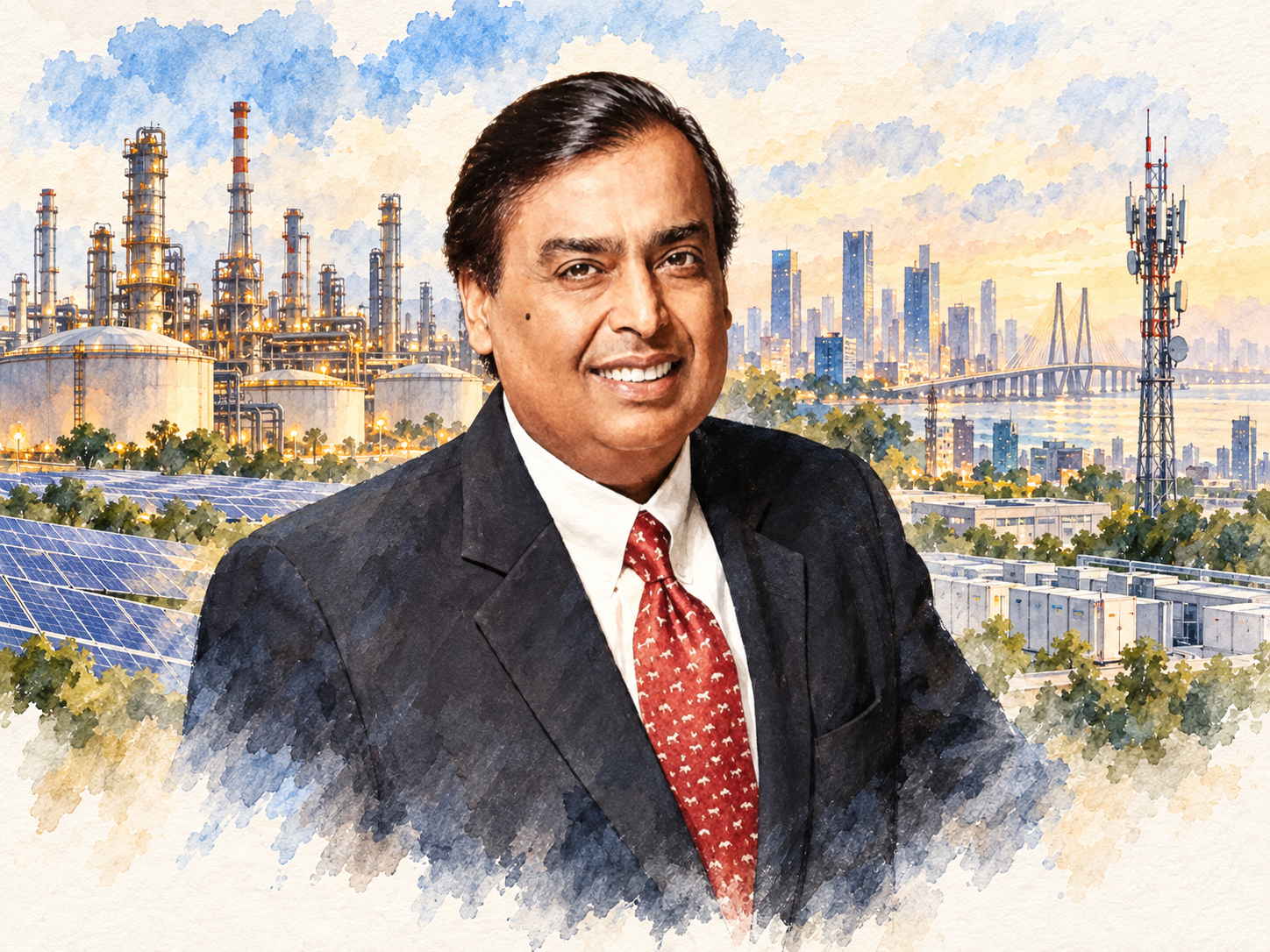
Mukesh Ambani and the corporate balance sheet building India’s next economy
Mukesh Ambani’s most important asset may not be Reliance Industries’ size. It may be his ability to decide which part of the old economy should finance the next one.
Reliance still earns enormous amounts from energy and petrochemicals. But Ambani increasingly uses that financial strength to build businesses in telecom, digital infrastructure, retail, renewable energy and artificial intelligence.
He described the logic himself:
“This business financed our past. It is financing our future.”
Mukesh Ambani, Chairman and Managing Director, Reliance Industries
That is more than a statement about cash flow. It is a philosophy of industrial development.
Build first, invite the market later
Jio shows how the model works. Reliance absorbed the enormous cost of building a national telecom network before the business had fully proved itself. Ambani did not wait for public markets to decide whether India needed another telecom platform. He built it.
Only after Jio had reached scale did major outside investors such as Meta and Google enter. Public markets are now moving closer as well, with plans for a Jio Platforms listing. That order matters.
Reliance capital came first. Strategic investors came later. The wider market arrived once the business was much easier to understand and value.
The market is not absent. Ambani decides when it becomes useful.
Ambani therefore does something that is unusual in more fragmented financial systems: he separates the decision to build from the moment the market is ready to price what has been built. That gives him time. And time can be an industrial advantage.
From oil to the next industrial platform
Ambani is now trying to repeat that logic elsewhere. Reliance is building new energy manufacturing capacity at Jamnagar, spanning solar technology, batteries and new fuels. It is also expanding digital and AI infrastructure.
These are businesses that require large investments before they produce reliable returns.
A standalone company may need to convince investors at every stage. Reliance can use profits generated elsewhere in the group to keep building while the economics are still developing.
That is the real power of the conglomerate. It can move capital from an industry that already works into one that does not yet exist at scale.
The conglomerate can move capital from an industry that already works into one that does not yet exist at scale.
For India, that matters because the country is entering a phase in which private companies are increasingly expected to build alongside the state — not only apps and services, but factories, networks, power systems and digital infrastructure.
Ambani’s balance sheet gives him the ability to move before those markets are fully mature.
The advantage — and the risk
The same structure also creates a problem.
If Ambani is right, Reliance can use yesterday’s profits to create tomorrow’s infrastructure much faster than a collection of smaller companies waiting separately for financing.
If he is wrong, the conglomerate can keep supporting an investment that public markets might have forced to prove itself much earlier.
That is why the central question is not simply whether Reliance has enough money. It is whether Ambani is allocating it to the right future. This makes him very different from the other figures in The New Architecture of Asian Capital.
Ambani is deciding which parts of India’s existing economy will help finance the industries of its future.
Hiromi Yamaji is trying to make Japanese companies more disciplined about how they use capital. Dilhan Pillay uses Temasek’s long-term balance sheet to decide which risks deserve time.
Ambani goes one step closer to the industrial economy itself. He decides which businesses inside Reliance should generate the cash — and which new industries should receive it.
The company as capital market
That is what makes Reliance such an important Asian case. In the conventional model, financial markets sit between yesterday’s wealth and tomorrow’s investment. Under Ambani, part of that function moves inside the corporation.
The old business generates the resources. The corporate centre decides where they go. New industries are built. Outside investors arrive later.
The result is not simply a large conglomerate. It is a company that can behave, in part, like its own capital market. Jio proved how powerful that model can be.
New Energy and AI infrastructure will test whether Ambani can do it again. And that leaves a much larger question for India:
What happens when one company becomes powerful enough not merely to participate in the next economy — but to help decide which parts of it get built first?
Credit
Illustration: Altair Media / OpenAI
Caption
Mukesh Ambani, Chairman and Managing Director of Reliance Industries. Under his leadership, cash generated by established businesses helps fund new platforms in telecom, energy and digital infrastructure — turning the conglomerate itself into a powerful mechanism for industrial investment.
