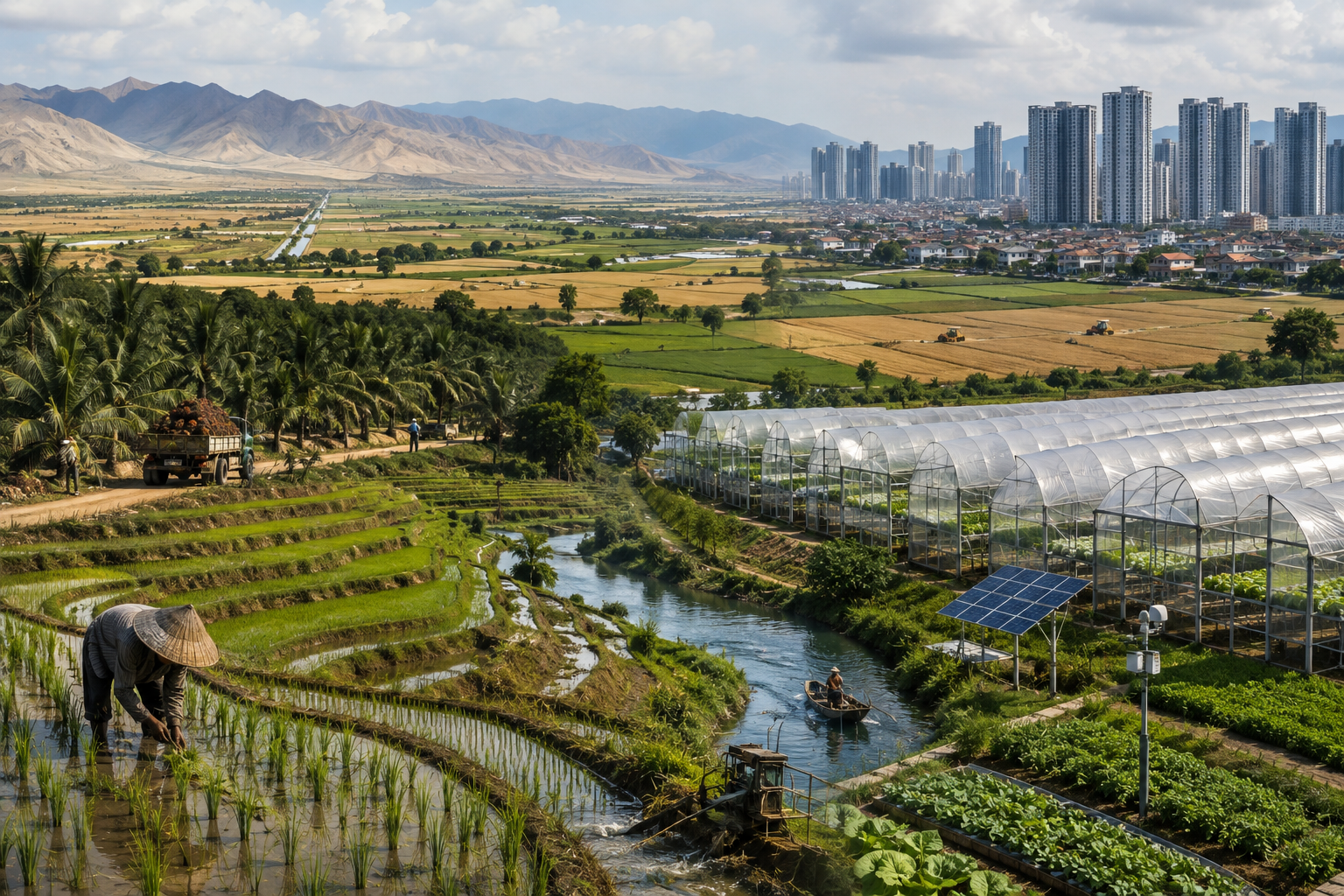
Beyond Asia’s megacities lies an immense agricultural landscape shaped by rice terraces, grain fields, plantations, irrigation and increasingly engineered farming. Understanding this geography reveals the physical system beneath Asia’s extraordinary economic and technological transformation.
Infrastructure
Infrastructure connects cities, industries and markets, enabling Asia’s economic expansion and regional integration.

Samsung Electro-Mechanics rarely appears in headlines, yet its microscopic components power the world’s most advanced technologies. From AI servers and electric vehicles to smartphones and robotics, the company demonstrates that modern innovation increasingly depends on invisible engineering rather than visible products.

Across Asia, governments are building increasingly digital states. As cloud infrastructure, AI and digital public services become part of national governance, Meridian Exchange 2026 explores how digital sovereignty is evolving into a question of resilience, trust and long-term state capacity.

A new U.S. sanctions proposal could place China’s largest banks under significant pressure, marking a shift from targeting Russia’s economy to targeting the financial networks supporting it. The development raises broader questions about energy, finance and the future architecture of the global financial system.

European companies and Chinese companies often compete in the same markets. Yet they frequently operate within very different economic architectures. Understanding those differences helps explain why debates about subsidies, trade and industrial policy have become increasingly central to relations between Europe and China.

Why does China invest hundreds of billions in semiconductors, artificial intelligence, batteries and high-speed rail? The answer lies in how Beijing views economic development. Many technologies are not seen as commercial sectors alone, but as strategic infrastructure that underpins future national power.
