How Much of Asia Is Still Agricultural?
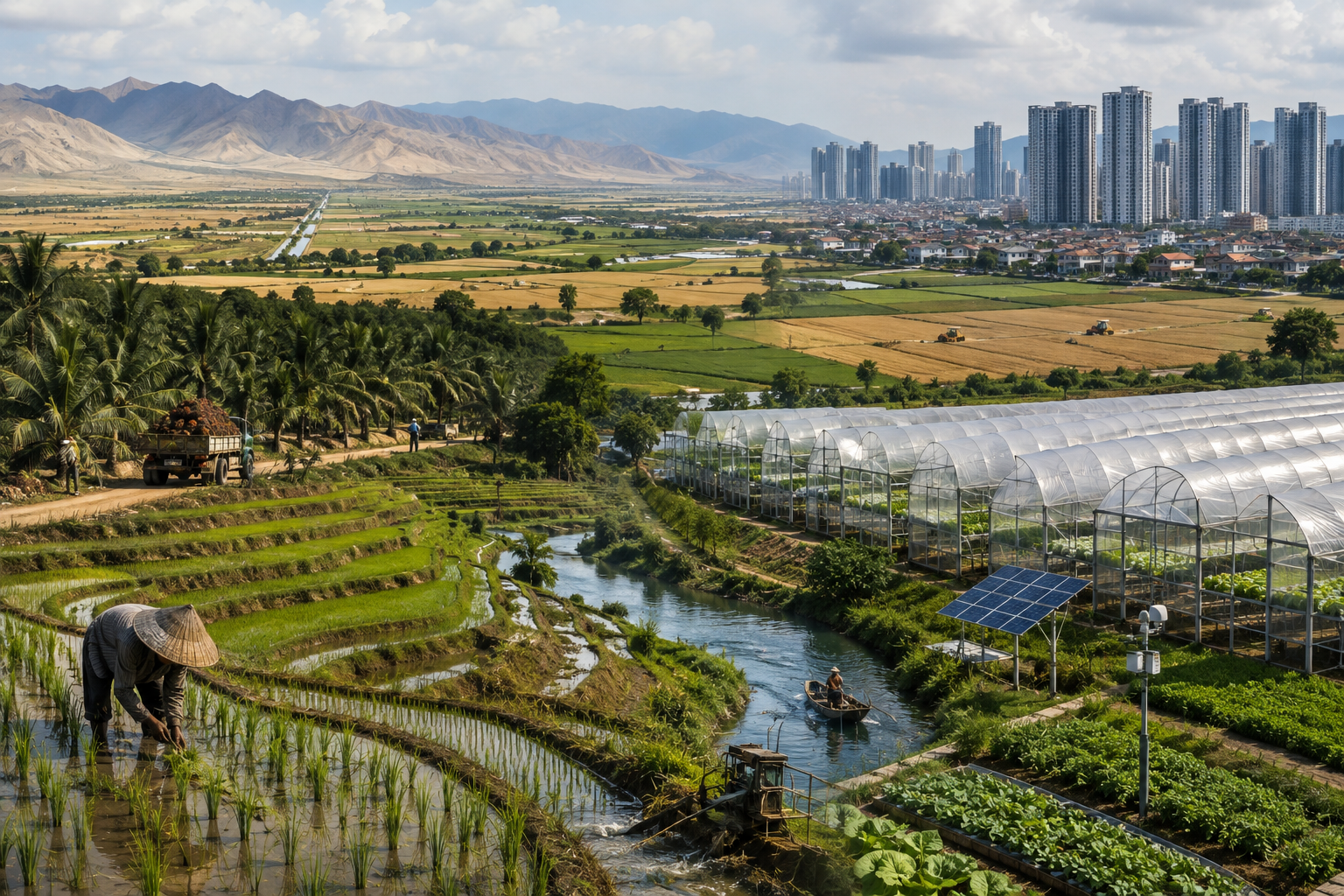
Understanding the landscapes behind Asia’s food system
Asia is often imagined through its megacities. Tokyo, Shanghai, Mumbai, Seoul, Bangkok and Jakarta symbolise a region shaped by urbanisation, industry and technological change. Yet beyond these metropolitan centres lies another Asia: rice terraces, wheat plains, plantations, orchards, greenhouses, river deltas and millions of small farms.
Agriculture still occupies an extraordinary physical and social space across the continent. But there is no single Asian agricultural landscape. Climate and geography matter, but so do centuries of human intervention. Rivers have been redirected, hillsides terraced, land redistributed and increasingly even agricultural environments themselves are being engineered.
Understanding those landscapes is the first step towards understanding The Land That Feeds Asia.
A Continent Still Shaped by the Land
Asia’s economic transformation has been remarkable. Over several decades, hundreds of millions of people have moved towards cities, manufacturing centres and service economies. Some of the world’s largest metropolitan regions now stretch across landscapes that were predominantly rural only generations ago. Yet urbanisation has not erased agriculture.
Across South, Southeast and East Asia, enormous areas remain cultivated. Rice paddies dominate humid river valleys and deltas. Wheat and other grains stretch across drier northern plains. Tea grows on hillsides, tropical crops flourish closer to the equator, while fruit, vegetables and livestock create entirely different agricultural landscapes elsewhere.
Travel further inland and the geography changes again. Across the continental landscapes of Central Asia, rainfall becomes scarcer and agriculture increasingly depends upon grasslands, irrigation and access to rivers. Grain, cotton and livestock occupy landscapes fundamentally different from the water-rich deltas of Southeast Asia.
Asia’s agricultural geography therefore runs from tropical wetlands to dry continental steppes.
Asia’s rise has changed its cities faster than it has erased the landscapes that feed them.
This diversity matters. Agriculture is not simply what remains outside the modern economy. It is part of the physical system supporting it.
The Geography of Rice
No crop illustrates the relationship between landscape and civilisation in Asia more clearly than rice.
Across large parts of East, South and Southeast Asia, generations of farmers have physically reorganised landscapes around its cultivation. Hillsides were carved into terraces. Floodplains were divided into level fields. Embankments and dikes controlled seasonal water, while networks of canals connected individual plots to wider agricultural systems.
The result is visible from the mountains of the Philippines and southern China to the great deltas of Vietnam and Bangladesh. These landscapes are not simply natural environments in which agriculture happens. Many are effectively constructed landscapes: geography reshaped over centuries to turn water and land into food.
The Mekong Delta, the Chao Phraya basin, the Ganges-Brahmaputra system and China’s great agricultural plains illustrate this relationship at enormous scale.
In many parts of Asia, the agricultural landscape itself became infrastructure.
But Asia Is More Than Rice
Rice may dominate the visual imagination of Asian agriculture, but it represents only part of a much larger system.
Northern China contains extensive wheat and maize regions. India combines major rice-producing areas with enormous wheat belts, particularly across its northern plains. Central Asia contains grain, cotton and livestock landscapes shaped by a much drier continental climate.
Move south towards the tropics and the geography changes again.
Indonesia and Malaysia became major centres for plantation crops. Vietnam developed important positions in coffee, rice and other agricultural exports. Thailand combines rice production with sugar, cassava and tropical agriculture. The Philippines has landscapes shaped by crops including coconut, banana and pineapple.
Japan and South Korea present another model. Limited available land, mountainous geography, high population density and advanced economies have encouraged intensive and increasingly high-value agriculture. But another agricultural landscape is now emerging that fits none of these traditional categories.
The New Agricultural Landscape
Around parts of Asia’s rapidly growing cities, agriculture increasingly disappears beneath plastic and glass.
Greenhouses, polytunnels, hydroponic systems and controlled agricultural environments are creating landscapes that are neither conventional countryside nor fully urban. China provides perhaps the most striking examples, with enormous concentrations of protected cultivation in agricultural regions supplying vegetables and other fresh produce to increasingly large urban populations.
Places such as Shouguang in Shandong illustrate this transformation. Agricultural production there is organised not only around soil and seasons, but around greenhouses, irrigation systems, logistics, temperature management and increasingly sophisticated production technology.
This represents something important. For thousands of years, farmers adapted production to the landscape. Increasingly, parts of Asia are beginning to adapt the landscape itself to production.
The agricultural landscape is no longer only cultivated. It is increasingly engineered.
Agriculture therefore does not necessarily disappear when societies urbanise. It can become more intensive, controlled and technologically integrated with the cities it serves.
The Small Farm Behind a Giant System
There is another characteristic that distinguishes much of Asian agriculture: the extraordinary contrast between aggregate scale and individual scale.
Asia produces food on an enormous scale, yet much of that production has historically depended upon relatively small farms. Millions of households cultivate comparatively limited areas of land, particularly across densely populated parts of East, South and Southeast Asia. That structure did not emerge from geography alone.
In several Asian societies, twentieth-century land reform deliberately changed patterns of agricultural ownership. Japan, South Korea and Taiwan redistributed agricultural land in ways that strengthened family farming. China followed a different political trajectory, but reforms beginning in the late 1970s increasingly placed agricultural production responsibility with individual rural households.
These systems differed profoundly, but together they help explain an important characteristic of the Asian landscape: agricultural production remained closely connected to millions of relatively small household units.
The physical fragmentation visible in many agricultural regions is therefore not simply the product of tradition. It also reflects political history.
The shape of a field can reveal the history of a society.
Today that structure is beginning to change. Younger generations increasingly find opportunities outside agriculture, while mechanisation, land consolidation and changing markets are altering rural economies.
One of the world’s largest food-producing systems may therefore gradually acquire a different physical shape.
When Agricultural Land Meets the City
Perhaps nowhere is this transformation more visible than at the edges of Asia’s expanding cities.
Urban growth requires land for housing, roads, industrial parks, logistics centres, airports and other infrastructure. Some of that expansion inevitably takes place across previously agricultural landscapes. This creates a strategic tension.
The same economic development that raises incomes and improves living standards can also increase pressure on the land systems supporting food production.
Cities require more than physical space. As populations become wealthier, diets often change as well. Demand for meat, dairy products, processed foods and higher-value crops can increase, changing both the quantity and type of agricultural resources required.
Urbanisation therefore does not make agriculture less important. It changes what agriculture must produce, where it can produce it and how closely food production must become connected to logistics, technology and urban demand.
Water Is the Invisible Landscape
If land determines where agriculture can exist, water increasingly determines how secure that agriculture will remain. Here the story changes from geography to vulnerability.
Across parts of northern India, intensive irrigation has placed growing pressure on groundwater reserves. Agricultural regions that became extraordinarily productive through irrigation now face the consequences of extracting water faster than natural systems can always replenish it.
In Southeast Asia, the challenge can be almost the reverse. The Mekong Delta depends upon enormous volumes of freshwater and sediment moving through a river system extending across several countries. Sea-level rise, saltwater intrusion, changing river flows and upstream infrastructure can alter the delicate balance upon which agricultural production depends.
Central Asia offers an even more dramatic historical warning. Large-scale diversion of river water for irrigated agriculture contributed to the catastrophic shrinking of the Aral Sea, demonstrating how attempts to increase agricultural production can transform an entire regional geography.
These are different problems, but they reveal the same underlying reality.
Water does not merely support Asia’s agricultural geography. It can redraw it.
The question is therefore no longer only where sufficient water exists. It is whether agricultural systems can continue to rely upon historical patterns of rainfall, rivers and groundwater in a changing climate and increasingly water-intensive economy.
A Landscape of Contrasts
Perhaps the most striking characteristic of Asian agriculture is the proximity of radically different worlds.
A farmer may cultivate a small rice field while a high-speed railway passes nearby. A centuries-old irrigation landscape can exist within reach of one of the world’s most technologically advanced cities. Small family farms coexist with industrial greenhouses, agricultural drones, satellite monitoring and increasingly sophisticated machinery.
This should not simply be understood as a contrast between old and new. It is evidence of a more complicated transition.
Asia is not moving from agriculture towards technology as though one replaces the other. Technology is increasingly entering agriculture itself, while urban economies remain dependent upon biological systems that cannot simply be digitised.
Food still requires land, water, nutrients, energy and time. That physical reality matters.
Agriculture as Infrastructure
This leads to a different way of looking at the Asian landscape. A rice terrace is not merely a field. A river delta is not merely a natural landscape. An irrigation network is not merely a local agricultural facility. Increasingly, even a landscape of greenhouses should be understood as something larger than a collection of individual farms.
Together, they form part of an enormous biological infrastructure. They convert sunlight, water, soil, knowledge, technology and human labour into the calories and nutrients upon which societies depend.
Seen from this perspective, agricultural landscapes belong alongside ports, energy networks, roads and digital infrastructure as systems that enable modern societies to function.
There is, however, one fundamental difference. Agricultural infrastructure is alive. Its productivity depends upon ecosystems, seasons, climate and biological processes that cannot be expanded or engineered as easily as a data centre, highway or factory. That makes its resilience particularly important.
The Land Beneath Asia’s Rise
Asia will continue to urbanise. Its cities will grow, its industries will evolve and technology will become still more deeply embedded in everyday life. But none of these developments removes the continent’s dependence upon productive landscapes.
Indeed, those landscapes themselves are changing. Traditional fields are consolidating in some places and disappearing beneath urban development in others. Protected cultivation is creating new agricultural environments. Water pressures are altering what can be grown and where. Technology is beginning to change the relationship between farmers and land.
The agricultural map of Asia is therefore not a historical remnant. It is a system in motion.
The skyscrapers of Shanghai, Singapore, Seoul and Mumbai may represent modern Asia more visibly than rice paddies, wheat fields or greenhouses. Yet those cities remain connected to agricultural systems extending far beyond their boundaries.
Modern food systems have simply become very effective at hiding that geography from consumers.
Final Reflection
Asia’s future is often described through semiconductors, artificial intelligence, manufacturing, infrastructure and megacities. All of those systems matter. But beneath them lies something older and more fundamental: the ability to turn land and water into food.
What makes Asia particularly fascinating is that this landscape has never been purely natural. Humans have been constructing it for centuries through terraces, irrigation, land reform and cultivation. Today, greenhouses, data, mechanisation and new production systems are beginning another transformation.
The question is therefore not only how much of Asia is still agricultural. It is also what agricultural Asia is becoming.
Because before asking whether Asia can feed itself in the future, we first need to understand the land that feeds Asia today.
The Land That Feeds Asia
About This Series
The Land That Feeds Asia looks beyond agriculture as an industry. It examines the relationship between land, water, technology, people and food security — and how these systems are changing across one of the most diverse and rapidly transforming regions in the world.
Agriculture, technology and the geography of food
Perspective I — How Much of Asia Is Still Agricultural?
Perspective II — What Does Asia Feed the World?
Perspective III — Can Asia Feed Itself?
Perspective IV — The Asian Farm After AI
Perspective V — The People Who Feed Asia
In the next Perspective, we move from landscapes to production and ask what Asia contributes to the global food system.
What Does Asia Feed the World?
Credit
Illustration by Altair Media. Created for The Land That Feeds Asia series, visualising the coexistence of traditional agriculture, water systems, protected cultivation, technological change and expanding cities across Asia.
Caption
How Much of Asia Is Still Agricultural? explores the landscapes behind Asia’s food system — from rice terraces and dry agricultural plains to greenhouses and expanding cities — revealing how geography, human intervention and technology continue to reshape the land that feeds Asia.
