Why India Wants to Build Chips, Not Just Code
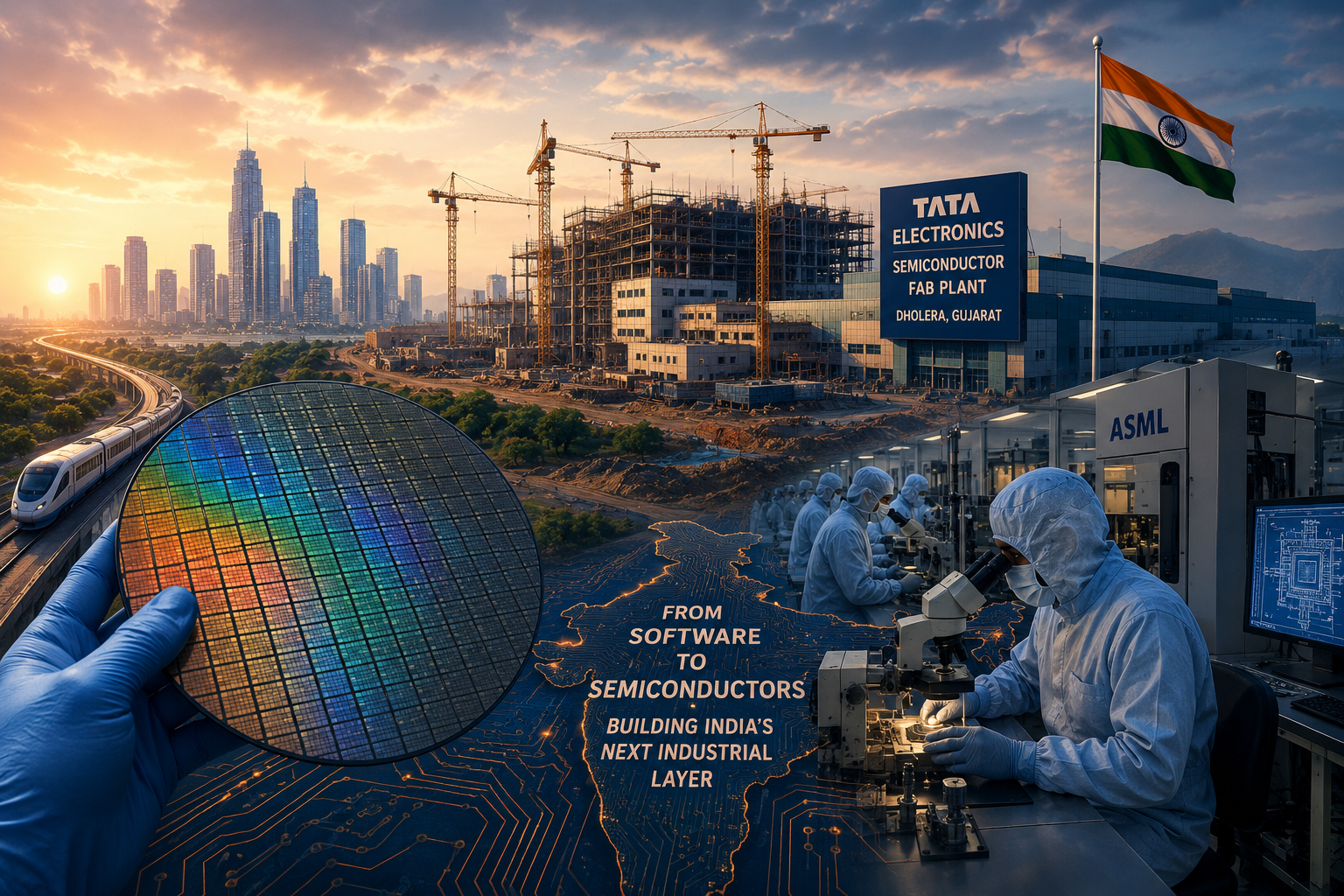
The quiet shift from digital services to industrial capability
Beyond Software
For decades, India’s global technology story was largely written in software. The country became a powerhouse in IT services, engineering support, outsourcing and digital talent. Millions of highly skilled professionals helped build the digital infrastructure of the global economy without necessarily manufacturing the hardware behind it.
Today, that story is beginning to change. India is no longer seeking only a larger role in the digital economy. Increasingly, it is attempting to build the industrial foundations that underpin it.
From Services to Systems
India’s rise as a technology hub was built on human capital. Large pools of engineers, competitive labour costs and expanding educational capacity allowed the country to become deeply integrated into global technology supply chains. Yet much of that participation remained concentrated in services rather than manufacturing.
Semiconductors represent a different challenge altogether. Designing software requires talent. Building chips requires ecosystems.
A software company can scale through talent, office space and connectivity. Semiconductor manufacturing demands something different: stable electricity, ultra-pure water, advanced logistics, specialised chemicals, precision engineering and years of accumulated industrial expertise. The challenge is not simply technological. It is infrastructural.
Fabrication plants require long-term investment, highly specialised suppliers and a level of coordination that extends far beyond any individual company. The barriers to entry are among the highest in the global economy.
That is precisely why India’s semiconductor ambitions have attracted growing international attention.
“The semiconductor race is no longer simply about technology. It is increasingly about industrial capacity.”
Recent partnerships involving Tata Electronics, ASML and international technology partners suggest that this transition is already moving from policy ambition to industrial implementation.
The objective is not merely to attract investment. The objective is to build capability.
The Infrastructure Behind Technology
Modern economies often focus on visible technologies: artificial intelligence, smartphones, cloud platforms and digital services. Less attention is paid to the industrial infrastructure that makes those technologies possible.
Semiconductors occupy a unique position within that infrastructure. They are simultaneously a product, a supply chain and a strategic dependency. Without chips there are no data centres, electric vehicles, telecommunications networks, military systems or advanced manufacturing facilities.
This is one reason governments increasingly describe semiconductors as strategic infrastructure rather than ordinary industrial products. India appears to be adopting the same perspective.
The ambition to establish multiple semiconductor facilities over the coming decade reflects a broader recognition that future economic influence will depend not only on software expertise, but also on participation in critical manufacturing ecosystems.
Demographics as an Industrial Advantage
India enters this transition from a very different position than many other Asian economies. While countries such as Japan, South Korea and China are confronting demographic ageing and slowing workforce growth, India continues to benefit from a relatively young population. That does not automatically guarantee success.
Industrial ecosystems require education, infrastructure, governance and capital alongside demographic scale.
Yet demographics influence economic possibilities. A growing workforce provides labour capacity, domestic demand and a longer development horizon for large-scale industrial projects.
Demographic advantages do not guarantee industrial success. But they provide something increasingly scarce across much of Asia: time. While several neighbouring economies are adapting to ageing populations and slower workforce growth, India still possesses a window in which demographic expansion can support industrial expansion.
In this sense, India’s semiconductor ambitions are not only about technology. They are also about timing.
“While some economies are adapting to demographic slowdown, India is attempting to convert demographic momentum into industrial momentum.”
Whether that transformation succeeds remains uncertain. But the opportunity itself is unusual.
From Self-Reliance to Indispensability
India’s semiconductor strategy is often discussed through the language of sovereignty and self-reliance. Yet semiconductors reveal the limits of complete independence.
No country controls every layer of the modern chip ecosystem. Design, manufacturing equipment, materials, packaging, software and fabrication are distributed across multiple countries and regions.
The strategic objective is therefore gradually shifting. The goal is not necessarily self-sufficiency. The goal is indispensability.
Countries increasingly seek positions within global supply chains that are difficult to replace. Influence emerges not from isolation, but from becoming deeply embedded within critical economic systems. India appears to be pursuing exactly that path.
Building the Next Layer
Semiconductor manufacturing remains one of the most difficult industries in the world to enter. Taiwan, South Korea, Japan and increasingly China spent decades building their positions. India is arriving later. Yet arriving later also offers certain advantages.
The country can learn from existing models, attract global partnerships and position itself within a supply chain that is already undergoing significant geopolitical restructuring.
The question is therefore not whether India will replace established semiconductor powers. It is whether India can build enough capability to become an indispensable part of the next generation of global technology supply chains. That may ultimately prove more important.
India’s semiconductor ambitions are often described as a technology story. Increasingly, they look like an industrial story. And perhaps even more fundamentally, they represent a shift in national ambition—from participating in the digital economy to helping build the physical infrastructure on which it depends.
Series — China Between Power and Pressure
This article is part of an Altair Media Asia series examining the quieter structural pressures emerging beneath China’s image of economic and geopolitical strength.
Across four essays, the series explores how demographics, slowing growth, technological competition and shifting social expectations are reshaping China’s next phase beyond the era of automatic acceleration.
Credit
Illustration created with AI assistance for Altair Media Asia
Caption
India’s semiconductor push represents more than a technology initiative. It reflects a broader shift from digital participation toward industrial capability, as the country seeks to convert demographic momentum into long-term economic and strategic influence.
