TSMC and the Next Frontier of AI: Who Captures the Value of Light?
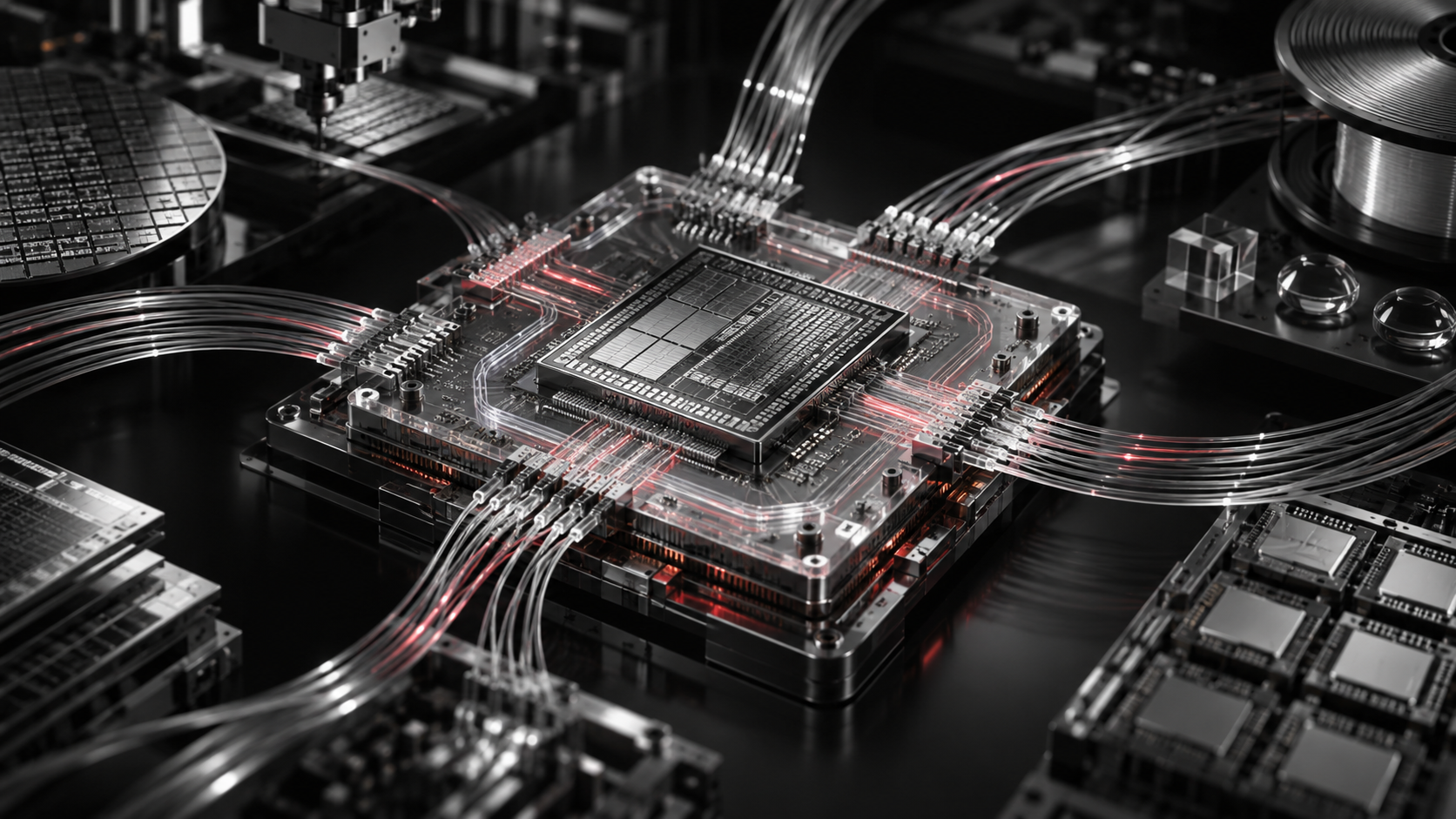
As photonics enters industrial production, Taiwan’s semiconductor ecosystem faces a new question: who controls the technologies needed to scale it?
Artificial intelligence needs more than faster processors. Moving information between chips and servers is becoming an increasingly important challenge. Taiwan’s TSMC is helping bring optical technology closer to electronic circuits, while NVIDIA has moved co-packaged optics into production. But as light becomes part of AI infrastructure, a new industrial question emerges: who will capture the value?
TSMC’s COUPE platform integrates silicon photonics with electronic control chips. NVIDIA’s Spectrum-X Ethernet Photonics switches demonstrate how this combination is moving into commercial production.
From technological possibility to industrial reality
The technology is advancing. Yet producing optical systems reliably at scale requires much more than manufacturing the semiconductor itself.
🟥 Has photonic computing entered a new industrial phase?
In May 2026, NVIDIA announced that its Spectrum-X Ethernet Photonics switches had entered production, with CoreWeave, Lambda and Oracle Cloud Infrastructure among the first ecosystem partners.
This is an important transition. Optical technology is no longer confined to laboratory demonstrations; it is becoming part of commercial AI networking infrastructure.
But the distinction matters. These systems use light primarily to move information between computing components, not to replace electronic AI processors with fully optical computers.
Commercial production has begun. The scale and economics of the wider industry remain open questions.
🟥 Could manufacturing become the next bottleneck?
TSMC provides the semiconductor manufacturing platform, but an optical engine needs additional components, precise assembly and extensive testing.
External lasers must supply light. Fibre connections must be aligned with extraordinary precision. Small manufacturing variations can affect performance and reduce production yields.
In October, NVIDIA announced plans with Taiwan’s SPIL to expand optical-engine capacity fifteenfold by mid-2027.
The ambition is substantial. But it also illustrates how much additional industrial capacity is required to support the technology’s growth.
🟥 Who controls the critical components?
Taiwan has a powerful semiconductor manufacturing and packaging ecosystem. Yet advanced optical systems depend on suppliers beyond the foundry.
Companies such as Coherent and Lumentum provide essential optical technologies, including laser components. In March 2026, NVIDIA announced investments of $2 billion in each company to expand capacity and strengthen access to optical technology.
Meanwhile, Taiwanese packaging and equipment suppliers are developing the precision assembly and testing capabilities needed for co-packaged optics.
The resulting industry is highly interconnected. Manufacturing leadership does not automatically mean control over every critical component.
🟥 Where will the industrial value accumulate?
TSMC manufactures and integrates advanced silicon technologies. Packaging specialists such as SPIL bring optical and electronic components together. Laser manufacturers, testing companies and equipment suppliers provide other essential capabilities.
Each contributes something different.
The economic opportunity therefore extends beyond the semiconductor wafer. Value may increasingly depend on scarce expertise in optical alignment, laser production, packaging and testing.
For Taiwan, the question is not simply whether it can manufacture photonic chips. It is how much of the wider industrial system its companies can develop and retain.
🟥 Is Taiwan building a new industrial advantage—or new dependencies?
Co-packaged optics strengthens Taiwan’s position in advanced computing infrastructure. Its semiconductor ecosystem offers a strong foundation for integrating light and electronics.
But the technology also creates new dependencies across international supply chains. Leadership in one part of the system cannot eliminate vulnerabilities elsewhere.
The challenge is to turn Taiwan’s manufacturing strengths into an enduring advantage while building reliable access to the components, expertise and production capacity the technology requires.
Signal
The next competitive advantage in AI may depend not only on who produces the most advanced chips, but on who can manufacture the systems that connect them.
TSMC demonstrates how light and electronics are becoming industrial partners. Yet the value of this transition will be distributed across a much wider supply chain.
As photonics scales, the decisive question is who controls the capabilities that allow the entire system to work.
Altair Signal | Altair Media Asia
Independent perspectives on the technologies, industries and economic systems shaping Asia’s future.
Sources
- NVIDIA, 31 May 2026 — NVIDIA Vera Rubin Ramps Into Full Production to Power Agentic AI Factories Worldwide.
- Focus Taiwan, 3 June 2026 — Nvidia ships TSMC-backed CPO switches to tackle AI data center bottlenecks.
- TrendForce, 27 July 2026 — NVIDIA and Broadcom Begin Volume Ramp of CPO Switches, with Optical Engine Yield and Advanced Packaging Capacity Emerging as Key Expansion Bottlenecks.
- TrendForce, 7 October 2026 — Passive Part, Active Battle: Inside CPO’s FAU Coupling Bottleneck.
- NVIDIA, 21 October 2026 — NVIDIA and Supply Chain Partners Expand Capacity to Accelerate AI Infrastructure Buildout.
- NVIDIA, 2 March 2026 — Strategic partnership announcements with Coherent and Lumentum.
Credit
Illustration: AI-generated conceptual artwork created with OpenAI for Altair Media Asia.
Caption
As photons and electrons converge, the next generation of AI infrastructure will depend on more than advanced chips. Optical components, precision packaging and specialised manufacturing capabilities are becoming essential parts of an increasingly interconnected semiconductor supply chain.
