The Sovereign Balance Sheet
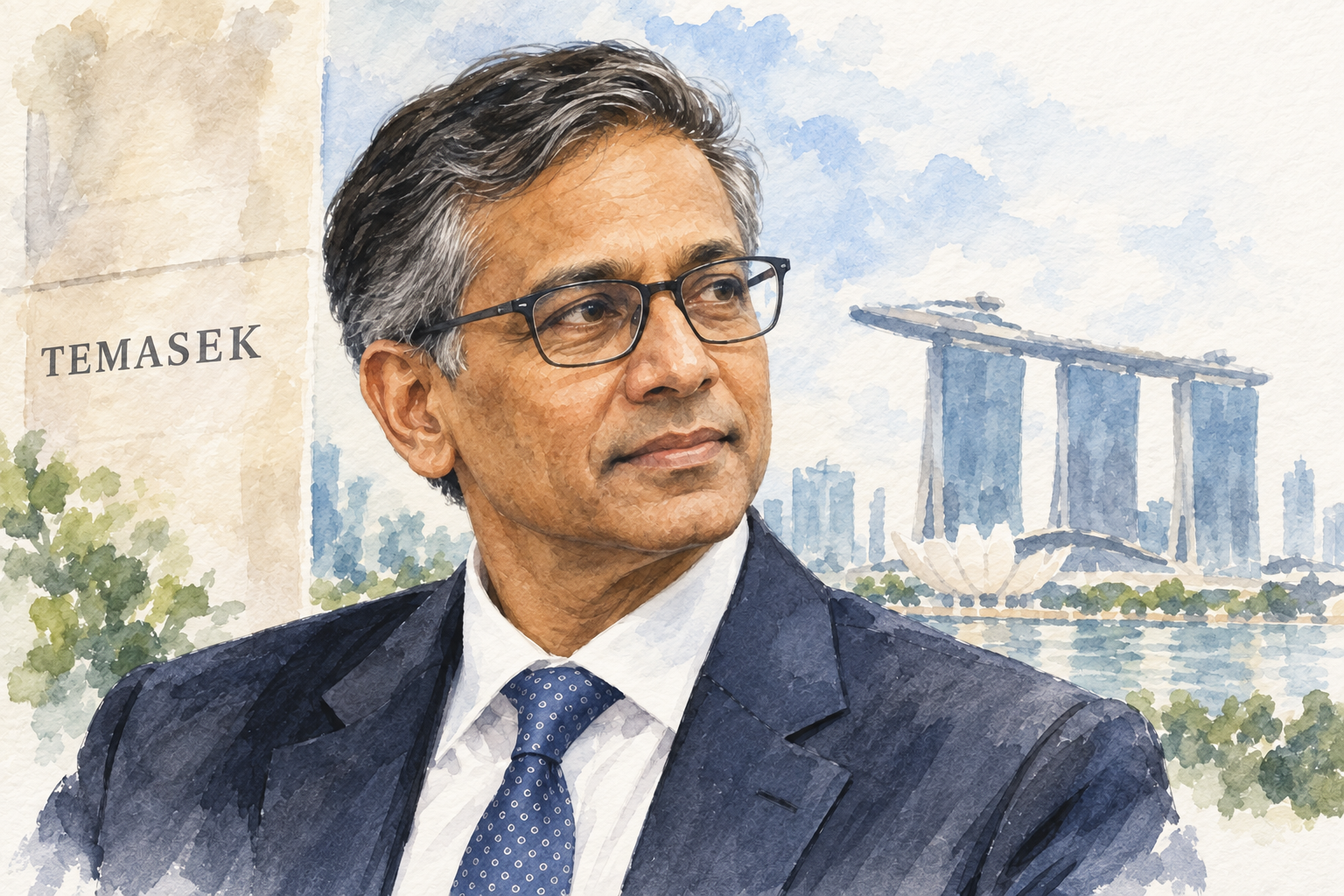
Dilhan Pillay and what it means to invest in generations
Singapore owns Temasek. But Temasek is not a ministry. That distinction is central to understanding Dilhan Pillay, the lawyer-turned-investor who has led Temasek Holdings since 2021. The company is wholly owned by Singapore’s Minister for Finance, yet its investment decisions are made commercially. Its board operates at arm’s length from government, while carrying a constitutional responsibility to protect the company’s past reserves.
That gives Pillay something rare: a balance sheet with public ownership, commercial discipline and no obligation to think in quarterly market cycles.
“Temasek operates at the intersection of geopolitics, business, energy and technology.”
Dilhan Pillay, Chief Executive Officer, Temasek
It is also why Temasek matters to The New Architecture of Asian Capital. Hiromi Yamaji is trying to make existing Japanese capital move more efficiently through market discipline. Pillay represents another model: capital that can be deliberately positioned across decades.
A sovereign balance sheet
Temasek ended its latest financial year with a net portfolio value of S$518 billion. More important than the number itself is the institution behind it. Temasek is neither a passive sovereign reserve nor a conventional asset manager investing other people’s money. It owns assets directly and can recycle capital between listed companies, private businesses, funds and infrastructure through multiple market cycles.
Pillay’s background helps explain the way he approaches that responsibility. Before joining Temasek in 2010, he spent more than two decades as a corporate lawyer specialising in mergers, acquisitions and governance. Today he chairs the committees responsible for strategy, portfolio risk and major investment and divestment decisions.
That legal background matters. Pillay approaches the sovereign balance sheet less as a trading portfolio than as a governance architecture in which ownership, risk and time have to be deliberately structured.
Patient capital is not simply capital held for longer. It is capital organised around different kinds of time.
His 2026 reorganisation of Temasek reflects that logic. The portfolio is now managed through dedicated Singapore, global-investment and partnership platforms, while strategic coordination and governance remain connected at group level. The objective is to give different forms of capital clearer mandates without fragmenting the institution itself.
AI meets patient capital
That architecture is being prepared for a much more capital-intensive economy. Temasek wants AI-related exposure to rise from around 6% of the portfolio to as much as 15% by 2031. But this is not simply a bet on software. Its investment map extends across the AI stack, including energy and data centres, semiconductors, cloud infrastructure, foundation models and applications.
Pillay is equally clear that owning AI companies is only part of the transformation. The rest of the portfolio must also adapt to AI if those businesses are to remain competitive.
At the same time, Temasek intends to increase core-plus infrastructure exposure from roughly 1% to as much as 5%, while private credit is targeted to rise from around 2% to 5%. Infrastructure offers longer-dated and more predictable cash flows; private credit adds recurring income and downside protection.
The three allocations belong together. AI offers growth, infrastructure provides the physical systems on which that growth increasingly depends, and credit adds another way to finance the transition. Patient capital is therefore not simply capital held for longer. It is capital organised around different kinds of time.
The energy constraint
Pillay’s most interesting contribution may be his refusal to treat AI and the energy transition as separate investment themes.
At Temasek’s Ecosperity gathering, he argued that generative AI is already absorbing enormous quantities of electricity and investment capital that might otherwise flow towards other priorities, including the climate transition. In his framing, technology, energy, geopolitics and finance increasingly collide rather than operate as separate systems. That creates a real allocation problem.
The objective is not simply to hold assets for longer. It is to decide which risks deserve time.
AI infrastructure may generate extraordinary economic value, but it also competes for grid capacity, generation and capital. Energy systems require long-term investment of their own, while security, affordability and decarbonisation increasingly have to be considered together.
For Temasek, those tensions cannot simply be traded away. Its portfolio has exposure across technology, infrastructure, energy and operating businesses, meaning that the consequences of one transition appear elsewhere on the same balance sheet. That is where Pillay’s model becomes interesting.
A conventional investor can analyse AI as one sector and energy as another. A generational investor increasingly has to understand how one changes the economics of the other.
Thinking in generations
This does not make Temasek immune to mistakes. A long horizon does not guarantee superior judgment and public ownership inevitably raises questions about accountability and the boundary between national interest and commercial return.
But it creates a capability that matters in a more physical economy: the ability to remain invested while infrastructure, technologies and industrial systems take years to mature. That is different from simply buying and holding.
A generational investor has to understand how one transition changes the economics of another.
Under Pillay, patient capital becomes an active allocation discipline. Some risks deserve liquidity and flexibility; others require capital willing to absorb uncertainty while an industry develops, infrastructure is constructed or an operating business transforms.
The objective is not simply to hold assets for longer. It is to decide which risks deserve time. That may be the real significance of the sovereign balance sheet.
Public markets are exceptionally good at pricing assets continuously. Temasek represents something different: an institution capable of asking whether capital can remain patient long enough for the underlying economic system to change.
For Dilhan Pillay, the challenge is therefore not merely finding the next investment. It is building an institution capable of deciding what should still matter a generation from now.
This article is part of The New Architecture of Asian Capital, an Altair Media Asia series examining how markets, states and industrial powers shape where capital moves — and what ultimately gets built.
Credit
Illustration: Altair Media / OpenAI
Caption
Dilhan Pillay, Chief Executive Officer of Temasek. Under his leadership, Singapore’s sovereign investor is positioning capital across AI, infrastructure, energy and private markets — with an investment horizon measured not only in market cycles, but in generations.
