The Quantum Layer
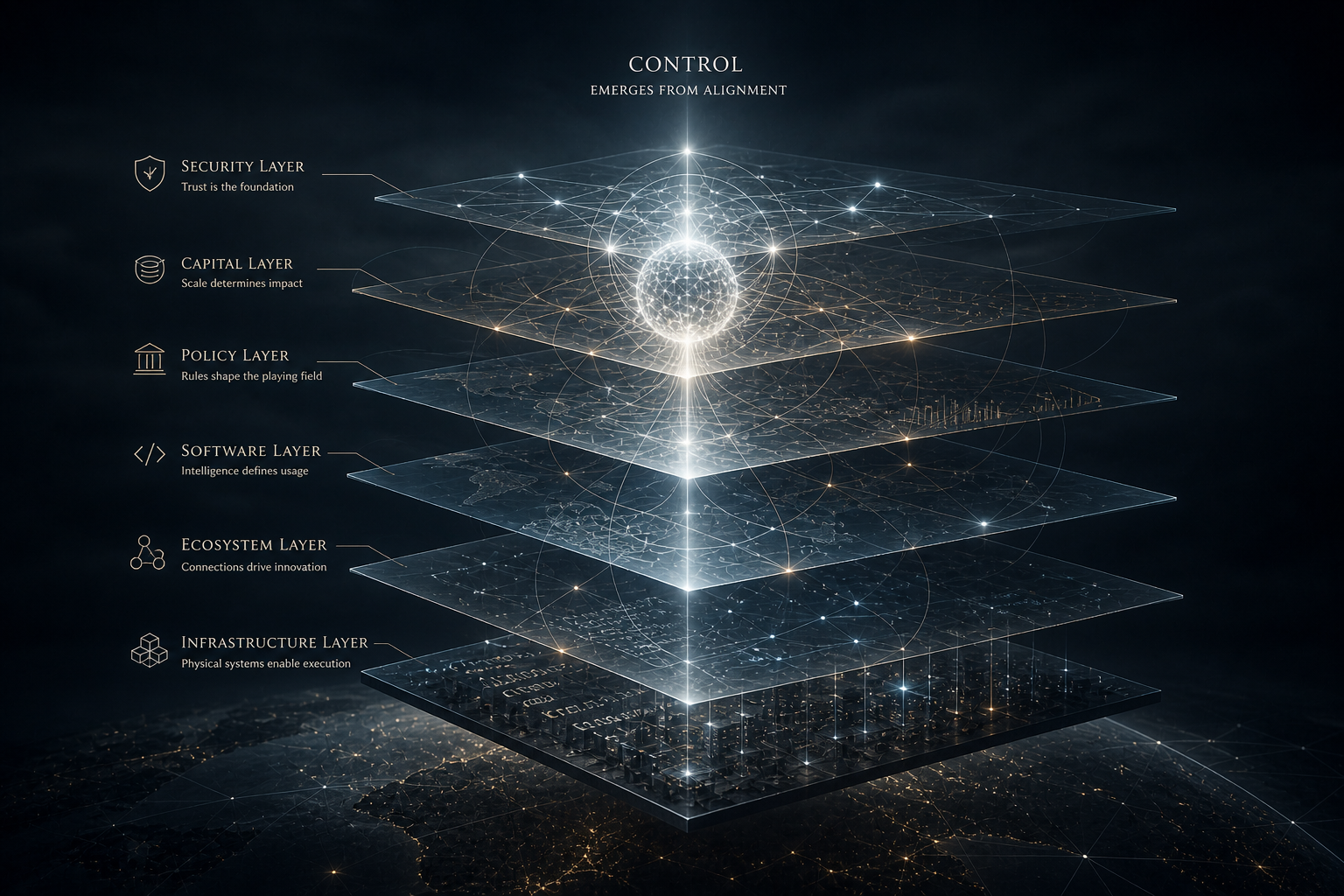
How quantum computing is reshaping power, infrastructure and strategic control across Asia
Quantum computing is often framed as the next major technological race. A competition between the United States and China. A battle for computational supremacy. A strategic contest over artificial intelligence, cybersecurity and next-generation infrastructure. But beneath that narrative, something deeper is beginning to emerge.
Quantum computing is becoming part of a broader restructuring of technological power. Not only through machines, but through infrastructure, standards, software, capital and security. And across Asia, that transformation is accelerating.
China has integrated quantum technologies into long-term national planning, linking advances in computation directly to cybersecurity, state infrastructure and strategic autonomy.
Japan and South Korea are strengthening quantum ecosystems through their semiconductor industries, advanced manufacturing capabilities and research institutions. Singapore is positioning itself as a coordination hub for deeptech, quantum networking and digital infrastructure.
India is increasingly investing in quantum research and secure communications as part of a broader technological sovereignty agenda.
Across the region, quantum is no longer treated purely as a scientific frontier. It is increasingly viewed as strategic infrastructure. And that changes the discussion entirely. Because once computation becomes infrastructure, the central question is no longer who builds the fastest machine. It becomes who controls the systems forming around it.
Beyond the Hardware Narrative
Most public discussions around quantum computing still focus on hardware. More qubits. More stable systems. More computational power.
Those developments matter. But technological history shows that long-term influence rarely remains confined to hardware alone.
Over time, power tends to migrate outward—toward the systems surrounding the machine.
The software layer.
The standards layer.
The infrastructure layer.
The security layer.
The capital layer.
Quantum computing now appears to be entering that phase.
The emerging ecosystem is increasingly defined not only by scientific breakthroughs, but by the interaction between multiple forms of control:
- who finances development
- who owns infrastructure
- who defines standards and protocols
- who secures communication
- who controls access to computation itself
This transforms quantum from a research challenge into a systems question. And in systems, standards are rarely neutral.
The actors who shape protocols for quantum communication, interoperability and post-quantum security may ultimately shape the rules governing digital trust for decades to come.
A Multipolar Quantum Order
The global quantum landscape is becoming increasingly multipolar.
The United States continues to rely heavily on hyperscalers, venture capital and platform-driven innovation. China approaches quantum through centralized industrial strategy and state-backed coordination.
Asia, however, is not a single bloc. Different countries are developing distinct approaches based on their economic structures, security priorities and technological capabilities.
Japan’s approach remains closely tied to industrial precision, semiconductors and long-term manufacturing ecosystems. South Korea is integrating quantum into broader ambitions around advanced chips, telecommunications and digital infrastructure. Singapore is focusing on interoperability, regional coordination and deeptech investment.
Meanwhile, Europe is pursuing a more distributed model centered around public-private cooperation, interconnected infrastructure and strategic coordination across borders.
These are not simply different business strategies. They reflect different philosophies of technological power. Some systems prioritize concentration and scale. Others emphasize resilience, interoperability and long-term coordination.
Whether these distributed approaches can compete with concentrated platform ecosystems remains uncertain. But they represent an increasingly important alternative within a fragmented technological world.
The Hidden Shift
What makes quantum computing fundamentally different from many earlier technology waves is that its impact extends far beyond one industry.
Quantum affects the foundations of digital systems themselves.
Encryption.
Financial infrastructure.
Defense communications.
Artificial intelligence.
Logistics and optimization systems.
Critical infrastructure networks.
As these layers become more interconnected, the nature of technological power begins to shift. Control no longer resides only in physical assets or visible platforms. It increasingly emerges from the ability to coordinate systems, secure networks and shape the rules through which information and computation flow.
That makes quantum computing as much a geopolitical issue as a technological one. And nowhere is that more visible than in the growing importance of digital trust.
Modern digital systems rely heavily on encryption built around mathematical assumptions that classical computing struggles to overcome. Quantum computing challenges those assumptions directly.
This does not simply mean faster decryption. It means a gradual redefinition of what can realistically remain secret over time.
Information that appears secure today may already be strategically vulnerable if it can be collected now and decrypted later. That possibility alone changes the strategic landscape.
The Quantum Layer — Full Series
To explore these emerging dynamics, Altair Media developed The Quantum Layer, an eight-part editorial series examining the hidden systems forming around quantum computing.
Rather than focusing only on technological breakthroughs, the series explores the deeper architecture of control emerging around computation itself.
1. The Quiet Strategy
Europe is not trying to win the quantum race — it is trying to redefine it.
An introduction to Europe’s infrastructure-oriented approach to quantum computing and strategic coordination.
2. The Infrastructure Play
Power in quantum will not come from isolated machines, but from integrated systems.
A closer look at infrastructure integration, supercomputing and hybrid systems.
3. The Fragmentation Advantage
What if Europe’s fragmentation is not a bug, but a feature?
An exploration of distributed ecosystems, resilience and optionality in emerging technologies.
4. Beyond Hardware
The real power of quantum may not be in the machine — but in what runs on it.
An analysis of software, algorithms and abstraction layers as emerging forms of control.
5. The Quantum Act Question
Can Europe turn scientific leadership into industrial power?
A critical examination of industrial strategy, regulation and technological coordination.
6. The Capital Gap
Europe can build the future — but can it finance it?
An exploration of deeptech funding, ownership and strategic dependence.
7. The Security Layer
Quantum will not just compute faster — it will break what we trust.
A geopolitical analysis of encryption, cybersecurity and informational asymmetry.
8. Who Controls Computation?
The real question is not who builds quantum computers — but who controls what they can do.
The concluding essay bringing together infrastructure, software, capital and security into a broader framework for understanding technological power.
Closing Reflection
Quantum computing remains an emerging technology. Its timelines continue to shift. Its commercial applications are still evolving. Its long-term impact remains uncertain. But one thing is already becoming clear.
Quantum is no longer just about faster computation. It is about the systems forming around computation—and the structures of power emerging through them.
The question is therefore no longer whether quantum computing will matter.
The question is which actors will shape the infrastructure, standards and security layers surrounding it.
Because in the end, the future of quantum computing may not be decided by a single breakthrough or a single machine. It may be determined by who controls the architecture surrounding computation itself.
Over the coming weeks, The Quantum Layer explores these emerging layers of power across infrastructure, software, capital, security and geopolitical control.
📸 Credit
Image generated with DALL·E
✍️ Caption
Control does not sit in one place. It emerges where layers align.
