The Internet Escapes the Screen
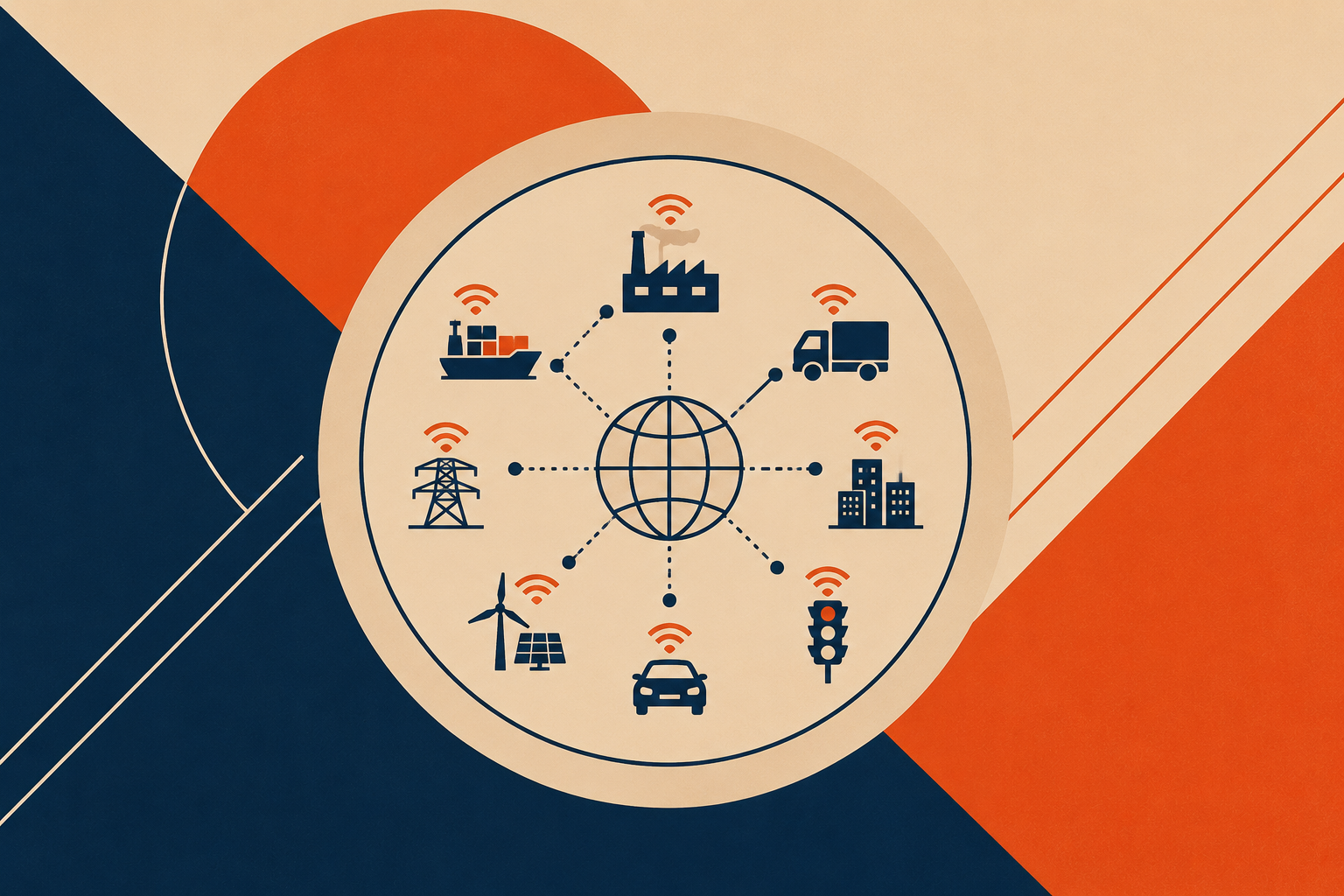
How connected infrastructure is turning the physical world into a computational environment
For decades, the internet existed behind glass. It lived inside computers, phones, dashboards and platforms. The physical world remained largely separate from the digital one. Factories produced goods. Traffic systems regulated movement. Buildings consumed energy. Ports moved containers. Machines operated in isolation. The internet described the world, but rarely interacted with it directly. That separation is beginning to disappear.
For years, the digital economy focused on bringing the physical world into computers through databases, dashboards and digital models. Now the direction is reversing. Computation itself is moving outward into the physical environment. Sensors, embedded systems and realtime networks are transforming infrastructure into something programmable, responsive and increasingly autonomous. The internet is escaping the screen.
From Automation to Ambient Intelligence
The first era of the internet connected people. The second connected platforms. The next phase connects environments themselves.
This matters because the internet is no longer primarily becoming a communication layer between humans. Increasingly, it is becoming a coordination layer between machines, infrastructure and physical systems operating in realtime.
A modern traffic network no longer simply follows pre-programmed instructions. It adapts dynamically to congestion, weather and movement patterns. Factories monitor vibration, temperature and machine behaviour continuously to predict failures before they happen. Energy grids increasingly balance fluctuating renewable supply automatically.
That shift marks the difference between automation and autonomy. Traditional automation follows instructions. Autonomous infrastructure increasingly responds to conditions on its own.
The result is what many technologists now describe as ambient intelligence: computation embedded quietly into the environment itself. The internet is no longer something people actively “use”. It becomes a persistent background layer woven into daily life, industry and infrastructure.
Infrastructure starts behaving less like static construction and more like software.
Why Asia Is Moving Faster
Nowhere is this transition more visible than in Asia. Partly because the region combines several structural advantages at once: dense urban populations, advanced manufacturing ecosystems, rapid infrastructure construction and aggressive deployment of 5G networks.
In many parts of Asia, connected infrastructure is not treated as an experimental consumer technology, but as a strategic layer of national development.
In China, Singapore and South Korea, cities, logistics corridors and industrial zones are increasingly designed around realtime coordination from the beginning.
That creates an important contrast with much of Europe. Many Western countries are attempting to retrofit intelligence onto older infrastructure. Sensors are added to aging bridges, ports and transport systems that were never originally designed to operate as connected environments.
Large parts of Asia face fewer legacy constraints. In some cases, the infrastructure itself is designed as a sensing system from the start. The bridge is not simply monitored by sensors. The bridge becomes a sensor.
This is one reason why Asia increasingly sets the pace in the deployment of the physical internet.
The Industrial Nervous System
Consumer devices attract headlines, but the real transformation is happening deeper inside industrial systems.
Ports, semiconductor facilities, logistics networks, warehouses, rail systems and energy infrastructure are quietly evolving into continuously monitored operational environments. Every movement, delay, vibration, temperature change or energy fluctuation becomes measurable in realtime.
The result is something resembling an industrial nervous system. For decades, industrial systems were largely reactive. Problems were identified after disruption occurred. Machines failed, delays emerged, supply shortages appeared and operators responded afterward.
Connected infrastructure changes that relationship. Systems increasingly anticipate disruption before it becomes visible to humans. Maintenance becomes predictive. Logistics become adaptive. Energy systems become self-balancing.
This shift matters geopolitically because visibility itself becomes a strategic capability. The regions that control these sensing layers gain unprecedented insight into economic activity, industrial performance and supply chain movement.
Infrastructure becomes intelligence.
AI Needs Eyes
Artificial intelligence may dominate public attention, but AI without realtime input remains fundamentally limited.
Most current AI systems are trained on historical human data: documents, images, conversations and archives of past behaviour. But the next generation of intelligent systems will increasingly rely on live environmental data flowing continuously from sensors, cameras, machines and connected infrastructure.
IoT functions as the sensory system of AI.
The relationship increasingly resembles a feedback loop. Sensors observe the environment. AI models interpret patterns. Connected systems and machines respond automatically. The physical world then generates new data, feeding the cycle again.
Without this loop, AI remains disconnected from reality itself.
AI may become the brain of intelligent infrastructure, but IoT provides the eyes, ears and nervous system. Without those sensory layers, even the most advanced models remain what one might call a brain inside a glass container: intelligent, but unable to perceive the world directly.
Smart Cities or Managed Environments?
The early internet optimized communication. The physical internet optimizes environments. That distinction changes the political dimension of technology itself.
Connected infrastructure can improve traffic flow, reduce energy waste, optimize logistics and increase resilience. But the same systems also expand visibility, monitoring and coordination at societal scale.
As cities become computational environments, governance itself may gradually become algorithmic.
The emerging question is no longer simply who governs people, but who governs flows: traffic, energy, logistics, information and movement. Increasingly, societies are creating digital twins not only of factories or infrastructure, but of urban systems themselves.
That raises uncomfortable questions. If algorithms coordinate traffic systems, energy distribution and urban logistics more efficiently than human administrators, where does authority ultimately reside? With elected officials? Or with the operators managing the infrastructure layer beneath the city itself?
The line between smart cities and managed cities may become one of the defining political debates of the coming decade.
The Operating System of Reality
For most of its history, the internet existed as a separate digital layer people temporarily entered through screens. That era is ending.
The next phase of technological competition will not primarily revolve around websites, apps or social platforms, but around connected infrastructure embedded directly into the physical world. Roads, ports, factories, vehicles, power systems and buildings are gradually becoming computational environments that continuously sense, process and respond.
We are moving from the Internet of People to the Operating System of Reality.
The countries and companies shaping this infrastructure will not simply control technology markets. They may shape how societies themselves function in realtime.
And those who fail to understand this transition may soon find themselves trying to navigate a world whose source code they can no longer read.
This article is part of The Physical Internet, a Featured Stories series by Altair Media Asia exploring how connected infrastructure, embedded intelligence and realtime sensing are reshaping industry, governance and geopolitical power across Asia.
From smart cities to industrial systems, the series examines how the internet is moving beyond screens and becoming part of the physical architecture of society itself.
🎨 Illustration Credit
Image generated with AI assistance for Altair Media Asia
📌 Caption
As connected infrastructure expands across factories, cities and logistics systems, the internet is increasingly moving beyond screens into the physical world itself.
