South Korea’s Demographic Emergency
Why one of Asia’s most advanced societies cannot reverse population decline
South Korea has spent years attempting to encourage family formation and slow demographic decline. Financial support, childcare measures, housing programmes and parental-leave policies have all been expanded. Yet despite years of government intervention, the direction of travel has proven remarkably difficult to reverse.
That makes South Korea more than a country with a low birth rate. It makes the country one of the clearest tests of how much influence governments still possess over demographic change.
The Pace of Change
Japan and South Korea are often grouped together because both face ageing populations and persistently low birth rates. Yet an important difference is frequently overlooked.
Japan has experienced demographic ageing over several decades, allowing institutions, businesses and communities time to adapt gradually. South Korea is moving through a similar transition at a much faster pace.
With fertility remaining well below one child per woman for several consecutive years, each new generation is projected to be around 40 percent smaller than the one before it if current trends persist. In demographic terms, that adjustment unfolds over roughly one generation — around thirty years.
The defining characteristic of South Korea’s demographic transition is not simply its scale. It is its speed.
The challenge is therefore no longer demographic decline alone. It is the speed at which demographic decline is beginning to outpace institutions that were designed for a growing society.
Beyond the Birth Rate
South Korea’s demographic problem is often presented through a single statistic: too few children are being born. But the statistic is only the visible outcome.
Beneath it lies a much broader system of housing costs, career structures, education pressure, gender expectations and urban lifestyles. These forces interact long before a decision about parenthood is made.
Successive governments have attempted to respond through subsidies, tax benefits, expanded childcare, housing assistance and workplace reform. The policy response has been extensive because the stakes are unusually high.
A shrinking population affects more than the number of future workers. It reshapes schools, housing markets, pension systems, healthcare demand, military capacity and the economic geography of entire regions.
Yet the continued decline suggests that demographic behaviour is not easily redirected through financial incentives alone.
The Limits of Policy
Governments often approach population decline as if it were a technical problem. Identify the financial barrier. Introduce a subsidy. Expand childcare. Improve parental leave. Reduce the immediate cost of raising children.
Each measure may help individual families. Together, however, they do not necessarily change the underlying social environment in which family decisions are made.
Demographic policy is becoming less about incentives and more about the organisation of society itself.
Demography is not a switch that governments can simply turn. It emerges from millions of private calculations about work, identity, relationships, security and time.
This is what makes the South Korean experience so significant. The country possesses considerable administrative capacity, advanced infrastructure and the financial resources to intervene. Yet even a capable state cannot easily persuade people to form families when the wider structure of everyday life continues to make that choice feel difficult.
A Society Built Around Competition
South Korea’s economic rise was built on extraordinary intensity. Education became a central route to social mobility. Companies developed demanding workplace cultures. Urban housing became closely connected to status and security. Families invested heavily in the future prospects of their children.
These systems contributed to rapid development. They also increased the perceived cost of parenthood.
Competition extends well beyond the labour market. Access to leading universities, recruitment by major industrial employers, housing in metropolitan areas and career progression all reinforce an environment in which long-term security often appears difficult to achieve.
For many younger adults, decisions about marriage and parenthood therefore become intertwined with broader questions about work-life balance, housing affordability, career continuity and personal autonomy.
The decision to have a child becomes embedded within a much larger calculation.
Not simply:
Can we afford a family?
But:
Can we sustain the kind of life that society expects a family to provide?
When Prosperity Changes Priorities
South Korea’s demographic decline is sometimes described as a failure of modernisation. It may be more accurate to see it partly as a consequence of modernisation.
Higher education, urbanisation and economic development expand individual choice. People gain more control over careers, relationships and life planning. Traditional expectations weaken, while the threshold for entering marriage or parenthood may rise.
That transformation is not necessarily evidence of social breakdown. It also reflects greater autonomy. But it creates a difficult paradox for governments.
The same development model that produced prosperity also helped create lifestyles and expectations that make family formation less automatic.
Economic success changed what people could choose. It also changed what they felt they needed before choosing parenthood.
The Demographic Laboratory
South Korea is becoming a demographic laboratory for other developed societies.
Japan has spent decades adapting to an ageing population through automation, labour-market adjustment and changes in social provision. South Korea has attempted more directly to prevent a similar future from taking shape. The difficulty of that effort carries lessons far beyond the Korean Peninsula.
China, Taiwan, Singapore and several European countries face related pressures. All are searching for ways to reconcile advanced economies, individual freedom and the long-term reproduction of society.
South Korea is no longer simply experiencing demographic decline. It is testing the limits of demographic governance.
South Korea’s demographic trajectory also matters beyond its own borders. The country occupies a pivotal position in global semiconductor manufacturing, advanced electronics and digital supply chains. As its working-age population contracts, questions emerge not only about Korean society, but also about the long-term resilience of industries upon which the global economy increasingly depends.
The central question is no longer simply whether governments can make parenthood cheaper. It is whether they can reshape the deeper systems influencing how people imagine work, relationships and the future.
Governing Within Decline
South Korea’s demographic emergency will continue to generate calls for stronger intervention. Some of those interventions may be necessary. Better childcare, more secure employment, affordable housing and greater equality within family life can improve both individual welfare and the conditions surrounding parenthood.
But the larger lesson may be that demographic decline cannot simply be solved through larger budgets or isolated policy instruments.
Another question is quietly beginning to emerge. If fertility remains exceptionally low despite years of financial incentives, childcare expansion and family policies, should future demographic strategies rely more heavily on immigration?
For societies with strong traditions of cultural homogeneity, this may become one of the most politically sensitive policy debates of the coming decades.
South Korea may still succeed in slowing its demographic decline. But its experience increasingly suggests that demographic change cannot simply be reversed through larger budgets or more generous incentives alone.
Japan is showing the world how an ageing society adapts. South Korea is asking a different question.
How quickly can a society reorganise itself when demographic change begins to outpace its institutions?
That question extends far beyond the Korean Peninsula. It is becoming increasingly relevant for China, Taiwan, Singapore and, ultimately, much of Europe as well.
Part of The Human Layer of Power in Asia — a series examining how demographic systems translate into economic and geopolitical capacity.
Credit
Illustration created with AI assistance for Altair Media Asia
Caption
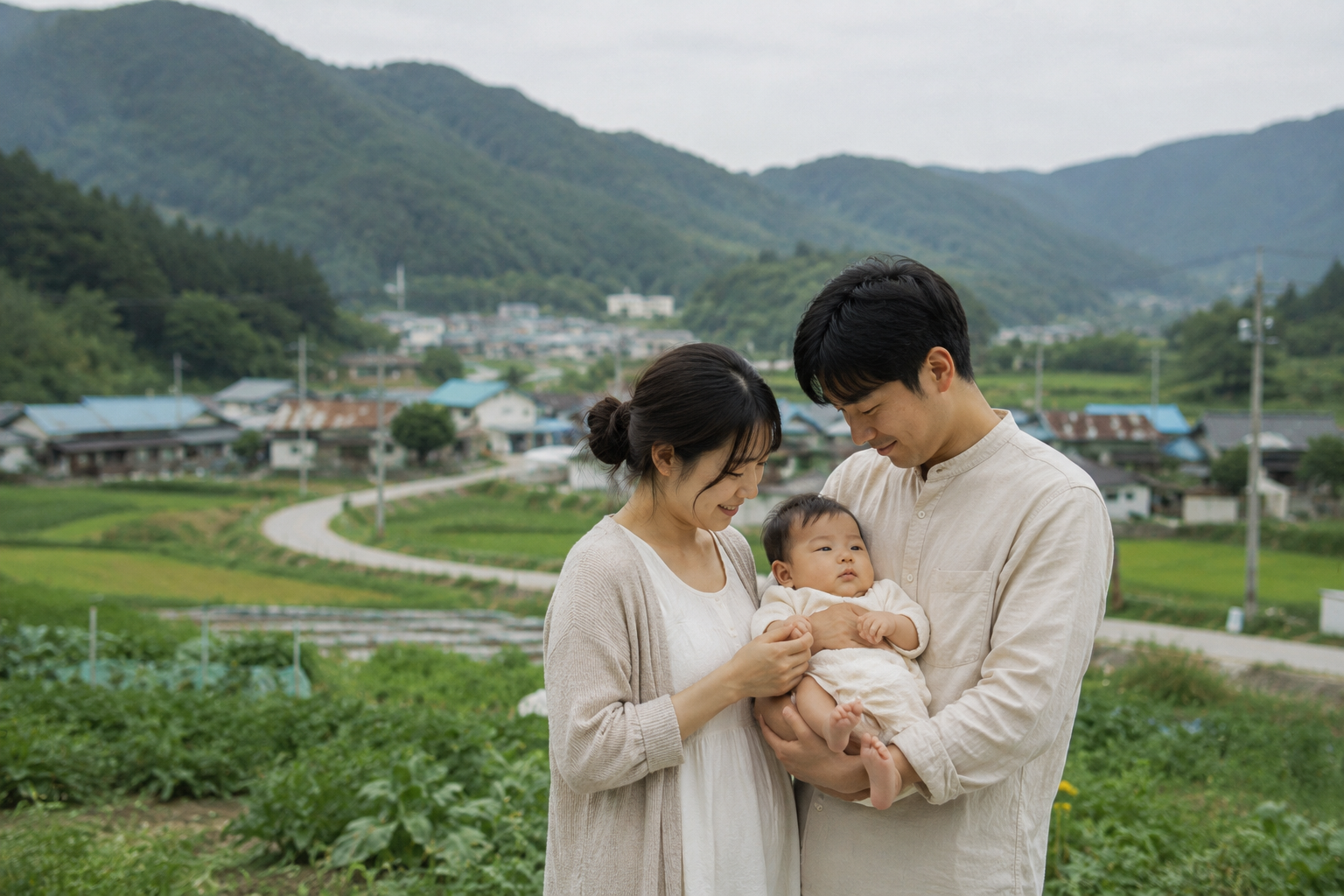
A young family stands together in the South Korean countryside, representing the generation at the centre of one of the world’s most significant demographic transitions. The image reflects the central question of this essay: not simply why birth rates have fallen, but how societies adapt when personal choices and public policy no longer move in the same direction.
