Hong Kong — A City Built Between Worlds
How trade, migration and openness shaped one of Asia’s most distinctive urban societies
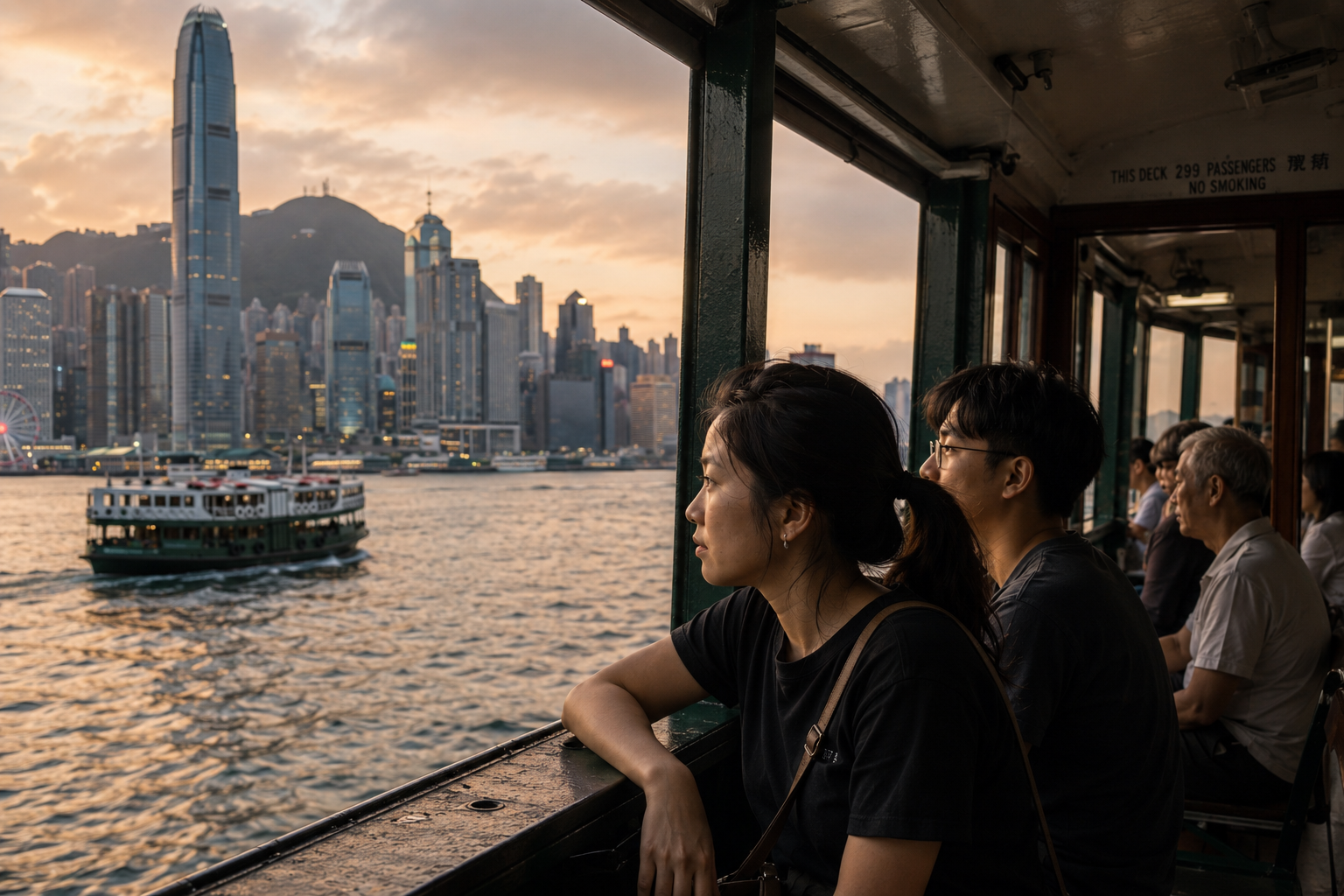
Hong Kong is one of the world’s most recognisable cities. Its towers rise almost vertically from Victoria Harbour, ferries cross between densely built shores and mountains frame an urban landscape compressed into remarkably little space.
For much of the outside world, this is the familiar Hong Kong: finance, property, trade and one of Asia’s most dramatic skylines. Yet the skyline explains surprisingly little about how Hong Kong became Hong Kong. The deeper story lies in movement.
For generations, people arrived from southern China and elsewhere in Asia to trade, work, escape instability or build new lives. British colonial institutions developed alongside Chinese families, businesses and traditions. Cantonese culture flourished within a city increasingly connected to international commerce, while merchants and migrants turned geographical constraint into economic opportunity.
Hong Kong did not emerge from a single cultural tradition. It emerged from exchange. That exchange eventually created something more than a trading centre. It produced a distinctive urban society: overwhelmingly Chinese in population and cultural roots, shaped by colonial institutions, connected to global markets and increasingly conscious of experiences that belonged specifically to Hong Kong.
Hong Kong’s greatest resource was never land. It was connection.
Understanding the city therefore begins not with 1997 and not with finance. It begins with the harbour.
A Harbour Before a Financial Centre
Geography came first. Hong Kong sits on the southern edge of China beside the Pearl River Delta, one of Asia’s great commercial regions. Its natural harbour opens towards the South China Sea while remaining closely connected to the economic hinterland of Guangdong.
Long before glass towers transformed the skyline, this geography gave the territory its strategic value.
Following the First Opium War, Hong Kong Island was ceded to Britain in 1842. Kowloon followed later and Britain leased the New Territories in 1898. What developed under colonial rule was initially less a coherent city than a strategic commercial outpost positioned between southern China and expanding global maritime networks. The harbour became its organising principle.
Ships brought goods, capital, information and people. Warehouses, docks, trading houses and commercial institutions developed around the movement of commodities between China and international markets. Hong Kong’s importance came not from controlling a vast hinterland of its own, but from providing access to much larger economic worlds on either side. This intermediary role became one of the most persistent features of Hong Kong’s development.
The city learned early that it did not need to possess everything it traded. It needed to connect those who did. That distinction would eventually shape far more than commerce. It encouraged institutions designed around exchange, businesses accustomed to operating internationally and a population whose everyday lives were connected to events far beyond the territory itself.
Before Hong Kong became a financial centre, it became a gateway. And gateways are shaped by the people who pass through them.
A City of Migrants
Migration transformed Hong Kong repeatedly. Its population grew through successive waves of people arriving primarily from mainland China, particularly neighbouring Guangdong. Some came for commercial opportunity. Others arrived because political instability, war or economic hardship made Hong Kong appear safer or more promising than the places they left behind. These movements accelerated during some of the most turbulent decades in modern Chinese history.
War, Japanese occupation, the Chinese Civil War and the establishment of the People’s Republic of China all reshaped the movement of people across the region. After 1949, large numbers of refugees and migrants arrived from the mainland, bringing skills, capital, business experience and cultural traditions with them. They did not simply enlarge Hong Kong’s population. They helped remake its economy.
Entrepreneurs established workshops and factories. Workers provided labour for expanding industries. Families built new lives in an increasingly crowded city where economic opportunity often existed alongside difficult housing conditions and considerable social inequality.
Hong Kong consequently became a place in which arrival itself formed part of the collective experience.
For many families, belonging to Hong Kong began only one or two generations earlier. Parents or grandparents might have come from Guangdong, Shanghai or elsewhere in China, while their children grew up within a very different urban environment. This produced an interesting relationship with identity.
Hong Kong was built by people who arrived from elsewhere—and by generations who gradually stopped thinking of the city as somewhere temporary.
Hong Kong remained deeply connected to China through language, family and culture, yet everyday experience increasingly became local. Schools, neighbourhoods, workplaces, public transport, popular culture and the rhythms of an unusually dense city created memories shared specifically by people who lived in Hong Kong.
Migration brought different lives together. The city gradually turned them into a society.
Chinese Society, Colonial Institutions
Hong Kong’s colonial history created another defining layer.
British rule introduced administrative, legal and commercial institutions that differed from those developing in mainland China. Common law, an internationally oriented civil service, English-language education and commercial regulation became important parts of Hong Kong’s institutional architecture.
Yet the society operating within those institutions remained predominantly Chinese.
Cantonese became the language of everyday life. Chinese religious traditions, festivals and family networks remained deeply embedded within communities, while merchants developed business relationships extending throughout southern China and Southeast Asia.
The result was not simply a neat fusion of East and West. Reality was more complicated.
Colonial Hong Kong was unequal. Political power remained concentrated within a system in which most residents had limited influence over how they were governed, while racial and social hierarchies were particularly visible during earlier periods of British rule.
At the same time, institutions created during the colonial period gradually became part of Hong Kong’s own social and economic environment. Courts, universities, schools, hospitals, public administration and commercial systems developed alongside local organisations, charities, businesses and community networks.
Hong Kong’s distinctiveness came not from choosing between institutional worlds, but from learning how to operate across them.
Over generations, people learned how to operate across these institutional worlds.
A Cantonese-speaking entrepreneur could conduct business through institutions shaped by British commercial law while maintaining family and trading networks across southern China. A student might encounter both Chinese cultural traditions and an education system influenced by British models. Businesses could operate locally while orienting themselves towards markets thousands of kilometres away. This ability to move between systems became a form of capability in itself.
Hong Kong was not simply where China encountered the international economy. It became a society unusually skilled at translating between them.
Cantonese Hong Kong
Culture made that society visible. By the second half of the twentieth century, Hong Kong had developed a cultural identity whose influence reached far beyond its physical size. Cantonese cinema, television and popular music travelled across Asia and into Chinese communities around the world.
For millions of people, Hong Kong became an image of urban modernity. Its films showed crowded streets, ambition, crime, romance, family and the peculiar intensity of life in a city where almost everything seemed to happen close together. Cantopop created a soundtrack for generations, while television carried Hong Kong language, humour and social conventions into homes far beyond the territory.
Food provided another expression of this identity. Cantonese traditions remained fundamental, but Hong Kong’s history of migration and international exchange produced its own everyday culinary culture. Dim sum restaurants existed alongside cha chaan tengs, bakeries, street food and dishes shaped by encounters between Chinese and European influences.
None of this made Hong Kong less Chinese in cultural origin. But it did make Hong Kong increasingly itself.
Culture gave people a shared vocabulary for experiences that could not be explained solely through ancestry. Someone might have family roots in Guangdong while speaking a distinctly Hong Kong form of Cantonese, watching local television, travelling on the same transport networks and participating in a popular culture created within the city. A local identity was taking shape through everyday life.
Becoming Hong Kong
Identity rarely appears at a single historical moment. It accumulates through shared experience.
For Hong Kong, those experiences included migration, colonial rule, economic transformation, dense urban life and an unusual degree of exposure to international markets and ideas. Generations grew up inside a society that remained deeply Chinese while becoming increasingly different from the society developing across the border. That distinction was cultural before it became explicitly political.
Hong Kong people developed their own expressions, humour, habits and expectations. The city’s extraordinary density encouraged particular forms of public behaviour, while its commercial culture rewarded adaptability and speed. International connections made outside influences unusually accessible, even as family traditions continued linking residents to southern China.
By the late twentieth century, the question of what it meant to belong to Hong Kong had become increasingly important.
The approaching end of British rule inevitably intensified that discussion. The 1997 handover would change the political framework within which Hong Kong existed, but it would not create the society being transferred.
That society had already been developing for generations. Its identity did not depend upon being culturally separate from China. Nor could it be reduced to the institutions inherited from Britain. It emerged from the interaction between them—and from the millions of ordinary lives lived in between.
Hong Kong was not simply where different worlds met. It became Hong Kong because generations learned how to live between them.
That capacity would prove enormously valuable economically.
The same city that learned to move between cultures and institutions also learned to connect manufacturers, traders, financiers and markets. Its density compressed those relationships into remarkably little space, while its international orientation allowed them to extend across the world.
Hong Kong’s next transformation would therefore be economic. But once again, the deeper story would not simply be about money. It would be about connection.
Density as Infrastructure
Hong Kong’s geography imposed an unusual discipline on its development.
Land suitable for large-scale urban construction was limited. Mountains rise sharply behind narrow strips of buildable territory, while the harbour divides the city’s principal commercial districts. As the population expanded, Hong Kong could not simply spread outward in the manner of many other metropolitan regions. It had to become denser.
Buildings rose higher, neighbourhoods intensified and transport infrastructure became essential to the functioning of everyday life. Housing, offices, shops and public services were compressed into relatively small areas, creating one of the world’s most intensely urban societies.
Density brought obvious costs. Housing became expensive, apartments were often small and competition for land shaped almost every aspect of urban development. Yet density also created economic advantages.
In Hong Kong, density did not simply shape the city. Density became economic infrastructure.
Workers, customers, suppliers, financiers and entrepreneurs could operate remarkably close to one another. Information travelled quickly through commercial networks. Businesses could reach enormous numbers of consumers within relatively short distances, while transport systems connected neighbourhoods to commercial centres with unusual efficiency. In Hong Kong, proximity became productive.
The city demonstrates that infrastructure is not only something constructed from concrete and steel. Sometimes the spatial organisation of people and institutions becomes infrastructure in itself.
That principle would influence almost every stage of Hong Kong’s economic development.
The Entrepreneurial City
Hong Kong is now associated primarily with finance, property and international business. Its economic foundations were broader.
During the decades following the Second World War, Hong Kong became a significant manufacturing economy. Factories produced textiles, garments, plastics, watches, toys, electronics and countless other consumer goods for international markets. Much of this industrial expansion occurred through relatively small businesses.
Migrants arriving from mainland China brought entrepreneurial experience, technical knowledge and commercial connections. Some established factories, while others created trading companies or joined the growing networks of suppliers and workshops that supported export manufacturing.
Hong Kong’s limited domestic market encouraged these businesses to look outward. They had little choice.
Factories needed customers elsewhere, which meant entrepreneurs had to understand international demand, shipping, currencies, contracts and changing consumer preferences. Manufacturing therefore developed alongside trading capability.
The distinction between producer and intermediary was often blurred. A Hong Kong entrepreneur might manufacture one product, source another from a neighbouring factory, coordinate packaging through a third company and sell everything through international commercial networks. This flexibility became one of the city’s defining economic capabilities.
Hong Kong was not simply producing goods. It was learning how to organise production.
Hong Kong’s entrepreneurial culture was built not only around making things, but around connecting the people who could make them.
This would become increasingly important when China’s economic reforms transformed the geography of Asian manufacturing.
When Manufacturing Crossed the Border
The opening of mainland China from the late 1970s fundamentally changed Hong Kong’s economic environment. Just across the border lay the Pearl River Delta: geographically close, increasingly open to investment and capable of accommodating industrial activity on a scale Hong Kong itself could never match.
Hong Kong manufacturers began moving production north.
Factories appeared across Shenzhen, Dongguan and other parts of Guangdong. Labour-intensive manufacturing that had once occupied Hong Kong’s industrial districts increasingly took place on the mainland, where land and labour were more abundant.
At first glance, this might appear to be a story of deindustrialisation. It was more complicated.
Many Hong Kong companies did not abandon manufacturing. Instead, they reorganised it geographically. Production moved across the border while management, financing, logistics, design, quality control and international customer relationships often remained connected to Hong Kong.
The factory and the commercial headquarters no longer needed to occupy the same territory. Manufacturing became regional.
Hong Kong did not simply stop manufacturing. Manufacturing became a regional system.
This transformation was enormously consequential.
Hong Kong provided capital, commercial expertise and international market access. Guangdong provided land, workers and rapidly expanding industrial capacity. Infrastructure gradually connected the two more closely, allowing materials, managers and goods to move across the border. What emerged was one of the most powerful manufacturing regions in the world.
Hong Kong’s role had changed from production centre to orchestrator. That distinction helps explain how the city continued to prosper even as factory employment declined. Economic value increasingly came from coordinating systems rather than physically producing everything within Hong Kong itself. This is also why the rise of Shenzhen should not be understood solely as the rise of a competitor to Hong Kong.
For decades, the development of the two cities was deeply interconnected. Shenzhen’s factories helped transform Hong Kong businesses. Hong Kong’s capital and commercial networks helped transform Shenzhen. The border separated two systems, but economic activity increasingly connected them.
The City as an Interface
This regional transformation revealed something fundamental about Hong Kong’s economic model. Its greatest advantage was not any particular industry. It was its ability to function as an interface.
Companies operating in mainland China needed access to international customers, financial institutions and professional services. Foreign companies needed knowledge about Chinese markets, suppliers and commercial practices. Hong Kong stood between these worlds with institutions capable of interacting with both.
Language mattered. Commercial culture mattered. Law mattered. So did trust.
A business transaction across different legal, political and cultural systems involves more than moving money from one account to another. Contracts must be understood, disputes resolved, financing arranged and expectations translated between parties that may operate very differently.
Hong Kong accumulated institutions capable of performing these functions. Its common-law system provided a familiar framework for many international companies. Professional services developed around accounting, insurance, shipping and commercial law. English and Cantonese connected different business communities, while Hong Kong’s proximity to mainland China allowed relationships to be maintained personally as well as institutionally.
The city therefore became valuable partly because different systems could meet there without becoming identical. That is a subtle but important distinction.
Hong Kong did not eliminate differences between China and the international economy. It created infrastructure through which those differences could be navigated.
Capital as Infrastructure
Finance eventually became the most visible expression of this intermediary role.
Hong Kong developed into one of the world’s major financial centres, supported by international banks, deep capital markets, its stock exchange and a currency system linked to the US dollar.
Yet finance should not be understood as an economy floating above the city’s earlier commercial history. It grew from it.
Trade required credit. Shipping required insurance. International businesses required currency exchange, legal services and mechanisms for raising capital. As China’s economy expanded, the financial relationship between mainland companies and international investors became increasingly important.
Hong Kong was positioned directly inside that relationship. The city’s stock market allowed companies connected to mainland China to access international capital, while global investors gained a channel into one of the world’s fastest-growing economies. Banks and professional-service firms developed expertise around transactions that crossed institutional and geographical boundaries. Capital became another form of connectivity.
Just as the harbour once connected physical goods between China and international markets, Hong Kong’s financial infrastructure increasingly connected money.
The harbour connected goods. The financial centre connected capital. Hong Kong’s underlying function remained remarkably similar.
This continuity is important.
Hong Kong’s economy changed dramatically during the twentieth century, moving from entrepôt trade towards manufacturing and later towards services and finance. Yet beneath those transformations remained the same fundamental capability.
The city organised flows. Goods. Information. People. Capital. Different eras simply changed what was flowing.
The Vertical City
Hong Kong’s physical infrastructure developed around the same logic of compression and connection.
The Mass Transit Railway became more than a transport network. Stations evolved into nodes around which offices, shopping centres and residential towers could be organised. Rail infrastructure and property development became closely intertwined, helping create neighbourhoods where large numbers of people could live, work, shop and travel without requiring the spatial footprint associated with lower-density cities.
Hong Kong therefore developed vertically as well as horizontally. A person might leave an apartment tower, enter a shopping centre, descend into a railway station, travel across the city and emerge beneath an office complex without spending much time at street level. This produced an urban experience unlike that of most cities. Infrastructure was layered.
Transport sat beneath commerce. Housing rose above stations. Walkways connected buildings across roads, while ferries continued linking districts across the harbour. The result could feel extraordinarily efficient. It could also feel intensely crowded. Those two characteristics were never entirely separate.
Hong Kong’s efficiency emerged partly because space was scarce enough to demand it. The vertical city became another example of the broader Hong Kong model: constraints did not disappear, but institutions and infrastructure learned to organise around them.
The Price of Density
The same system that generated enormous economic value also produced deep tensions.
Land scarcity and property development contributed to some of the world’s highest housing costs. For younger generations, home ownership became increasingly difficult, while inequality remained visible within one of Asia’s wealthiest cities. The physical contrast could be striking.
Global financial institutions operated from some of the world’s most valuable commercial real estate while families elsewhere lived in extraordinarily compact apartments. Wealth generated through property and finance did not distribute itself evenly across society.
This matters because Hong Kong’s economic model was often celebrated internationally as an example of market efficiency. From inside the city, the experience could be more ambiguous. Efficiency created opportunity. It also created pressure.
The same density that brought businesses and workers close together increased competition for space. The same property market that generated investment and public revenue made housing a persistent social concern. The same international openness that produced enormous wealth exposed workers and businesses to global economic volatility.
Hong Kong’s strengths and vulnerabilities frequently emerged from the same structures. That pattern would become increasingly important as the city approached another historic transition.
A Gateway in a Changing China
By the final decades of the twentieth century, Hong Kong had become extraordinarily successful at connecting China with the world. But China itself was changing.
Economic reforms were creating new industrial centres. Shenzhen grew from a relatively small border settlement into a major manufacturing city and later a technological powerhouse. Shanghai re-emerged as an international financial and commercial centre, while infrastructure increasingly connected mainland cities directly to global markets.
The environment that had made Hong Kong indispensable was beginning to evolve.
At the same time, another transformation approached. British administration would end in 1997, and Hong Kong would become a Special Administrative Region of the People’s Republic of China under the framework known as One Country, Two Systems.
The handover would inevitably alter Hong Kong’s political context. But economically, something equally important was happening.
The gateway was becoming connected to a China that increasingly possessed gateways of its own. That raised a question that remains central to Hong Kong today. What happens to an intermediary when the systems on both sides become increasingly capable of connecting directly?
Hong Kong had reinvented itself before—from harbour to manufacturing centre, from factory economy to regional orchestrator, and from trading hub to global financial centre. Its next transformation would take place under very different political and economic conditions.
To understand that transformation, however, we first need to understand what changed in 1997—and what did not.
1997 Was a Transition, Not a Beginning
On 1 July 1997, sovereignty over Hong Kong was transferred from the United Kingdom to the People’s Republic of China.
For the outside world, the handover became an obvious historical dividing line. British colonial rule ended, the Hong Kong Special Administrative Region was established and the framework known as One Country, Two Systems began.
Yet Hong Kong did not begin again in 1997. The city that entered Chinese sovereignty already possessed its own institutions, commercial networks, legal traditions and deeply developed urban identity. Generations had grown up speaking Cantonese, participating in an internationally connected economy and navigating a society shaped simultaneously by Chinese culture and British colonial institutions.
The handover therefore did not create a new society. It placed an existing one within a new constitutional architecture. That distinction is important.
Under the Basic Law, Hong Kong retained a high degree of autonomy in many areas. Its common-law legal system continued, the Hong Kong dollar remained its currency and the territory preserved separate customs, immigration and economic systems. The framework was designed to allow Hong Kong’s distinctive institutions to continue while sovereignty rested with Beijing.
The handover did not create modern Hong Kong. It changed the political architecture around a society that already existed.
For businesses and citizens, much of everyday life initially continued with considerable institutional continuity. Yet the fundamental question had changed.
Hong Kong had spent more than a century developing between different worlds. After 1997, it had to discover how that distinctiveness would function within the sovereignty of one of them.
One Country, Two Systems
The genius—and difficulty—of One Country, Two Systems lies in its attempt to hold two ideas together. Hong Kong is part of China. Hong Kong is also institutionally different from mainland China.
For many years, that distinction helped preserve the city’s role as an international interface. Foreign businesses could operate within a familiar legal environment while gaining proximity to mainland China. Capital could move through financial institutions operating under rules distinct from those across the border, while Hong Kong maintained separate commercial and judicial structures.
Difference itself had economic value. The arrangement also contained an inherent tension.
How much institutional difference can exist within a single sovereign state? How much political autonomy is compatible with national integration? And who ultimately determines where those boundaries lie?
Those questions became increasingly important as Hong Kong society evolved after the handover.
For many residents, local identity had strengthened over generations. Expectations surrounding public institutions, freedom of expression and civic participation had also developed within Hong Kong’s distinctive historical environment.
Beijing, meanwhile, increasingly emphasised national sovereignty, security and integration. The relationship between those perspectives became one of the central tensions of post-handover Hong Kong. It was no longer simply a question of connecting different systems economically. It became a question of how different systems could coexist politically.
When Identity Meets Statecraft
Political tensions became increasingly visible during the first decades of the twenty-first century.
Large demonstrations emerged at different moments around questions of political reform, governance and Hong Kong’s relationship with Beijing. The Umbrella Movement in 2014 and the much larger protests of 2019 revealed deep disagreements within society about the city’s political direction and the meaning of autonomy under One Country, Two Systems. These events were interpreted very differently depending on perspective.
For many participants, they reflected concerns about political representation, civil liberties and the preservation of Hong Kong’s distinctive institutions. For Beijing and its supporters, the unrest increasingly raised questions about national sovereignty, political stability and security. Those competing interpretations matter because they reveal a deeper institutional conflict.
Hong Kong’s locally developed political expectations had emerged from a history unlike that of mainland China. Beijing’s approach to sovereignty and national integration emerged from a very different historical experience.
The resulting tension cannot be understood simply as East versus West or democracy versus authoritarianism. It is also a collision between different understandings of order, legitimacy and political belonging.
The introduction of the National Security Law in 2020 marked a major change in this relationship. The political environment became more restrictive, opposition politics narrowed significantly and the boundaries surrounding public dissent changed.
For some residents, these developments represented a profound alteration of the Hong Kong they had known. Others placed greater emphasis on restored stability and closer integration with the mainland.
Either way, the institutional balance had shifted.
Hong Kong’s political tension is not only about who governs the city. It is also about how much difference can exist within a larger political system.
That question remains central to Hong Kong’s future.
The Economic Interface Remains
Political change did not erase Hong Kong’s economic capabilities. The city remains deeply connected to international finance, trade and professional services, while its legal and financial institutions continue to distinguish it from mainland Chinese cities in important ways. Its role, however, is changing.
For much of the twentieth century, Hong Kong possessed capabilities that mainland China largely lacked. It offered international finance, commercial expertise, global connections and institutional infrastructure through which foreign businesses could engage with China. Modern China is very different.
Shanghai has developed enormous financial markets. Shenzhen has become one of the world’s most important technology centres. Mainland companies possess sophisticated international operations of their own, while China’s ports, airports and digital infrastructure connect its economy directly to global markets.
Hong Kong therefore no longer enjoys the same degree of functional exclusivity. But declining exclusivity does not necessarily mean declining relevance.
In some areas, Hong Kong’s intermediary role may become more specialised rather than disappear. Its financial markets remain important for connecting Chinese companies and international capital. Its currency, legal environment and professional-service ecosystem continue to provide capabilities that differ from those available on the mainland.
The question is increasingly not whether China still needs Hong Kong. It is what China and the wider world need Hong Kong for now. That is a much more demanding question.
From Gateway to Greater Bay Area
Hong Kong’s future is increasingly connected to a much larger urban system. The Guangdong–Hong Kong–Macao Greater Bay Area brings Hong Kong into closer economic relationship with Shenzhen, Guangzhou, Macau and other cities across the Pearl River Delta. Together, the region contains manufacturing, technology, finance, logistics, research and consumer markets on an extraordinary scale. For Hong Kong, this creates both opportunity and pressure.
Shenzhen is no longer simply the place across the border where Hong Kong manufacturers relocated factories. It has become a major centre for technology, entrepreneurship and advanced industry in its own right. That changes the relationship between the two cities.
Hong Kong brings international financial infrastructure, professional services and global commercial connections. Shenzhen contributes technological dynamism, manufacturing ecosystems and access to the enormous mainland economy.
Increasingly, their capabilities can be complementary. But they can also overlap.
Hong Kong once connected China to the world. Its next role may be to connect a Chinese megaregion to global systems.
The challenge for Hong Kong is therefore to avoid thinking about integration simply as absorption into a larger Chinese economy. Its greatest contribution to the Greater Bay Area may lie precisely in the institutional differences that allow it to perform functions other cities cannot perform in exactly the same way.
If those differences remain economically meaningful, Hong Kong can continue to serve as an interface. Only the scale of the interface changes.
A City Under Social Pressure
Yet Hong Kong’s future cannot be understood solely through finance, politics or regional integration. There is also the question of everyday life.
Housing remains one of the city’s most persistent challenges. Extraordinary property values have created wealth for some while making secure and spacious housing difficult for others. Younger residents face questions about affordability, social mobility and whether the opportunities available to previous generations remain equally accessible.
The population is also ageing. Like several other advanced Asian societies, Hong Kong must consider how healthcare, labour markets and social support systems adapt as demographic structures change. Migration adds another layer.
Hong Kong has always been a city shaped by people arriving and leaving. Recent political and economic changes have contributed to another period of movement, while the city simultaneously seeks talent from mainland China and elsewhere to support its economy. This matters because cities are sustained by more than capital. They are sustained by people’s willingness to build lives in them.
A financial centre can remain internationally important while residents question whether they can afford homes, raise families or imagine their future there. Economic competitiveness and social confidence are related, but they are not the same thing.
A global city ultimately depends on something deeply local: whether people still believe they can build a life there.
For Hong Kong, this may become as important as any competition with Shanghai or Shenzhen.
Does the World Still Need a Gateway?
For much of modern history, Hong Kong’s function was relatively clear. China and the international economy operated through very different systems, and Hong Kong helped bridge the distance between them. Today, both sides of that relationship have changed.
China is wealthier, more technologically sophisticated and more internationally connected. Global companies understand Chinese markets better than they once did, while digital technology allows capital and information to travel through channels that did not exist when Hong Kong first became an international commercial centre.
At the same time, geopolitical fragmentation is increasing. Relations between China and several Western countries have become more complicated. Technology supply chains are being reconsidered, governments are placing greater emphasis on economic security and capital increasingly moves through a world shaped by strategic competition.
Paradoxically, that could make interfaces more important rather than less. When systems become more similar, gateways lose some of their value. When systems become more different, trusted mechanisms for navigating between them can become essential.
Hong Kong therefore faces an unusual possibility. The geopolitical divisions that create uncertainty around its future may simultaneously increase the value of some of the capabilities it has spent generations developing.
The question is whether Hong Kong will retain enough institutional distinctiveness to perform that role.
The Next Hong Kong
Hong Kong has reinvented itself repeatedly. A harbour became a trading centre. A trading centre became a manufacturing economy. Manufacturing expanded across the border and Hong Kong became an orchestrator of regional production. Finance and professional services then transformed the city into one of the world’s leading global business centres. None of those transitions was predetermined.
Each emerged because Hong Kong adapted its underlying capability—connection—to a changing environment. The next transformation may require the same process.
Hong Kong will increasingly operate inside a powerful Chinese economic region rather than simply at its edge. Shenzhen’s technological capabilities, the Greater Bay Area’s industrial scale and China’s expanding financial infrastructure will continue to change the functions the city performs.
At the same time, Hong Kong’s international character remains difficult to reproduce.
Institutions, professional networks, commercial knowledge and global relationships accumulate over generations. They cannot simply be constructed by building another skyline.
Hong Kong’s future may therefore depend less on competing directly with neighbouring Chinese cities than on understanding what remains distinctive about its position between them and the wider world.
The gateway may become less dominant. The interface may become more sophisticated.
A City Built Between Worlds
Hong Kong is often described through contrasts. East and West. China and Britain. Capitalism and state power. Local identity and national integration. These contrasts are real, but they can obscure something more fundamental.
Hong Kong’s greatest strength has rarely come from choosing between worlds. It came from connecting them.
Migrants connected their histories to new opportunities. Entrepreneurs connected factories to international consumers. Traders connected southern China to maritime markets. Financial institutions connected capital to companies, while Cantonese culture connected a local urban experience to audiences throughout Asia.
Even Hong Kong’s physical form reflects this instinct. Railways connect towers. Walkways connect neighbourhoods. The harbour connects shores. The city itself became an architecture of movement. That role is now changing.
China no longer needs Hong Kong in precisely the way it once did. Shenzhen has become a technological powerhouse, mainland capital markets have expanded and the Greater Bay Area is creating new forms of regional integration.
Hong Kong itself has changed as well. Its political environment has become more closely aligned with Beijing, while debates about identity, autonomy and belonging continue to shape how different generations understand the city.
Yet cities are rarely defined by a single historical function.
Hong Kong has reinvented itself before. Its future will depend on whether it can do so again without losing the accumulated capabilities that made it distinctive in the first place.
The most important question may therefore not be whether Hong Kong can remain what it was. It is whether a city built on connection can once again redefine what it connects.
Hong Kong’s greatest resource was never land. It was the ability to connect worlds larger than itself.
About this Series
Hong Kong is part of Greater China, one of the regional series within Portrait of Asia.
Portrait of Asia explores the people, societies and economies shaping a changing continent. Each regional series begins with people, culture and institutions before examining the economic and technological systems that emerge from them.
Greater China examines China, Taiwan, Hong Kong and Macau—four societies connected by deep historical and cultural relationships, yet shaped by very different institutional, political and economic trajectories.
Together, their stories reveal how shared histories can produce remarkably different paths towards modernity.
Credit
AI-generated editorial image / Altair Media Asia
Caption
Crossing Victoria Harbour, everyday life unfolds against Hong Kong’s extraordinary urban landscape. For generations, the city has connected people, cultures, capital and commerce—turning its position between larger worlds into one of its most distinctive strengths.
