
China’s economic slowdown is often discussed through statistics and growth forecasts. Yet behind the numbers lies a quieter reality: changing expectations, weakened confidence and a society learning to operate without the momentum that once seemed automatic.
Essays
In-depth analysis of the structural forces shaping Asia’s economies, technologies and geopolitical position.
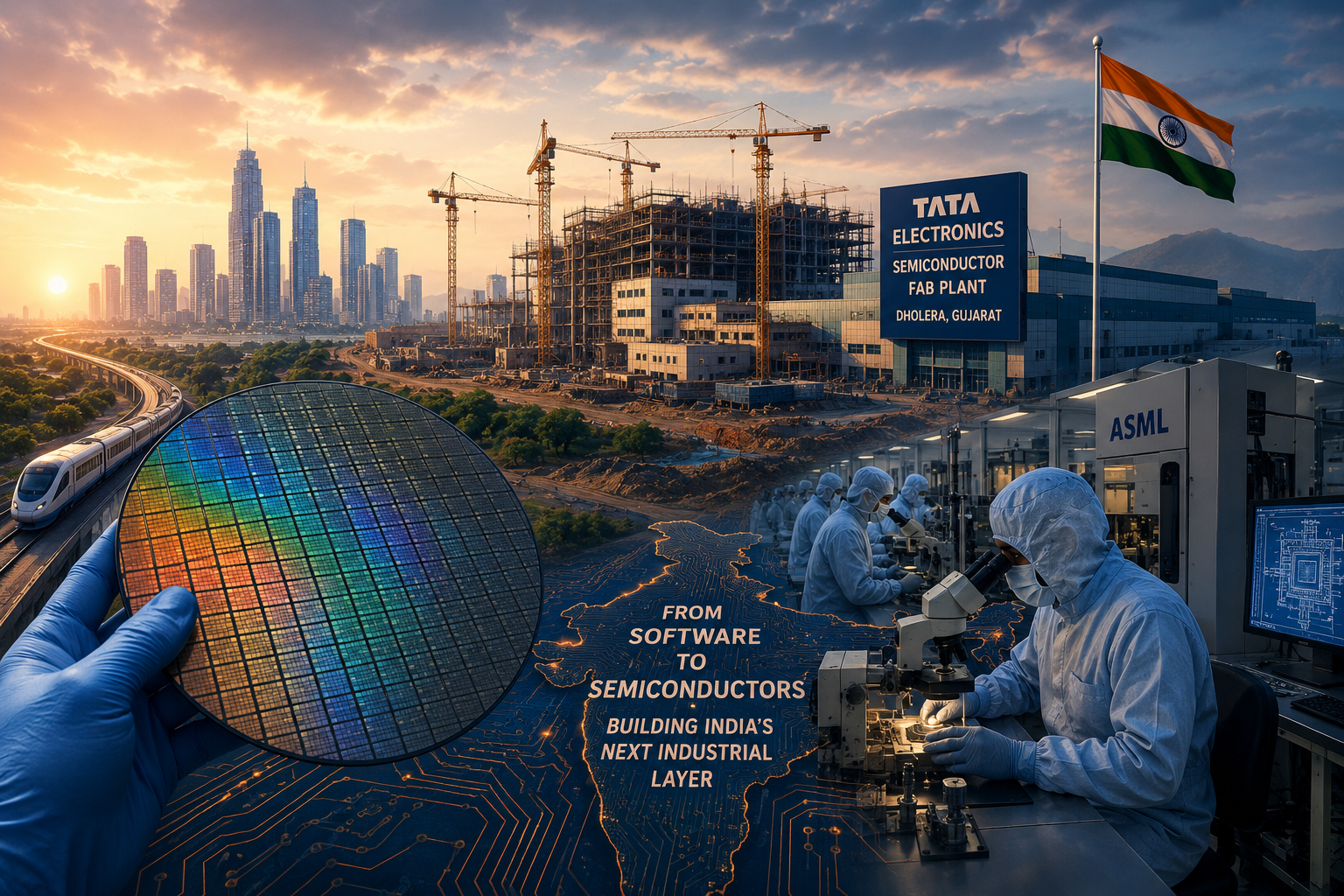
India’s semiconductor ambitions are often described as a technology story. Increasingly, they look like something deeper: a shift from software to industrial capability, from talent to ecosystems, and from participation in global supply chains to becoming indispensable within them.

Japan is often portrayed as the world’s robotics leader. Yet behind the futuristic image lies a more practical reality. As demographic decline accelerates and labour shortages deepen, automation is becoming less a choice than a necessity — raising new questions about the future relationship between technology and human care.
China remains one of the world’s largest industrial powers, yet beneath the language of stability and resilience, quieter economic signals are emerging. This article explores how China is gradually shifting from managing expansion toward managing stabilisation.

The internet is no longer confined to apps, platforms and screens. Across Asia, sensors, embedded systems and connected infrastructure are transforming factories, cities and energy networks into realtime computational environments — reshaping how societies operate, govern and compete.

From hard drives to electric vehicles, Nidec powers the movement behind the digital economy. Its precision motors and evolving role in cooling and electrification make it a silent but essential force shaping modern industry and global infrastructure.

A new global competition is emerging — not for capital, but for talent. As India, China and Singapore build distinct systems to deploy human capital, the future of economic power will be defined by which model proves most resilient.

As chip innovation shifts beyond transistor scaling, advanced packaging has become essential to performance. ASE Technology operates at this critical layer, transforming silicon into functional systems and quietly enabling the next generation of AI, computing and global digital infrastructure.

Singapore has built a different model of technological power — not through scale, but precision. By treating talent as policy and the state as a platform, it has engineered a global knowledge hub designed for connectivity, control and long-term strategic advantage.

As the world shifts toward electrification, Rohm Semiconductor plays a crucial but largely unseen role. Its advanced power chips and Silicon Carbide technology enable more efficient energy use in electric vehicles, industry and infrastructure, quietly shaping the future of global energy systems.

A wordless four-panel sequence traces a young woman’s struggle to maintain composure as a minor disruption spirals into awkward escalation and release. The silent joke reveals how posture, restraint and social awareness can communicate humor across cultures without relying on language.

China’s rapid push into photonic technologies signals a shift from the semiconductor race to a deeper infrastructure contest. As AI strains the limits of electricity, light-based computing, optical networks and quantum communication emerge as the foundations of future technological power.
