Southeast Asia Is Building an AI Economy. Washington Holds the Keys.
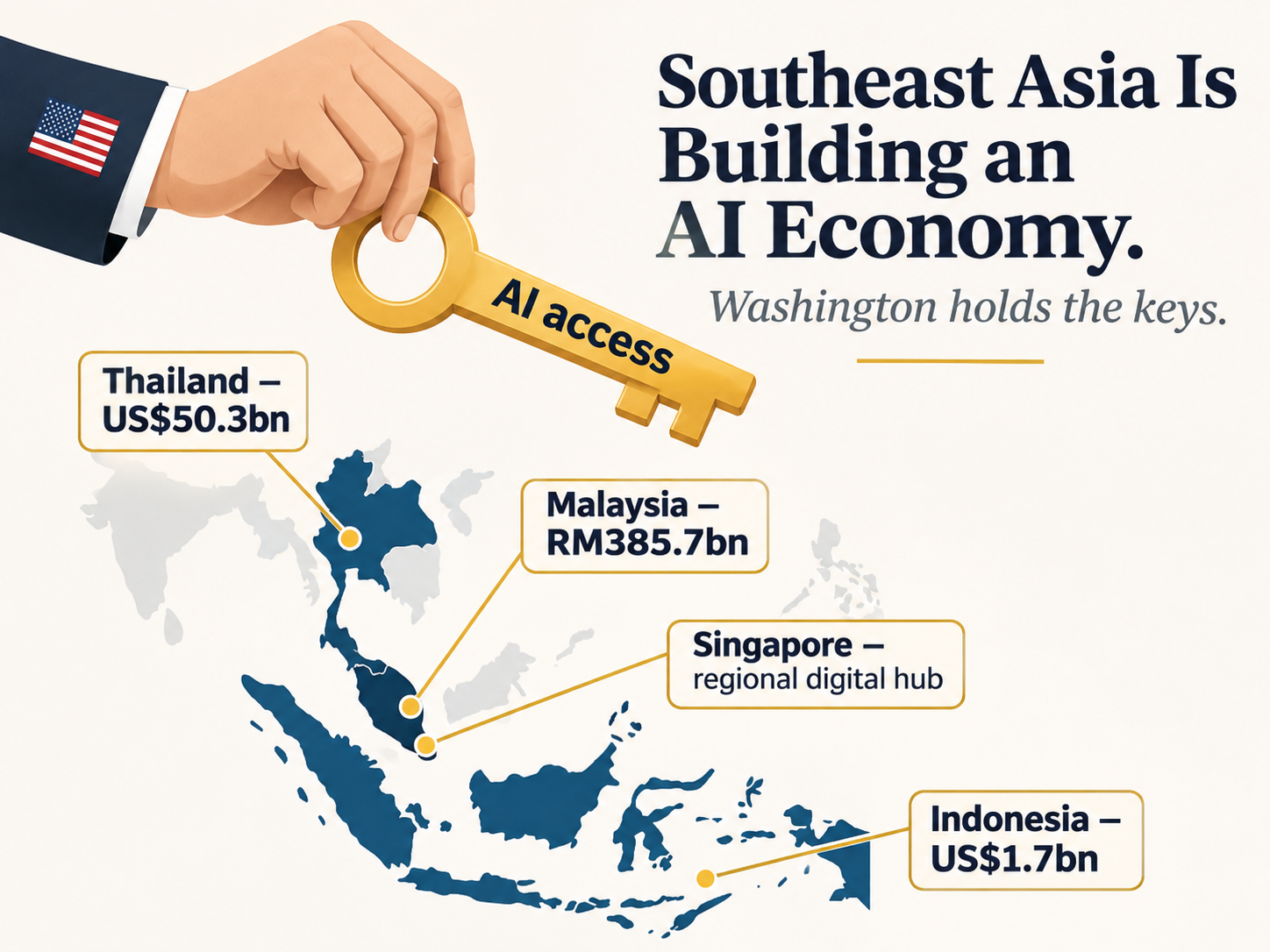
From Singapore to Indonesia, billions in digital infrastructure investments face a new geopolitical uncertainty: access to the technology on which their economic ambitions depend.
Nvidia has reportedly instructed manufacturing partners to suspend server shipments to Malaysia, Singapore, Thailand and Indonesia, according to the Financial Times. Following new US semiconductor export controls, the decision exposes a growing vulnerability in Southeast Asia’s AI ambitions. The duration of the shipment suspension remains unclear.
Washington’s objective is to restrict China’s access to advanced computing power through overseas data centres. But the economic consequences could extend far beyond China.
Five questions deserve particular attention.
🟦 Can Southeast Asia protect its investment momentum?
According to the Malaysian Investment Development Authority (MIDA), Malaysia recorded RM385.7 billion (approximately US$94 billion) in approved data centre-related investments between 2021 and mid-2026. Thailand’s Board of Investment reported US$50.3 billion in total investment applications during the first nine months of 2026, driven increasingly by AI and advanced technologies.
The tension: investment decisions are made for decades. Export conditions can change within days.
🟦 Is an uneven competitive landscape emerging?
The new US regulations, published in the Federal Register on 19 November, exempt qualifying US-headquartered companies and their subsidiaries from certain licensing requirements, subject to reporting obligations.
Regional cloud and data centre providers could consequently face licensing delays and commercial uncertainties that qualifying American hyperscalers may avoid.
The tension: measures designed to protect national security could also reshape commercial competition within Southeast Asia itself.
🟦 Who bears the economic consequences?
Data centre development creates demand well beyond the technology sector, generating opportunities for construction firms, energy suppliers, telecommunications operators and skilled workers.
In Indonesia, where Microsoft announced a US$1.7 billion cloud and AI investment commitment in 2024, and across neighbouring markets, prolonged supply uncertainty could affect the wider domestic economy.
The tension: geopolitical decisions made abroad may influence employment, entrepreneurship and industrial development at home.
🟦 Can ASEAN negotiate from a position of strength?
Singapore is already engaging Washington to safeguard access to advanced computing technologies for legitimate businesses.
Malaysia, Thailand and Indonesia face similar strategic challenges. Could greater regional coordination strengthen their negotiating position and provide investors with greater long-term certainty?
The tension: Southeast Asia’s economic attractiveness rests partly on its international openness, yet geopolitical fragmentation increasingly challenges that model.
🟦 Where does technological sovereignty begin?
The dilemma extends beyond Asia. This week, the Dutch government pushed back against proposed US legislation — the MATCH Act — that could further restrict semiconductor equipment manufacturer ASML’s business in China.
Different economies are confronting a similar question about the extraterritorial reach of American technology policy.
The tension: attracting strategic technology is not the same as achieving strategic autonomy.
🟦 THE ALTAIR SIGNAL
Southeast Asia has become an increasingly important destination for global technology capital. Its next challenge may be securing predictable access to the technology itself. An AI economy cannot be built on investment alone when access to its essential infrastructure remains politically conditional.
Image credit
Illustration: Altair Media Asia / AI-generated editorial artwork.
Caption
Southeast Asia’s digital ambitions meet geopolitical reality. As Malaysia, Thailand, Singapore and Indonesia develop their AI economies, US export controls raise questions about investment certainty, commercial competition and technological sovereignty.
Note: The investment figures represent different categories of investment approvals, applications and commitments and are not directly comparable.
