The Silent Joke — Trying to Be Normal
Why Everyday Life Is a Performance We Can Never Fully Sustain
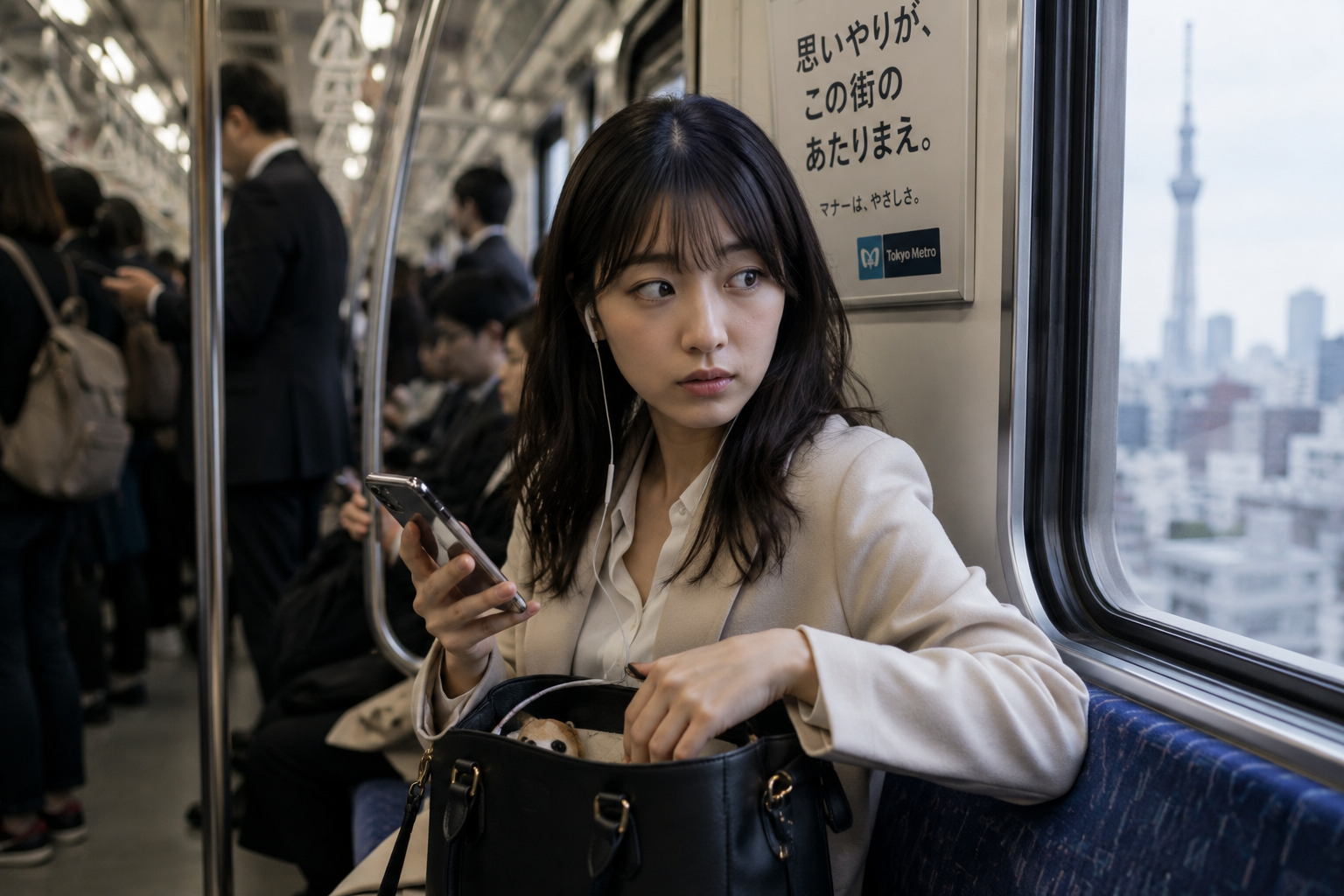
A young woman sits on a crowded commuter train in Tokyo during the morning rush. She is dressed for work, headphones in her ears, phone in her hand. Everything about her appearance signals normality. She blends effortlessly into the choreography of the carriage, one participant among hundreds in the daily ritual of movement, routine and restraint.
Then a sound interrupts the silence. A soft bark. Nobody reacts. A few moments later it happens again. The woman glances briefly at her phone. No notifications. She returns to her screen. Another bark. This time she realizes it is coming from her bag.
The source, she remembers with growing horror, is a small electronic toy secretly placed there by her young nephew the previous evening. The device emits the sound of a dog every twenty seconds.
The volume is low enough to create uncertainty. High enough to be heard. The woman knows other passengers can hear it. The passengers know that she knows they can hear it. Yet nobody says a word.
Everyone continues as though nothing is happening. And that is precisely why it becomes funny. The comedy does not lie in the barking toy. It lies in the collective effort to maintain normality despite its presence.
The Performance of Everyday Life
We often speak about normal behavior as though it were natural. In reality, normality is one of the most carefully maintained social constructions in human life.
People constantly observe one another for cues. How loudly should we speak? How long should eye contact last? When is it appropriate to laugh? When should we remain silent?
Most of these rules are never formally taught. They are absorbed through observation and repetition. We learn them by watching others and gradually adjusting ourselves to the expectations around us.
Normality, therefore, is not a fixed state. It is a continuous performance.
Most of the time, we do not notice it. The performance becomes visible only when something interrupts it. And when that happens, humor often appears.
The Invisible Script
The sociologist Erving Goffman famously compared everyday life to theater. Individuals move through social settings much like actors moving across a stage. They perform roles, follow scripts and manage impressions.
The comparison remains surprisingly accurate. A passenger on a train knows how a passenger should behave. An employee understands the role expected in a meeting. A customer knows how to act in a restaurant.
As long as everyone follows the script, the script itself remains invisible. The moment someone forgets a line, however, everything changes.
A prolonged silence. An unexpected laugh. A misplaced comment. A barking toy hidden inside a handbag. Suddenly, the machinery beneath social life becomes visible. The audience notices the performance because the performance can no longer hide itself.
The Japanese Art of Continuing
In many high-context societies, maintaining social harmony often takes precedence over openly addressing disruption.
Imagine a café in Kyoto. A young waitress carrying drinks stumbles slightly. A glass slips from the tray and shatters on the floor.
For a brief second, everyone notices. Then something curious happens. Several customers deliberately look away. Not because they are indifferent. Quite the opposite.
Looking away allows the waitress to recover her composure. It offers her a path back to normality without forcing public acknowledgment of the mistake. Everyone has seen the incident. Everyone pretends not to have seen it.
The resulting tension creates a peculiar form of comedy. The joke is not the accident. The joke is the collective effort to continue as though the accident never occurred.
When the Mask Becomes Visible
Much of human behavior depends on roles remaining invisible. Managers are expected to project confidence. Students are expected to appear prepared. Professionals are expected to remain composed. Influencers are expected to appear spontaneous. Yet every role requires effort. Humor emerges when that effort becomes visible.
A manager attempting to sound relaxed during a crisis meeting often appears more anxious than if they had admitted concern. A presenter who repeatedly insists they are “totally comfortable” usually convinces nobody. The harder people work to maintain a particular image, the easier it becomes to see the image as a performance.
The mask itself becomes the source of the joke.
The Internet and the Collapse of Normality
Digital culture has amplified this phenomenon dramatically. Social media platforms encourage authenticity while simultaneously turning authenticity into a performance.
People are expected to be genuine, relatable and spontaneous in front of audiences that may include friends, colleagues, family members and strangers.
The contradiction is obvious. The performance of being natural often becomes more visible than the person behind it. This helps explain the popularity of reaction videos, awkward interviews and viral moments of social discomfort.
Audiences are drawn to situations where carefully maintained performances begin to crack. Not because they enjoy failure, but because those moments reveal something real beneath the performance.
The Comfort of Shared Imperfection
Perhaps this is why awkward situations are often so funny. They remind us that everyone is participating in the same social experiment.
Everyone is trying to say the right thing. Everyone is trying to appear competent. Everyone is trying to behave normally. And everyone occasionally fails.
When someone momentarily loses control of the performance, they expose something universal. The audience recognizes the effort because they are engaged in the same effort themselves.
The laughter that follows is not necessarily cruel. Often it is empathetic. It reflects recognition rather than judgment.
The Silent Agreement
Eventually, the woman on the train finds the toy in her bag. She switches it off. The barking stops. Nobody comments. Nobody looks up. The train continues its journey exactly as before.
Yet for several minutes, dozens of strangers participated in the same silent performance. They collectively managed a disruption without ever acknowledging it directly.
Everyone understood the situation. Everyone knew the rules. Everyone played their part. And that is what made it funny. Because perhaps normality is not the absence of absurdity.
Perhaps normality is simply the shared agreement to behave as though absurdity is not sitting beside us, barking every twenty seconds.
This article is part of The Silent Joke, a series exploring how social rules, awkwardness and restraint shape what we find funny. Through body language, micro-expressions and everyday disruptions, it examines the fragile performance of composure in public life.
📷 Photo Credit
AI-generated image (OpenAI / DALL·E), created for editorial use.
📸 Caption
A young commuter on a Tokyo train tries to maintain composure as an unexpected sound from her bag quietly disrupts the carriage. Nobody acknowledges the moment, yet everyone understands it — a small example of how normality is collectively performed.
