Macau — A Society Shaped by Encounter
How centuries of exchange created one of Asia’s most unusual small societies
Macau is usually introduced through numbers: casino revenues, visitor arrivals, hotel rooms and the extraordinary amounts of money that pass through an exceptionally small territory. For much of the outside world, the city has become almost synonymous with gaming. Yet these numbers explain surprisingly little about Macau.
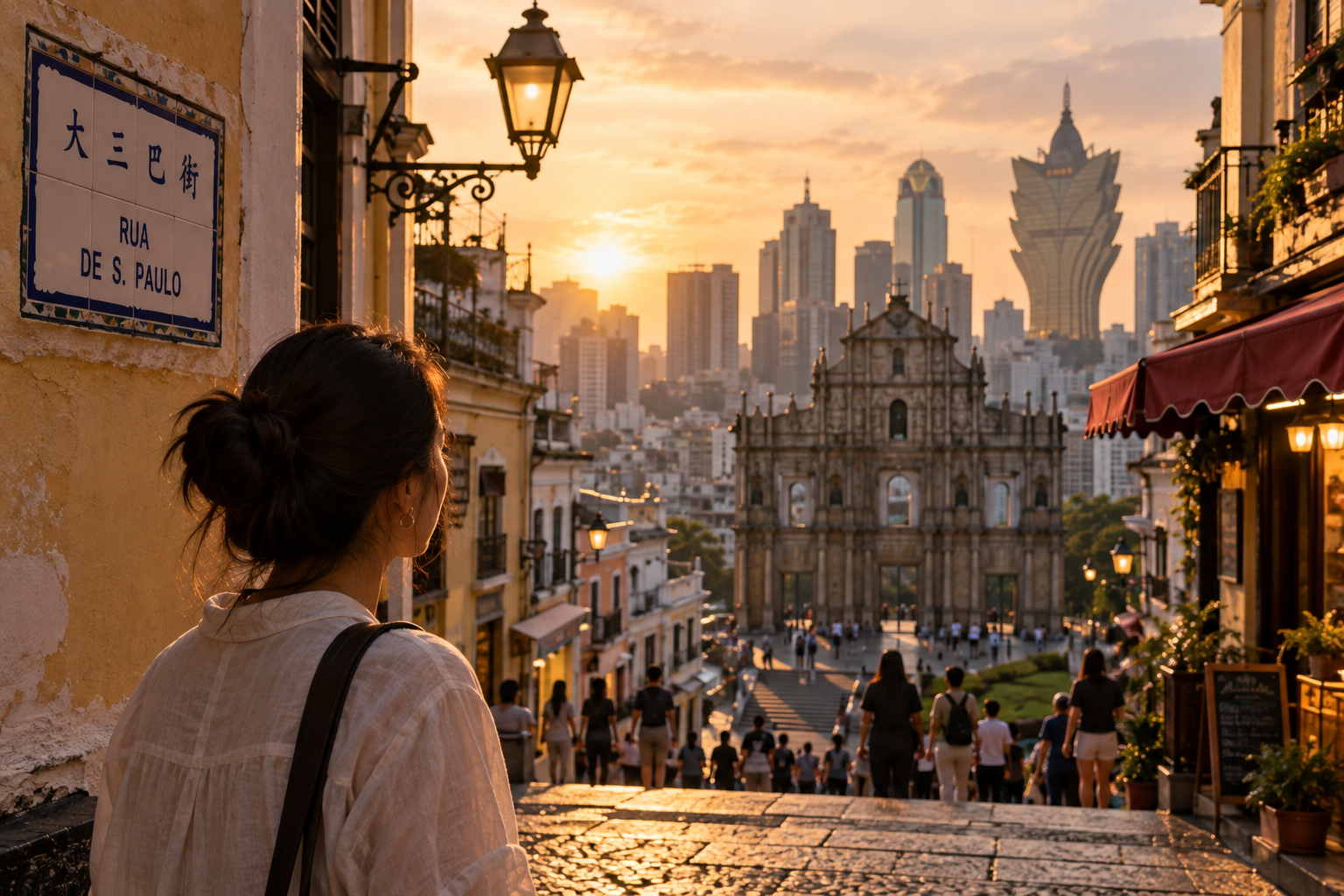
Walk beyond the large resorts and another place appears. Portuguese street names accompany Chinese characters. Catholic churches stand within walking distance of Chinese temples. Cantonese dominates everyday conversation, while Portuguese remains embedded in public institutions and the legal system. Restaurants serve dishes whose histories stretch across maritime routes connecting southern China with distant parts of the Portuguese-speaking world. These are not simply remnants of a colonial past. Together, they reveal something fundamental about the society that developed here.
Macau was never simply Portuguese or Chinese. Its distinctiveness emerged from the long encounter between them.
For centuries, Macau existed at the intersection of worlds much larger than itself. Chinese merchants, Portuguese traders, missionaries, sailors and families lived within a territory connected not only to southern China, but also to Japan, Southeast Asia, India and Europe. Languages, religions, foods and institutions encountered one another repeatedly, sometimes peacefully and sometimes uneasily.
The result was never a perfect fusion of cultures. Nor did one society simply replace another. Macau became distinctive because different traditions accumulated beside one another for an unusually long time. Understanding Macau therefore begins not with casinos, and not with the transfer of sovereignty in 1999. It begins with encounter.
A Maritime Meeting Place
Geography gave Macau its first international role. Situated on the western side of the Pearl River estuary, the territory lies beside one of southern China’s great commercial regions. Guangzhou had long connected Chinese merchants with maritime trade, while the waters beyond the estuary opened towards Southeast Asia and the wider networks of the South China Sea.
During the sixteenth century, Portuguese traders were expanding a maritime system that stretched across oceans. Their commercial routes connected ports in Europe, Africa and Asia, with Goa serving as an important centre in India and settlements such as Malacca linking trade further east.
China represented an enormous commercial opportunity, but access was regulated by Chinese authorities. Portuguese traders gradually established a permanent presence at Macau during the sixteenth century, with the settlement developing under arrangements that changed considerably over subsequent centuries. This history was more complicated than the conventional image of a European colonial power simply arriving and taking possession of territory.
Chinese sovereignty, Portuguese administration, commercial interests and local authority interacted in changing ways. For long periods, Macau existed within an ambiguous political space in which Portuguese institutions developed while Chinese authorities continued to exercise important forms of influence. That ambiguity did not prevent commerce from flourishing. In some ways, it made Macau particularly useful.
The settlement became an intermediary through which different commercial systems could interact. Chinese silk and other goods moved through maritime networks, while merchants connected Macau to Japan and other Asian markets. Ships brought silver, commodities, information and people from distant ports. Macau therefore became part of something much larger than the territory itself. Its streets were local. Its connections were global. Over time, those connections began to shape the society living within them.
Chinese Life, Portuguese Presence
Despite its association with Portugal, Macau remained deeply rooted in southern Chinese society. Chinese residents formed the large majority of the population, and Cantonese language, family structures, religious practices and commercial networks shaped everyday life. Temples served local communities, merchants maintained relationships across the Pearl River Delta and generations of families lived within cultural traditions shared with neighbouring parts of Guangdong.
Portuguese institutions developed alongside this Chinese social world. Churches, schools, administrative buildings and Catholic organisations became part of the urban landscape. Portuguese legal and governmental traditions shaped public institutions, while the territory’s international connections introduced people and ideas from other parts of the Portuguese maritime world. The two spheres were never entirely separate.
Commerce required interaction. Administration required negotiation. Daily life brought people into contact through work, neighbourhoods and family relationships. Over centuries, the boundaries between communities could become permeable even while important cultural distinctions remained. Macau consequently developed through coexistence rather than cultural replacement. That distinction matters.
Colonial encounters are sometimes described as if two clearly defined cultures meet and eventually merge into something new. Macau’s history was less orderly. Communities overlapped in some places and remained separate in others. Power was unevenly distributed, identities changed across generations and political arrangements evolved repeatedly.
Yet the duration of the encounter made Macau unusual. A temporary trading settlement became a permanent society. Institutions that had once arrived from elsewhere became part of the local landscape. Chinese traditions continued while absorbing influences generated through contact with people and networks extending far beyond China.
Macau’s history was not a story of one culture replacing another. It was a story of cultures accumulating beside each other.
Eventually, it became difficult to describe every element of Macau as simply foreign or local. Some had become both.
The Macanese
Perhaps nowhere is that accumulated history more visible than in the Macanese community. Over generations, families emerged whose histories reflected the maritime world surrounding Macau. Portuguese and Chinese influences were important, but the cultural roots of Macanese communities could also extend through other parts of Asia connected to Portuguese trade and settlement. The result was not merely a demographic category.
A distinctive culture developed around family, religion, language and food. Catholic traditions often existed alongside customs shaped by Chinese society, while Portuguese influences were adapted to the realities of life in southern China. Language provides one example of how deeply these encounters could develop.
Alongside Cantonese and Portuguese, Macau historically produced its own creole language, commonly known as Patuá, which incorporated influences accumulated through centuries of contact. Today it is spoken by very few people, but its existence reveals something important about Macau’s past: encounter became embedded not merely in institutions or architecture, but in the way people communicated with one another.
Food tells an equally revealing story. Macanese cuisine developed from ingredients, techniques and tastes that travelled through Portuguese maritime networks and encountered Chinese and Southeast Asian culinary traditions. Dishes could carry traces of journeys extending across continents, transformed over generations until they became associated with Macau itself.
Food therefore became more than evidence of cultural mixing. It became a form of memory. Recipes preserved encounters that official histories could easily overlook. They recorded how families actually lived between cultural traditions, adapting what arrived from elsewhere to local ingredients, preferences and circumstances.
In Macau, history can sometimes be read more clearly from a kitchen than from a government building.
The Macanese community has always represented only part of Macau’s population, and its size should not be confused with its cultural significance. Its history provides an unusually visible example of the larger process that shaped the territory: repeated encounters gradually producing forms of belonging that could not be understood through a single origin.
Faith in a Shared Landscape
Religion offers another way of reading Macau. The city’s historic landscape contains Catholic churches and Chinese temples separated by remarkably short distances. The Ruins of St Paul’s have become Macau’s most recognisable historical monument, while sites such as A-Ma Temple connect the territory to much older Chinese religious traditions. Their proximity is more than visually striking. It reflects the different communities that made Macau their home.
Portuguese missionaries regarded Macau as an important base for Catholic activity in Asia. Religious institutions became connected to education, charitable work and the broader European presence in the territory. At the same time, Chinese temples continued serving communities whose beliefs, rituals and festivals were rooted in southern Chinese traditions.
These traditions did not dissolve into a single religion. They learned to occupy the same urban landscape. That pattern appears repeatedly in Macau’s history. Difference did not necessarily disappear simply because people lived close together. Instead, the territory developed ways of accommodating multiple cultural systems within an exceptionally confined space. The physical city still makes that history visible.
A person can walk from a Chinese temple towards streets bearing Portuguese names, pass buildings influenced by southern European architecture and arrive in neighbourhoods where Cantonese remains the language of everyday life. Few places allow centuries of cultural encounter to be experienced across such short distances. Macau’s smallness concentrates history.
The Architecture of Encounter
Buildings are particularly important because they turn Macau’s abstract history into something physical. The historic centre contains churches, squares, fortifications, government buildings, temples and residential streets that emerged from different periods and communities. Portuguese architectural influences adapted to subtropical conditions and local building practices, while Chinese structures continued reflecting traditions rooted in the surrounding region.
Over time, these buildings became part of the same city. This does not mean Macau developed without conflict or inequality. Colonial rule created hierarchies of power, and relations between Portuguese administrators and Chinese residents changed repeatedly. The architecture should therefore not be romanticised as evidence of effortless cultural harmony. What it demonstrates instead is duration.
Different institutions remained present long enough to become embedded in the territory. Buildings survived political transitions. Street patterns persisted. Religious sites continued attracting communities. Public spaces accumulated memories that belonged increasingly to Macau rather than exclusively to the cultures from which they originated.
That accumulated landscape would eventually become internationally recognised as heritage. But for residents, it was first something simpler. It was home. And that difference is important. A church or temple may appear to visitors as evidence of history, while for the people living around it, the same building forms part of an ordinary neighbourhood. Heritage becomes meaningful because generations have continued living among it.
Macau is therefore not simply a museum of Portuguese encounters with China. It is a society that continued after those encounters became history.
A Small Society with a Long Memory
Macau’s size profoundly influenced the society that emerged. It never possessed the demographic or economic scale of the great Chinese cities around it. Even Hong Kong, with which Macau is frequently compared, developed into a much larger commercial and financial centre.
Macau followed another trajectory. Its relatively small population, compact geography and particular colonial history produced a society in which cultural and institutional layers remained unusually close to one another. Chinese traditions, Portuguese influences and Macanese culture were not distributed across distant regions. They existed within kilometres of each other.
This proximity did not automatically produce a single identity. Most residents remained culturally and linguistically connected to the Chinese world, particularly southern China. Cantonese became the overwhelmingly dominant language of everyday society, while continuing migration from the mainland reinforced those connections.
Yet Macau also developed experiences that belonged specifically to Macau. Its institutions were different from those across the border. Its streets looked different. Its legal traditions followed another path. Its relationship with the outside world had been shaped by centuries of maritime exchange, while its small scale created a social environment unlike the much larger urban societies surrounding it.
Local identity therefore developed without requiring cultural separation from China. This is one of the subtle differences between Macau and the other societies explored in the Greater China series.
Taiwan’s identity became increasingly connected to democratisation and the accumulation of multiple historical experiences. Hong Kong developed a powerful local urban identity through migration, Cantonese culture, colonial institutions and its role as an international gateway.
Macau’s distinctiveness developed more quietly. Its identity rested less on defining a sharp boundary between itself and the societies around it than on absorbing encounters into everyday life.
Perhaps that is why Macau can initially appear difficult to define. Its history resists clean categories. Chinese and Portuguese influences coexist without being equal. Colonial history exists alongside deep Chinese cultural continuity. Local identity exists without erasing connections to the mainland. Heritage survives inside a society that has repeatedly reinvented its economic purpose.
Macau became distinctive not by resolving these contradictions, but by living with them for centuries.
Macau did not become distinctive by separating itself from the worlds around it. It became distinctive by absorbing their encounters.
That ability would eventually become economically important.
For centuries, Macau’s relevance had depended on its position within maritime trade. But geography does not guarantee importance forever. During the nineteenth century, new ports and new commercial systems transformed the region, while nearby Hong Kong emerged as a far more powerful international gateway. Macau faced a question that would return repeatedly throughout its history.
What does a small place do when the function that once made it important begins to disappear? The answer would eventually transform the territory almost beyond recognition. The maritime gateway would become something very different. And the movement of goods would gradually give way to the movement of people.
When the Harbour Lost Its Advantage
For centuries, Macau’s importance had been tied to movement across the sea. Its harbour connected merchants, missionaries and commercial networks stretching between China and distant parts of Asia and Europe. Geography had given the territory a role much larger than its physical size. But geography does not guarantee permanent relevance.
By the nineteenth century, the commercial environment surrounding Macau was changing. New trading arrangements altered China’s relationship with foreign powers, steamships transformed maritime transport and Hong Kong emerged nearby as a larger and increasingly powerful international port. Macau could not compete on the same terms.
Hong Kong possessed a deep natural harbour, expanding commercial infrastructure and the institutional backing of the British Empire. As trade increasingly concentrated there, Macau’s earlier position as a major intermediary weakened. This was more than an economic setback. It represented the erosion of the function around which the territory had developed.
Macau had spent centuries connecting worlds because its location made that connection valuable. Now another city could perform much of the same role at far greater scale.
Macau’s economic reinvention began when the harbour was no longer enough.
The territory therefore confronted a problem familiar to many small economies: what happens when the advantage that once made a place important belongs increasingly to somewhere else? Macau’s answer did not emerge all at once. Over time, however, the economy began shifting away from the movement of goods and towards something different. The movement of people.
Creating a Reason to Arrive
Macau’s small size imposed obvious economic constraints. There was limited land for large-scale industry, a relatively small domestic market and little possibility of competing with the manufacturing capacity developing elsewhere in southern China. Unlike Hong Kong, Macau did not evolve into a major financial centre capable of connecting international capital with the Chinese economy. It needed another source of demand.
Tourism gradually became one. Visitors did not need Macau to manufacture something they could buy elsewhere. They needed a reason to travel to Macau itself. That distinction changed the economic logic of the territory. A manufacturing economy exports products. A trading centre facilitates exchange. A tourism economy effectively exports access to place: visitors travel towards the product rather than the product travelling towards them.
Macau possessed several characteristics that made such a model possible. Its historical environment gave it cultural appeal, while its proximity to Hong Kong and the densely populated regions of southern China provided a vast potential market. Gaming eventually added something much more powerful. Casino gambling had existed in Macau long before the contemporary resort economy emerged, and the authorities had regulated and licensed gaming as a source of revenue from the nineteenth century onward. Over time, however, the sector became increasingly central to the territory’s economic model.
Macau’s geography made it accessible. Its institutional distinctiveness gave people a reason to arrive.
Gaming provided Macau with something scarce. It created a reason for visitors to cross a border. That made the territory’s institutional difference economically valuable. The same principle had appeared elsewhere in Macau’s history. Its importance had often depended not simply on what existed inside its boundaries, but on how those boundaries differed from the systems surrounding them. The port had once connected different trading regimes. Gaming now exploited another kind of difference.
From Gaming Sector to Gaming Economy
During the twentieth century, gaming became progressively more important to Macau’s economy, particularly under the concession system that concentrated casino operations within a tightly regulated framework. Yet the decisive transformation came around the turn of the twenty-first century.
After the transfer of sovereignty to China in 1999, Macau retained its own economic and legal system as a Special Administrative Region under One Country, Two Systems. Shortly afterwards, the gaming market was liberalised, ending the longstanding monopoly structure and allowing new operators to enter. Investment accelerated.
International resort companies brought capital, management expertise and a model of casino development operating at a scale Macau had not previously experienced. New hotels, entertainment venues, restaurants and retail complexes appeared as the territory repositioned itself for a rapidly expanding visitor economy.
At the same time, economic growth in mainland China was creating an enormous new population of consumers with greater disposable income and increasing opportunities to travel. Macau sat directly beside that transformation. Gaming revenues expanded dramatically. But describing what followed as the growth of a casino industry understates the scale of the change.
Casinos required hotels. Hotels required restaurants, retail, transport and large numbers of workers. Visitors generated demand for taxis, ferries, entertainment, luxury goods and property. Government finances became strongly connected to taxes and revenues generated by gaming activity. An entire economic ecosystem developed around the visitor.
Macau did not simply develop a casino industry. It built an economy around the movement of people and expenditure.
The distinction matters because economic concentration extends beyond the companies operating gaming tables. When one activity becomes large enough, other sectors begin organising themselves around it. Labour markets respond. Infrastructure responds. Property markets respond. Public finances respond. Gaming therefore became more than an industry within Macau. It became part of the architecture through which the wider economy functioned.
Why Macau Is Not Las Vegas
The scale of Macau’s gaming industry inevitably produced comparisons with Las Vegas. The comparison is understandable. Both cities developed large casino resorts, hotels, entertainment venues and tourism economies capable of attracting millions of visitors. The visual language of contemporary Macau, particularly around Cotai, can reinforce the resemblance.
Yet describing Macau as the “Las Vegas of Asia” obscures more than it explains. Las Vegas developed in a very different geographical and historical environment. Its modern identity grew largely around tourism, entertainment and gaming. Macau was already centuries old before the contemporary casino economy emerged. Its temples, churches, neighbourhoods and culinary traditions belonged to a society formed through long interaction between southern China and the Portuguese maritime world. Gaming did not create Macau’s identity. It was layered onto it. This produces one of the territory’s most unusual contrasts.
A visitor can encounter a historic Chinese temple, walk through streets shaped by Portuguese urban traditions and later enter a resort complex constructed at a scale associated with the global entertainment industry. These environments belong to different historical moments. Yet they exist within the same tiny territory. Macau is therefore not simply a casino city with an old centre. It is an old society onto which an enormous visitor economy has been constructed. That difference becomes particularly visible in Cotai.
Building a Second Macau
Macau’s limited territory might have appeared to impose a natural ceiling on the growth of tourism. Instead, the territory changed its geography. Land reclamation between the islands of Taipa and Coloane created Cotai, providing space for development that the older Macau Peninsula could not easily accommodate. What followed was one of the most dramatic physical transformations in the territory’s modern history. Large integrated resorts emerged on reclaimed land.
Casinos were combined with hotels, shopping centres, restaurants, conference facilities and entertainment venues, creating destinations designed to keep visitors within enormous self-contained environments. The scale was fundamentally different from the older casino economy. Rather than simply providing places to gamble, the integrated resort model attempted to organise much of the visitor’s experience within a single complex. Cotai therefore represented more than expansion. It represented a new economic geography.
Historic Macau had developed slowly through centuries of encounter. Streets, religious buildings and neighbourhoods accumulated as different communities made the territory their home.
Historic Macau accumulated over centuries. Cotai was built in decades. The modern territory lives between both timescales.
Cotai was largely planned around visitors. One landscape emerged through history. The other was constructed around demand. The contrast between them tells much of modern Macau’s story.
On one side stands the Ruins of St Paul’s, a fragment of a seventeenth-century church that has become a symbol of Macau’s accumulated past. Elsewhere, vast resort complexes demonstrate the territory’s ability to manufacture economic scale despite severe geographical constraints. Both are now part of Macau. But they represent very different ideas about what makes a place valuable.
The Economics of Scarcity
Macau’s transformation also reveals something broader about small economies. Size does not determine economic importance. Scarcity can. Macau could never compete with neighbouring Chinese cities through population, land or industrial scale. Instead, its economic model developed around activities that could generate unusually high value within a very small territory. Gaming was particularly suited to this environment.
A factory requires land, logistics networks and physical inputs. Heavy industry requires even more. Casino and hospitality activity can generate significant revenue from relatively concentrated spaces, particularly when surrounded by a large regional market.
Macau therefore turned institutional scarcity into economic value. Visitors could find experiences there that were not available under the same conditions across mainland China. The border became economically productive precisely because different rules existed on either side. This is an important characteristic of many gateway economies.
Difference can function as infrastructure. Hong Kong demonstrated this through finance and law. Macau demonstrated it through tourism and gaming.
Yet economies built around institutional difference face a particular vulnerability. Their advantage depends partly on that difference continuing to matter.
If regulations change, consumer preferences shift or neighbouring economies develop alternative attractions, the economic value of the boundary can change quickly. Macau’s extraordinary success therefore contained an equally extraordinary dependence.
Prosperity and Dependence
Gaming transformed Macau’s material prosperity. Government revenues increased, employment expanded and the territory developed infrastructure and public resources that would have been difficult to finance through its earlier economic base.
For many residents, the transformation created opportunities that previous generations could scarcely have imagined.
Yet success concentrated risk. When visitors arrived in enormous numbers, the system generated extraordinary revenue. When visitor flows slowed, the consequences spread rapidly across the economy because so many activities depended directly or indirectly on tourism and gaming. This vulnerability became impossible to ignore during the COVID-19 pandemic.
Travel restrictions and border controls disrupted the movement of visitors on which the economy depended. Hotels, casinos, restaurants, retailers and workers experienced the effects simultaneously, while public revenues came under pressure.
The shock was exceptional. The structural lesson was not.Macau had built one of the world’s most productive visitor economies, but productivity and resilience are not the same thing. An economic model can be extraordinarily successful precisely because it specialises. That same specialisation can make adaptation more difficult.
Macau’s economic problem is not that gaming failed. It is that gaming succeeded so completely.
This creates a dilemma for economic policy. Diversification sounds straightforward when expressed as an objective. Governments can identify new sectors, announce strategies and invest in infrastructure. But successful industries produce ecosystems of their own. Workers develop specialised skills, companies organise around existing demand and investors follow activities that already generate reliable returns.
A dominant sector therefore shapes the alternatives available to a society. Macau does not need simply to identify other industries. It needs to create conditions in which other industries can become ecosystems. That is much harder.
Beyond the Gaming Table
The integrated resort model itself reflects an attempt to broaden Macau’s visitor economy. Hotels, conferences, restaurants, retail, cultural events and entertainment can encourage visitors to spend time and money beyond casino floors. The objective is not necessarily to replace tourism, but to make tourism less dependent on one form of expenditure.
Macau’s heritage offers another possibility. Its historical centre, culinary traditions and unusual cultural landscape provide reasons to visit that have little to do with gaming. The territory possesses something that new resort developments cannot manufacture: centuries of accumulated history. But heritage operates according to a different economic logic.
A historic neighbourhood cannot absorb visitors indefinitely without changing the qualities that make it valuable. Cultural traditions cannot simply be scaled like hotel capacity. Preservation and commercialisation can support one another, but they can also come into tension.
Macau therefore confronts two different ideas of growth. One depends on scale. The other depends partly on protecting what cannot be reproduced. The future visitor economy may require both.
A Different Kind of Gateway
There is another reason why Macau’s historical identity may retain economic significance. The territory’s Portuguese legacy connects it to a wider Lusophone world extending far beyond Europe. Portugal, Brazil, Angola, Mozambique and other Portuguese-speaking countries form economic and cultural networks in which Macau can potentially operate as an intermediary with China.
This role is very different from the maritime gateway of the sixteenth century. Yet the underlying principle is familiar. Macau can create value because it contains institutional, linguistic and cultural knowledge that connects systems larger than itself.
The territory’s past therefore need not function only as heritage. It can also become capability. This possibility is particularly important as Macau becomes more closely integrated into the economic geography of the Pearl River Delta. Surrounded by cities possessing vastly greater industrial and technological scale, Macau is unlikely to compete by attempting to replicate what they already do. Its value may instead depend on difference. The same smallness that limits Macau’s economic options can force greater clarity about what only Macau can provide.
From Port to Platform
Seen across centuries, Macau’s economy has undergone an extraordinary transformation. It began as a maritime intermediary connecting trading systems. When that role weakened, the territory gradually developed new reasons for outsiders to arrive. Gaming turned institutional difference into economic value, while mass tourism and integrated resorts transformed that difference into an economic system.
The goods changed. The visitors changed. The physical landscape changed almost beyond recognition. Yet one characteristic remained surprisingly persistent.
Macau continued to derive importance from relationships between larger worlds. First it connected maritime trading networks to China. Later it attracted visitors across institutional boundaries. Today it is searching for a new role within an increasingly integrated southern Chinese economy. That search raises a larger question.
Can a society whose prosperity became so closely associated with one extraordinarily successful industry build a broader economic future without losing the distinctiveness that made it valuable in the first place? The answer will depend partly on economics. But it will also depend on politics, institutions and Macau’s changing relationship with China.
In 1999, that relationship entered a new era. Macau returned to Chinese sovereignty under One Country, Two Systems, beginning another chapter in the long history of a territory accustomed to living between larger systems.
The next challenge would be different from the one it had faced when its harbour lost importance. Macau no longer needed to discover how to become prosperous. It needed to decide what should come after prosperity.
1999 Was Another Layer
On 20 December 1999, Portugal transferred sovereignty over Macau to the People’s Republic of China. More than four centuries of Portuguese presence came to an end, and Macau became a Special Administrative Region of China under the principle of One Country, Two Systems. It was an obvious political turning point. But, as with Hong Kong two years earlier, the transfer did not create a new society.
Macau did not enter a new history in 1999. It added another layer to a history already centuries deep.
Macau entered Chinese sovereignty carrying institutions, laws, languages, cultural traditions and historical memories accumulated over centuries. Cantonese remained the language of everyday life, Portuguese continued to have an official role and the territory retained a legal and administrative system distinct from that of mainland China.
The Macanese community did not cease to exist. Catholic churches remained part of the landscape. Chinese temples continued traditions much older than the Portuguese presence itself. The streets of the historic centre still carried names and architectural traces inherited from another era.
Sovereignty changed. Society accumulated another layer. That distinction is important because Macau’s history has rarely been defined by complete breaks with the past. New systems have repeatedly been added to older ones, creating a territory in which different historical periods remain visible at the same time. The transfer of 1999 continued that pattern.
One Country, Two Different Experiences
Macau and Hong Kong are frequently placed beside one another. The comparison is understandable. Both were European-administered territories returned to Chinese sovereignty at the end of the twentieth century. Both became Special Administrative Regions, and both retained legal, economic and institutional systems different from those operating in mainland China. Yet similar constitutional architecture did not produce identical societies.
Hong Kong entered the post-handover period as a large international financial centre with a strongly developed local identity, an active civic sphere and a history of increasingly visible political mobilisation.
Macau was different. Its population was much smaller, its economy became exceptionally dependent on tourism and gaming, and its relationship with mainland China followed another social and political trajectory. Integration with the mainland generally produced less sustained political confrontation than in Hong Kong, while economic ties with Chinese visitors and capital became central to Macau’s prosperity. Those differences cannot be explained by constitutional design alone. Institutions operate within societies shaped by history.
Similar institutions do not necessarily produce similar societies. History determines the ground on which institutions have to stand.
Scale matters. Economic structure matters. Patterns of migration matter. Political expectations matter. So do the ways in which people understand local identity and their relationship with the larger state around them.
Macau therefore provides an important counterpoint within Greater China. The same broad principle of One Country, Two Systems was applied to two neighbouring territories, yet each experienced it through a different social architecture. That tells us something larger about institutions. They do not land on empty ground. They encounter societies that already exist.
Integration Changes the Map
For much of its history, Macau derived value from being different from the places around it. Its maritime role depended on connecting commercial systems. Its later gaming economy benefited from institutional differences between Macau and mainland China. Even its cultural identity developed partly because Chinese society and Portuguese institutions coexisted within the same small territory.
Today, another process is becoming increasingly important. Integration. Macau is no longer best understood simply as a small territory sitting beside southern China. It is increasingly embedded within one of the world’s largest and most complex urban regions. The Guangdong–Hong Kong–Macao Greater Bay Area brings together Macau and Hong Kong with Guangzhou, Shenzhen, Zhuhai and other cities across the Pearl River Delta. Within this region are major manufacturing clusters, technology companies, universities, financial institutions, ports, airports and enormous consumer markets.
Infrastructure is making the distances between these places feel smaller. Bridges, railways, roads and border connections increasingly bind the region together, while economic policies encourage greater movement of people, capital, services and knowledge. For Macau, this changes the meaning of geography.
For centuries, its smallness was partly offset by its position at the edge of larger systems. Increasingly, Macau is becoming embedded inside one. That creates opportunities. It also raises a difficult question. If integration makes neighbouring cities easier to reach and economic systems increasingly interconnected, what remains uniquely valuable about Macau? The answer cannot simply be size.
Macau will never possess the industrial scale of Guangzhou, the technological ecosystem of Shenzhen or the financial depth of Hong Kong. Its future therefore depends on complementarity rather than imitation.
Beyond Macau: Hengqin
Nowhere is that logic more visible than in Hengqin. Immediately across the water from Macau lies Hengqin Island, part of Zhuhai in mainland China. Its development provides Macau with something the territory itself possesses in extremely limited supply. Space.
The Guangdong-Macao In-Depth Cooperation Zone in Hengqin represents an attempt to create a new economic environment in which Macau’s institutions, businesses and residents can interact more deeply with the mainland while developing activities beyond the territory’s traditional gaming economy.
The significance of Hengqin is therefore larger than a conventional development project. It effectively expands the economic geography available to Macau. A territory constrained by physical size gains access to land where new industries, services, research activities and residential functions can develop in closer connection with the mainland economy. This changes one of Macau’s oldest constraints.
For centuries, the territory had to create extraordinary value from very little land. Cotai answered that problem through reclamation and vertical development. Hengqin offers another answer. Instead of creating more Macau entirely within Macau, the territory can begin extending some of its economic functions into a neighbouring space. That is a profound shift. The border does not disappear, but its economic meaning changes.
Cotai expanded Macau by creating land. Hengqin may expand Macau by redefining where its economy can operate.
Whether that produces genuine diversification will depend on more than infrastructure. A bridge can connect two places. It cannot by itself create an ecosystem.
Diversification Is an Institutional Problem
Macau’s desire to diversify beyond gaming is easy to understand. The pandemic demonstrated the vulnerability of an economy overwhelmingly dependent on visitor flows, while long-term resilience requires a broader range of activities capable of creating employment, investment and public revenue. The difficult question is how.
Economic diversification is often discussed as though sectors can simply be selected. Tourism can be supplemented with finance. Gaming can be complemented by healthcare, technology, cultural industries, conferences, traditional Chinese medicine or other forms of professional activity. But industries do not become ecosystems because governments put them into strategic plans. They require skills, companies, suppliers, research institutions, capital, regulation and markets. They need people with specialised knowledge and organisations capable of retaining that knowledge over time. Most importantly, they require reasons to concentrate in a particular place.
Macau’s gaming ecosystem developed because the territory possessed an unusually powerful combination of institutional difference, regional demand and accumulated expertise. Any alternative sector must develop its own logic for why companies and people should locate there rather than in Shenzhen, Guangzhou, Hong Kong or elsewhere in Asia. That is a much higher bar than announcing diversification.
Hengqin can provide space. The Greater Bay Area can provide markets. Macau can provide capital, international connections and institutional differences. But those elements still have to become capabilities.
Economic diversification is easy to announce. The difficult task is creating the institutions, skills and relationships that allow another ecosystem to take root.
The future of Macau’s economy may therefore depend less on finding a replacement for gaming than on gradually reducing the degree to which every other activity depends upon it. Diversification is not an event. It is accumulation. In that sense, the economic challenge resembles Macau’s history itself.
An Old Connection with New Value
One of Macau’s more unusual potential advantages comes directly from its past. The Portuguese language and the territory’s historical connections to the Lusophone world may appear peripheral beside the enormous economic weight of mainland China. Yet precisely because they are unusual, they can have value.
Portuguese-speaking countries stretch across several continents, including Portugal, Brazil, Angola, Mozambique and others. China has substantial commercial relationships with parts of this world, particularly in trade, energy, infrastructure and investment.
Macau possesses linguistic, legal and cultural connections that can help support those relationships. Its role should not be exaggerated. Macau will not become the principal gateway through which China conducts its relations with Portuguese-speaking economies. But that is not necessary for the capability to matter. Small places often become valuable by specialising in connections too narrow to define the strategy of a larger economy but important enough to require dedicated knowledge and institutions. Macau has centuries of experience doing precisely that.
The maritime networks of the sixteenth century cannot be recreated. But the cultural and institutional residue they left behind can acquire new functions. History becomes useful when it produces capabilities that remain difficult to reproduce elsewhere. Macau’s Portuguese inheritance may therefore represent more than heritage. It may still be infrastructure.
The Social Question Behind Diversification
Economic transformation will inevitably change Macau itself. A more diversified economy requires different skills and different workers. New industries may attract professionals from mainland China and elsewhere, while deeper integration with the Greater Bay Area makes mobility across borders increasingly normal. That can strengthen the economy. It can also alter the social balance of a small territory surprisingly quickly.
Macau has always been shaped by migration, but scale makes demographic change particularly visible. In a society of limited physical size, new populations, new industries and new patterns of work can transform neighbourhoods and institutions within relatively short periods. The challenge is therefore not simply to create more economic activity. It is to ensure that residents can participate in it.
Education becomes part of economic strategy. So does housing. So does the ability of younger generations to imagine careers outside the dominant gaming and hospitality sectors. This is where diversification becomes a social project. An economy becomes resilient not merely when it contains more industries, but when people possess more possible futures within it.
For Macau, diversification ultimately means more than creating new sectors. It means creating more ways for people to build a life.
That question returns the story to where it began. To society.
Preserving What Cannot Be Rebuilt
Macau’s transformation creates another tension. Some of its most valuable assets are valuable precisely because they cannot be scaled. Historic streets cannot simply be replicated elsewhere. A centuries-old temple does not become more meaningful by building ten copies of it. Macanese culinary traditions cannot be manufactured through infrastructure spending, while languages such as Patuá cannot be restored simply because they are recognised as culturally important.
These things depend on continuity. They survive because people continue practising, remembering and transmitting them. That makes cultural preservation fundamentally different from economic development.
Governments can construct transport systems, reclaim land and create development zones within years or decades. Cultural memory works across generations. Once lost, it is much harder to rebuild.
This matters particularly in Macau because the territory’s distinctiveness emerged through accumulated encounter. If its historical layers become little more than decorative scenery surrounding a visitor economy, the city risks preserving the appearance of its past while losing some of the social practices that gave that past meaning.
Heritage therefore cannot be reduced to tourism. The Ruins of St Paul’s may attract visitors, but Macau’s deeper cultural inheritance also lives in food, language, religion, family histories and ordinary neighbourhoods. These are not merely assets for the economy. They are part of the society the economy exists to support.
What Should Remain Small?
Modern development tends to associate success with scale. More visitors. Larger resorts. Bigger infrastructure. Deeper regional integration. Greater flows of capital and people.
Macau itself demonstrates the power of scale. Gaming transformed the territory because extraordinary volumes of expenditure could be concentrated into an exceptionally small area.
Yet Macau’s history suggests that not everything becomes more valuable when it becomes larger. Some of its most distinctive qualities emerged precisely because the territory remained small enough for different worlds to remain physically close.
A Chinese temple and a Catholic church could occupy the same urban landscape. Portuguese street names could become ordinary features of a Cantonese-speaking city. Families could carry histories connecting several continents while remaining rooted in a territory measured in kilometres rather than regions. That proximity gave Macau its texture.
The challenge of integration is therefore not simply to determine how much larger Macau’s economic system can become. It is also to decide what should resist scale. Local culture. Historic neighbourhoods. Community memory.
The ability to recognise a place as something more than an interchangeable component within a metropolitan region. Macau’s future may depend partly on protecting precisely those qualities that cannot be expanded.
The Next Macau
Macau has reinvented its economic function before. A maritime trading settlement became a colonial city. A declining port found new economic value in gaming and tourism. A casino economy expanded into an integrated resort system whose revenues transformed public finances and the physical landscape. Now another transition is beginning.
Macau is becoming more deeply integrated into the Greater Bay Area while attempting to broaden its economic base beyond gaming. Hengqin creates new physical possibilities, while China’s enormous domestic economy offers markets that earlier generations could scarcely have imagined.
Yet the next Macau cannot simply be built by adding more. More land will not automatically create innovation. More integration will not automatically create distinctiveness. More industries will not automatically create resilience. The deeper challenge is institutional.
Macau must discover which capabilities can emerge from the particular combination of history, location, culture and institutional difference that no neighbouring city possesses in exactly the same form.
That may involve tourism and entertainment. It may involve professional services, healthcare, culture or connections with Portuguese-speaking economies. The precise combination will continue to evolve. But the underlying principle is older.
Macau becomes valuable when it connects larger systems without simply disappearing into them.
A Society Shaped by Encounter
Macau is easy to underestimate. Its territory is tiny beside the enormous urban region surrounding it. Its population is modest compared with the megacities of southern China, while its contemporary economy is dominated by an industry so visible that it can obscure almost everything that came before. Yet Macau contains an unusually long history of encounter.
Chinese communities and Portuguese institutions lived beside one another for centuries. Maritime trade connected the territory to distant parts of Asia, Africa and Europe. Religion, language, architecture and food accumulated rather than simply replacing one another. From those encounters emerged a society. Later, another Macau appeared.
Gaming transformed the economy. Cotai transformed the landscape. The return to Chinese sovereignty transformed its political framework, while the Greater Bay Area is now transforming its regional position. None of these changes completely erased what came before. That may be Macau’s most persistent characteristic. It absorbs new systems while retaining traces of older ones.
The challenge is whether that capacity can survive the scale of the next transformation.
Macau’s future will depend partly on whether it can turn its historical inheritance into something more than heritage, its institutional difference into something broader than gaming and its integration with China into an opportunity without losing the local character that makes integration valuable in the first place.
Because Macau’s most distinctive resource may never have been its harbour. Nor its casinos.It may be the accumulated experience of living at the intersection of worlds.
Macau’s history is not the story of a small place isolated from the world. It is the story of what can happen when the world repeatedly arrives in a small place.
Greater China — Four Paths to Modernity
Macau completes our journey through Greater China. The four societies explored in this series share deep historical and cultural connections, yet their modern trajectories reveal how differently societies can develop even when parts of their civilisational inheritance overlap.
China carried an ancient civilisation into the architecture of a modern state.
Taiwan accumulated indigenous, Chinese, Japanese and democratic experiences into an increasingly distinctive identity.
Hong Kong transformed migration and institutional difference into an extraordinary capacity to connect larger worlds.
Macau turned centuries of encounter into a small society whose cultural landscape still contains traces of global exchanges extending far beyond its shores. Their histories intersect. Their modernities do not simply converge. That may be the larger lesson of Greater China.
Shared cultural roots do not determine a single political, economic or social destination. Geography matters. Institutions matter. Migration matters. Historical experience matters. So do the choices societies make when circumstances change.
Understanding Greater China therefore requires something more than understanding China. It requires understanding the different societies that history created around it.
One civilisation can leave many inheritances. Modernity determines what societies build from them.
About this Series
Macau is the final portrait in Greater China, one of the regional series within Portrait of Asia.
Portrait of Asia explores the people, societies and economies shaping a changing continent. Each regional series begins with people, culture and institutions before examining the economic and technological systems that emerge from them.
Greater China has explored China, Taiwan, Hong Kong and Macau—four societies connected by deep historical and cultural relationships, yet shaped by different institutional, political and economic trajectories.
Together, their stories reveal why shared histories do not necessarily produce a shared path towards modernity.
Credit
AI-generated editorial image / Altair Media Asia
Caption
A woman looks across historic Macau towards the Ruins of St Paul’s and the modern skyline beyond. The scene reflects a society shaped by centuries of encounter, where Chinese traditions, Portuguese influences and contemporary economic transformation continue to occupy the same remarkably small space.
