China’s Satellite Build-Out: When Does Scale Become a Service?
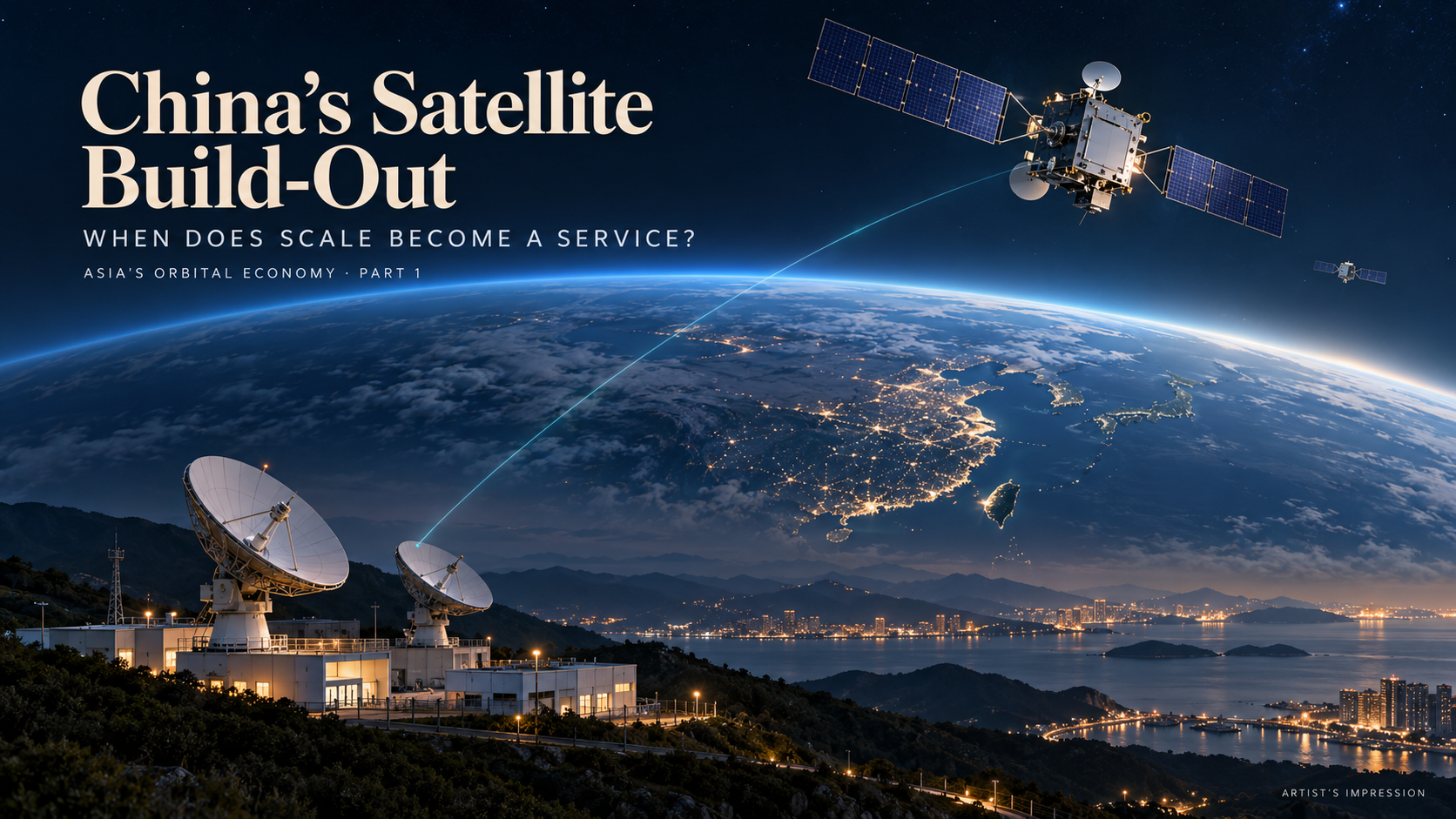
Guowang and Qianfan are expanding China’s orbital infrastructure. Their commercial significance depends on what customers can purchase—and who takes responsibility for delivering it.
China launched another group of internet satellites on October 25, extending a build-out that reaches from spacecraft factories to commercial launch sites. The harder transition is from infrastructure in orbit to dependable connectivity on the ground: which customers will buy the capacity, who guarantees delivery, and when will revenues support the investment?
This four-part series examines satellite networks, telecom partnerships, launch economics and computing in orbit. Its opening focus is China SatNet’s Guowang network and SpaceSail’s Qianfan constellation, also known as Thousand Sails. Six questions connect their deployment to commercial delivery.
🟩 What does a successful launch actually establish?
The China National Space Administration confirmed that the October 25 mission used a Long March 8A from the Hainan commercial launch site and placed the 28th group of low-orbit internet satellites into their intended orbit. That announcement establishes a deployment milestone. It provides no customer-service performance figures.
The next assessment concerns how the new spacecraft contribute to the network: commissioning, available capacity, continuity of coverage and performance under demand.
A satellite count cannot answer those questions alone. A commercial customer needs to know what connection is available at a particular location, at what price and with what support.
The meaningful progression is from spacecraft delivered to capacity available, contracted and reliably used. Each stage requires different evidence.
🟩 Who is the customer—and what are they buying?
SpaceSail’s agreement with Malaysia’s MEASAT provides a concrete example. Their February 2025 memorandum envisages potential collaboration on LEO broadband and other satellite services in Malaysia and Asian markets where MEASAT operates.
That introduces an intermediary between the constellation and the end user. A satellite operator might sell capacity to a regional provider, which combines it with equipment, installation, support and other network services.
The customer proposition then differs from a household buying a broadband subscription directly. Contracted capacity, availability and integration may matter more than a headline download speed.
MEASAT also identifies itself as a Starlink reseller. Its SpaceSail relationship illustrates how a regional provider can evaluate several networks within one portfolio.
Supplier diversity could strengthen negotiating power and reduce dependence on one network. Whether it improves resilience depends on how independently those services operate—and how effectively the provider can switch between them.
🟩 Who guarantees the complete connection?
A customer experiences one service, even when several organisations supply it. The connection depends on spacecraft, ground infrastructure, user equipment, terrestrial links and the systems managing traffic between them.
The MEASAT–SpaceSail memorandum includes a proposed joint study of rain-related signal attenuation in high-frequency Q/V-band transmission. That is a practical reminder that orbital capacity must work through local operating conditions.
Market entry also requires a plan for the applicable service permissions, spectrum access and ground infrastructure. Commercial coverage must account for both the technical reach of the network and the conditions under which it can serve customers.
The service agreement must then allocate responsibility. Who diagnoses an interruption? Which party supplies replacement equipment? What happens when delivered performance falls below the contracted level?
Regional partners can contribute local knowledge and support. The constellation operator must supply the operational visibility needed to resolve problems across the complete connection.
🟩 Can the launch schedule support the service?
Deploying a constellation requires an initial sequence of launches. Sustaining it adds recurring demands: replacing failed or ageing spacecraft, expanding capacity and maintaining the network during those changes.
The October 25 mission demonstrates continued access to Chinese launch infrastructure. A commercial assessment must examine whether production and launch capacity can support the service throughout its operating life.
Replacement assumptions belong inside that calculation. Each system’s expected spacecraft life, failure rate and replenishment schedule determine how much continuing expenditure is needed to preserve capacity.
Predictable launch access therefore has financial value. Delayed replacement can constrain supply, while rapid deployment commits capital before all that capacity necessarily earns revenue.
The operator must align manufacturing, launch bookings and customer demand. Revenue from the deployed fleet needs to support both current operations and the infrastructure required to keep the service running.
🟩 Who finances capacity before it earns revenue?
Guowang is being developed for the state-owned China Satellite Network Group. Its national infrastructure role makes public objectives relevant alongside any commercial assessment.
Strategic coverage, resilience and industrial capability can justify investment on grounds that differ from subscription revenue. Those objectives still require clear measures of cost and delivery.
For any constellation, the financing challenge is the interval between paying for infrastructure and collecting enough revenue to sustain it. Customer terminals, ground facilities and support operations add expenditure beyond spacecraft and launches.
Committed purchasing contracts could reduce that uncertainty. Expressions of interest and partnership announcements provide weaker evidence of future cash flow.
An assessment needs to distinguish investment supporting a public capability from investment expected to produce a commercial return. Otherwise, deployment progress can obscure the financial obligations accumulating behind it.
🟩 Can international partnerships become repeat business?
Airbus provides another route toward customers. In December 2025, Airbus and SpaceSail announced a memorandum aimed at integrating the future SpaceSail network into the HBCplus inflight-connectivity offering. Airbus described it as an additional option for airline customers, including Chinese carriers.
HBCplus connects airlines to managed service providers through certified aircraft equipment. Introducing another constellation therefore involves integration with an aviation service platform, rather than simply making orbital capacity available.
Commercial plans must account for the relevant validation, aircraft configuration, installation schedules and support arrangements. Those steps affect the interval between a partnership announcement and revenue from operational flights.
The memorandum establishes an intended development path. It does not establish deployment of SpaceSail connectivity across a paying airline fleet.
International expansion ultimately requires the service to fit a partner’s existing suppliers and customer commitments. The evidence to watch is contracted capacity entering service, followed by customers renewing or expanding their purchases.
Signal
China’s satellite build-out is creating the infrastructure for a larger connectivity business. Its commercial strength will become clearer through contracted capacity, dependable service and repeat purchasing. The decisive measure is how effectively the organisations behind the networks convert deployment into sustained customer value.
This article is part of Asia’s Orbital Economy, a four-part Altair Media Asia series exploring satellite networks, telecom partnerships, launch economics and computing in orbit.
Credit
AI-generated illustration: OpenAI for Altair Media.
Caption
Artist’s impression linking a satellite constellation above China with a ground station. The conceptual montage illustrates the infrastructure connecting orbital capacity to services on Earth; it does not depict specific Guowang or Qianfan hardware.
