South Korea Makes the Memory. Who Controls the AI Economy?
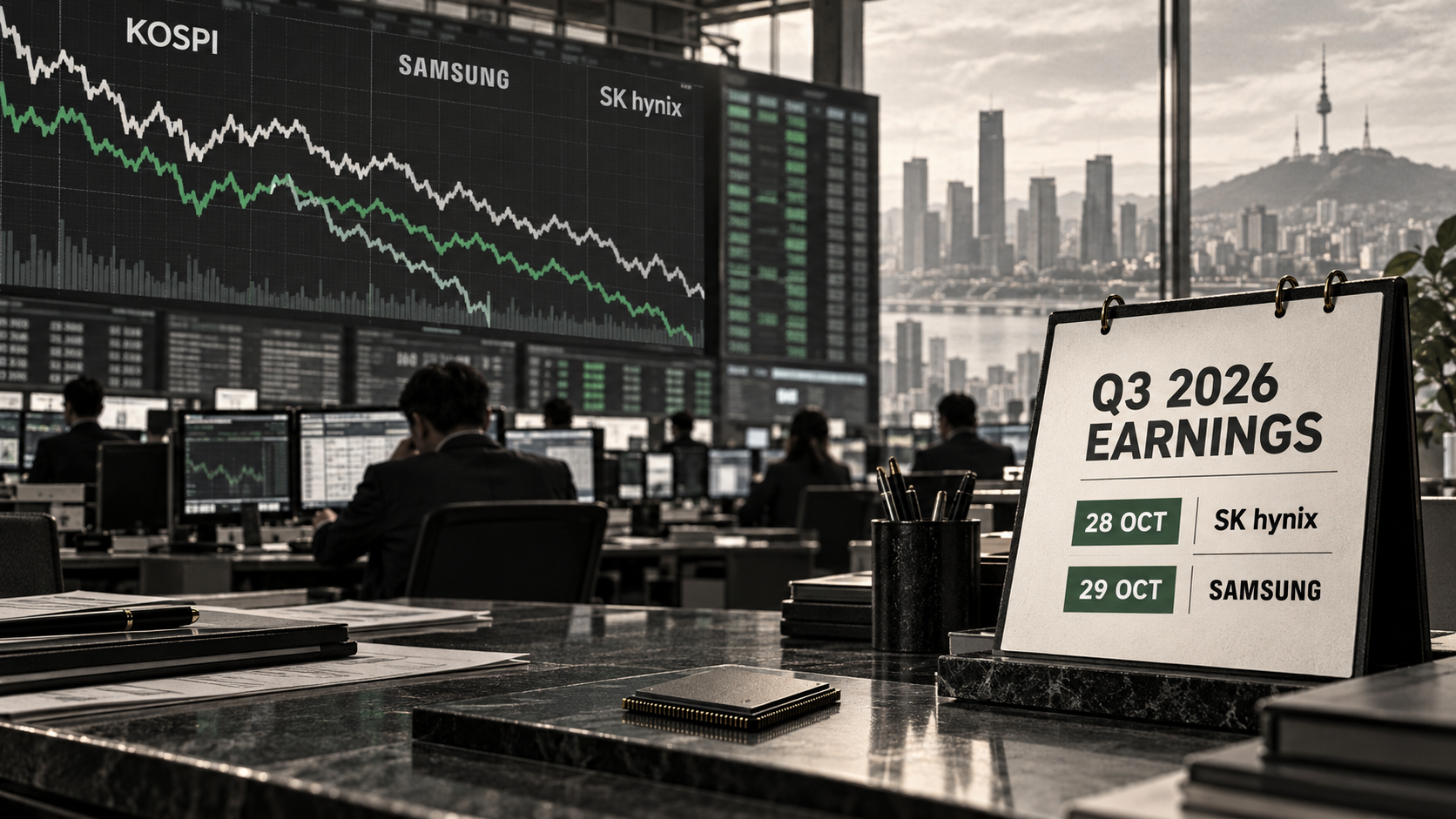
Samsung and SK hynix’s coming earnings updates will test whether industrial strength can withstand growing doubts about the spending behind the AI boom.
South Korea’s chipmakers are reporting extraordinary profits, yet their shares are falling as investors question the durability of AI spending. Ahead of earnings updates from SK hynix and Samsung, the sell-off exposes a deeper tension: the country supplies essential technology, but much of the demand depends on investment decisions made by large American technology companies.
The immediate test comes on 28 October, when SK hynix reports third-quarter results, and 29 October, when Samsung presents its detailed earnings. Five questions matter beyond the headline profits.
🟩 Why are chip shares falling when profits are rising?
Samsung’s preliminary guidance puts third-quarter operating profit at approximately 107.4 trillion won, almost nine times the figure a year earlier. Those are estimated earnings, with the detailed breakdown still to come.
Yet strong profits have failed to prevent a sharp market correction. On 13 October, Samsung fell around 7.4% and SK hynix 10.1%, while the Kospi lost approximately 5.5%, amid concerns about financing the AI infrastructure boom.
The distinction is between money already earned and the earnings investors expect next. Today’s chip deliveries can remain profitable while confidence in tomorrow’s data-centre projects weakens.
That leaves management facing a harder demand: demonstrate how long exceptional earnings can last. Another strong quarter may confirm the boom without resolving doubts about its durability.
🟩 If Korea is indispensable, why is it so exposed?
Advanced memory gives Korean manufacturers real bargaining power. AI processors need rapid access to enormous quantities of data; high-bandwidth memory, or HBM, helps provide it. In its second-quarter report, SK hynix said mass shipments of HBM4 had begun during the quarter, with production set to expand in the second half of 2026.
These relationships involve demanding engineering and production requirements. Customers cannot simply replace a qualified supplier overnight.
But technological leverage does not give suppliers control over their customers’ investment budgets. A chipmaker can negotiate prices and delivery commitments while remaining exposed to delays in the data centres that will use its products.
The dependence runs both ways. American AI companies need Korean manufacturing capability; Korean manufacturers need customers willing and able to keep expanding. The risk is that factories and financial expectations adjust at different speeds.
🟩 Has AI ended the memory industry’s boom-and-bust cycle?
SK hynix argues that AI is broadening demand across both specialised and conventional memory. In July, it reported long-term agreements with around ten customers and said further discussions were under way.
That offers a stronger basis for investment than relying entirely on short-term orders. It also leaves important questions unanswered publicly: how much volume is firmly committed, how prices are determined, and what flexibility customers retain if their plans change.
The historical distinction matters. In its 2023 annual report, rival Micron described long-term agreements under which prices, quantities and other terms were periodically renegotiated. That does not establish the terms of today’s Korean contracts, but it shows why a contract’s duration alone says little about its financial protection.
If a contract permits deliveries to be postponed, revenue can move into a later quarter while factory costs continue. The relevant question is who absorbs that timing risk.
The central uncertainty is whether rising AI use will absorb the capacity now being built at prices that sustain current returns. Demand can keep growing while profitability falls if supply expands faster or buyers negotiate better terms. The earnings calls need to clarify how much protection the contracts actually provide.
🟩 Should the AI windfall fund factories or shareholders?
On 23 October, SK hynix ended consideration of a potential pre-IPO fundraising and listing for Solidigm, citing capital-market conditions and share-price trends. It maintained that the subsidiary’s growth prospects and investment needs were unchanged.
The decision shows financial conditions changing the proposed funding route for expansion. It does not, by itself, establish that a factory project has been delayed. The investment requirement remains, and the company must assess alternative ways to finance it.
Alongside those needs, SK hynix has committed to a 40 trillion won share repurchase and cancellation programme. In August, it also announced plans to return more than half of cumulative free cash flow for 2025–2027 to shareholders.
Free cash flow accounts for capital spending, so these commitments do not automatically compete for the same money. But their affordability still depends on future earnings, investment costs and timing.
Management must demonstrate how expansion and shareholder payouts remain affordable if customer spending slows or financing becomes more expensive.
🟩 What must the October earnings actually prove?
SK hynix’s 28 October results and Samsung’s 29 October presentation will provide the next opportunity to compare market anxiety with operating evidence. Samsung has already published its preliminary totals; the additional value lies in the business breakdown and management’s outlook.
For SK hynix, the questions concern HBM deliveries, the strength of customer commitments and the balance between expansion and shareholder distributions.
Samsung faces an additional test across memory and its foundry business, which manufactures chips for other companies. In July, it reported improved foundry earnings before incentive-related provisions and outlined further expansion in advanced manufacturing processes. Investors now need evidence that this expansion can generate sustainable returns alongside the memory business.
Both companies also need scrutiny on prices and volumes. Higher revenue generated by rising prices has different implications from growth driven by more chips shipped. Neither, by itself, establishes how profitable the next wave of capacity will be.
The decisive evidence will concern future commitments: what customers have ordered, what manufacturers must spend to deliver, and how much risk each side carries if the investment cycle slows.
🟩 The Signal
Korea’s industrial leverage is substantial; its exposure to the AI investment cycle remains. Solidigm shows how financial volatility can change funding plans while companies still report strong demand. The next test is whether contracts, cash reserves and investment discipline can turn exceptional profits into durable resilience.
Credit
Altair Media Asia / OpenAI — AI-generated editorial illustration.
Caption
Stylised market charts and an earnings calendar in an illustrated Seoul trading room. SK hynix reports on 28 October 2026, followed by Samsung’s detailed results on 29 October, as investors reassess the spending behind the AI boom.
