The Architecture of Patient Capital
Can a Market Be Directed Without Ceasing to Be a Market?
China does not lack capital. It has household savings, insurers, state funds, banks and one of the world’s largest investment industries. The harder question is what kind of behaviour that capital should reward. Under CSRC Chairman Wu Qing, Beijing is trying to create “patient capital”: money willing to finance technological risk for longer, without turning national priorities into speculative bubbles.
Regulators are normally expected to stop markets from taking too much risk. Wu Qing faces a more unusual challenge: China wants investors to take more of the right kind of risk.
Artificial intelligence, semiconductors, robotics, advanced manufacturing and new energy require large amounts of capital long before reliable profits appear. Some technologies will fail, commercialisation can take years and investors must be willing to tolerate uncertainty. If financial markets demand immediate returns, strategically important companies may struggle to survive the period between research and scale.
China wants capital to become more adventurous and more disciplined at the same time.
Wu has been unusually explicit about that problem. In June, he told China’s fund industry that emerging and future industries urgently needed capital and called on private equity to support early-stage and hard-technology companies for longer. Yet in the same speech he warned managers against blindly betting on fashionable sectors, launching funds simply because prices had risen or turning technological enthusiasm into “concept hype”.
That captures the Chinese dilemma almost perfectly. Beijing wants more equity finance, more venture capital and greater tolerance for technological risk, while simultaneously demanding more stability, stronger supervision and less speculation.
Engineering a longer horizon
Beijing is not leaving that transformation entirely to investor preference. It is changing the institutional environment in which investors operate.
Insurers are being encouraged to play a larger role as long-term equity holders, while the state has strengthened the capital position of major financial institutions so they have greater capacity to absorb market risk. In September, a new round of capital injections into state-owned banks and insurers was partly intended to reinforce institutions that Beijing increasingly expects to support the real economy and provide medium- and long-term capital.
The direction continued in October, when the CSRC proposed lowering the minimum capital required to launch equity mutual funds. The objective is not simply to stimulate stock-market activity, but to expand the institutional channels through which longer-term money can enter equities.
Patient capital only creates value if patience eventually meets performance.
This makes “patient capital” more than an investment slogan. It is becoming a form of institutional design. Capital requirements, investment mandates, fund structures and performance horizons can all be adjusted to make financial institutions behave differently.
Wu’s task is to make that engineered patience compatible with a market that still needs to price risk.
Patience still needs an exit
There is another part of patient capital that receives less attention: eventually, investors need to get their money back.
That makes IPOs and acquisitions an essential part of the architecture. Venture capital can wait through years of technological development only if investors believe that successful companies will eventually have access to liquid capital markets or strategic buyers.
China has experienced the difficulty from both directions. Tighter scrutiny of mainland IPOs from 2023 onwards improved regulatory discipline but also contributed to a sharp fall in new listings and withdrawals of prospective offerings. For private equity and venture investors, fewer exits can turn patience into trapped capital.
The real challenge is distinguishing risk that finances innovation from risk that merely follows policy or momentum.
The policy direction is now becoming more accommodating for strategically important technology companies. This year, regulators announced reforms to Shenzhen’s ChiNext market and greater support for listings by companies in “future industries”, including artificial intelligence, quantum technology and other advanced fields.
That creates another balancing act for Wu. China wants rigorous listing standards, but a system designed to finance innovation also needs a credible exit route.
When patience becomes protection
The harder problem is deciding which companies actually deserve more time.
If investors believe that a semiconductor, robotics or AI company will continue receiving support simply because it operates in a politically favoured sector, patience can become something very different from long-term conviction.
Losses may be tolerated for too long. Capital can remain inside weak companies because investors assume further state support will arrive. Strategic importance can begin to substitute for commercial discipline.
A market can be guided towards longer horizons — but it still has to know when to say no.
That is the risk behind what economists sometimes describe as a soft budget constraint: companies survive not because their economics justify continued investment, but because the system finds it difficult to let them fail.
Wu’s warnings about speculative fund launches and fashionable investment themes therefore matter. China does not simply need more money flowing towards technology. It needs financial institutions capable of distinguishing between risk that finances innovation and risk that merely follows policy or momentum.
Markets do not always make that distinction well. Governments do not either.
Can patience be designed?
This is what makes Wu Qing such a revealing final figure in The New Architecture of Asian Capital.
Hiromi Yamaji is pushing Japanese companies to use existing capital more efficiently. Dilhan Pillay can use Temasek’s long-term balance sheet to decide which risks deserve time. Mukesh Ambani can move profits from mature businesses into industries Reliance wants to build.
Wu is attempting something broader: to influence the time horizon and risk appetite of an entire capital market.
China is therefore not simply choosing between state direction and market allocation. It is trying to combine them. The state identifies strategic priorities, changes incentives and encourages investors to stay longer. Markets are still expected to select companies, price risk and eventually withdraw capital from those that fail.
That combination could solve a genuine weakness of modern finance. Markets dominated by short-term performance pressures can underinvest in technologies that require years of research, infrastructure and industrial scaling.
But directing capital creates its own danger. If political priority becomes a substitute for investment judgement, the system may become patient precisely where it should become impatient.
That is why the success of China’s experiment cannot ultimately be measured by how much capital reaches AI, semiconductors or advanced manufacturing. It must be measured by whether that capital becomes better at identifying productive companies and allowing unsuccessful ones to fail.
Because patient capital only creates value if patience eventually meets performance.
And that leaves Wu Qing with perhaps the most difficult question in this series:
Can capital remain patient because investors believe in the future — when the system is also telling them which future deserves their patience?
This article is part of The New Architecture of Asian Capital, an Altair Media Asia series on the people and institutions shaping how capital is directed across the region. The series concludes with Masayoshi Son and SoftBank.
Credit
Illustration: Altair Media / OpenAI
Caption
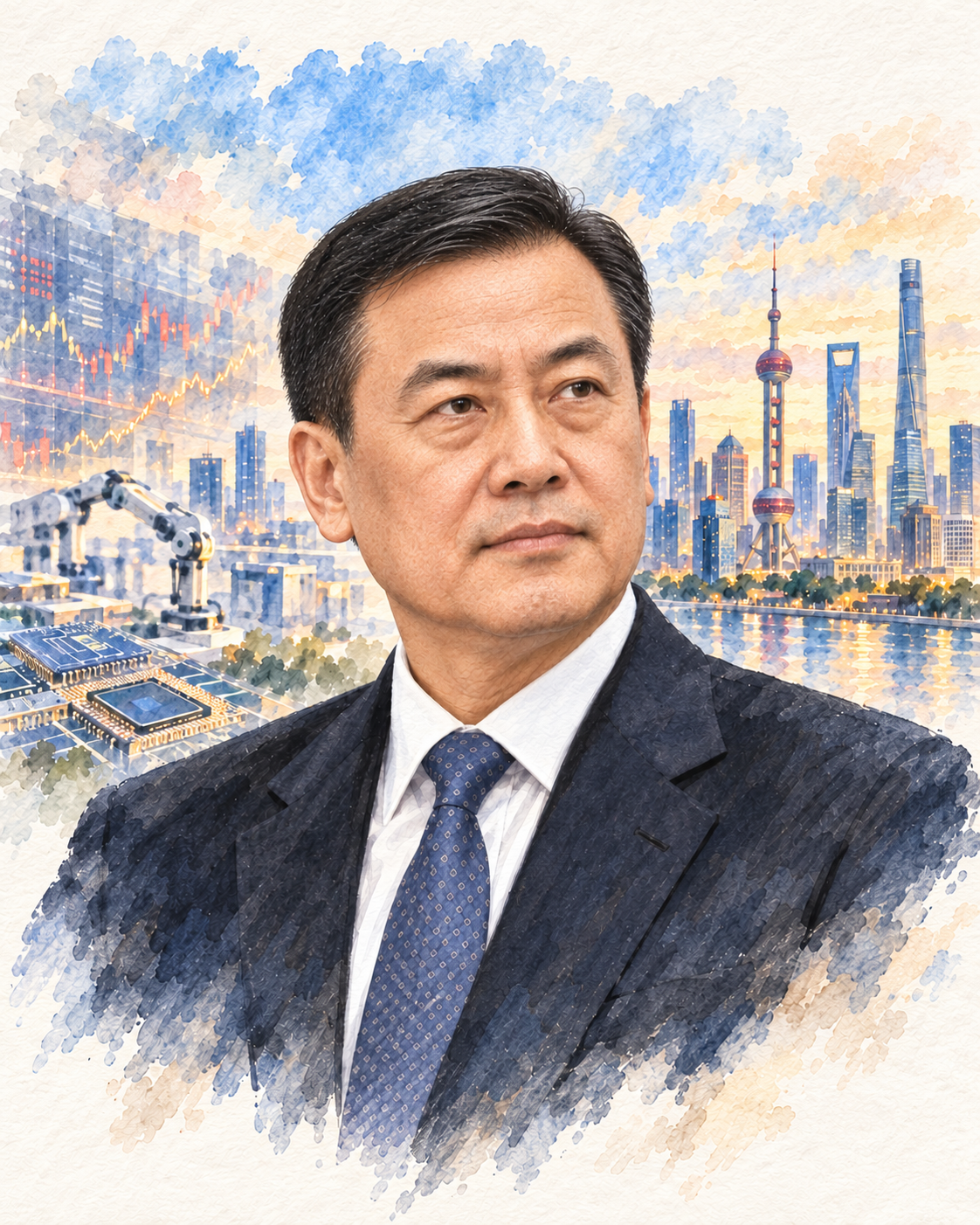
Wu Qing, Chairman of the China Securities Regulatory Commission. As Beijing pushes more long-term capital towards technology and advanced industry, his challenge is to encourage patience without allowing strategic priorities to replace market discipline.
- “”
- “”
- “”
Als je er nog een vierde wilt voor afwisseling, vind ik deze ook sterk:
- “”
