The New Khmer Cool
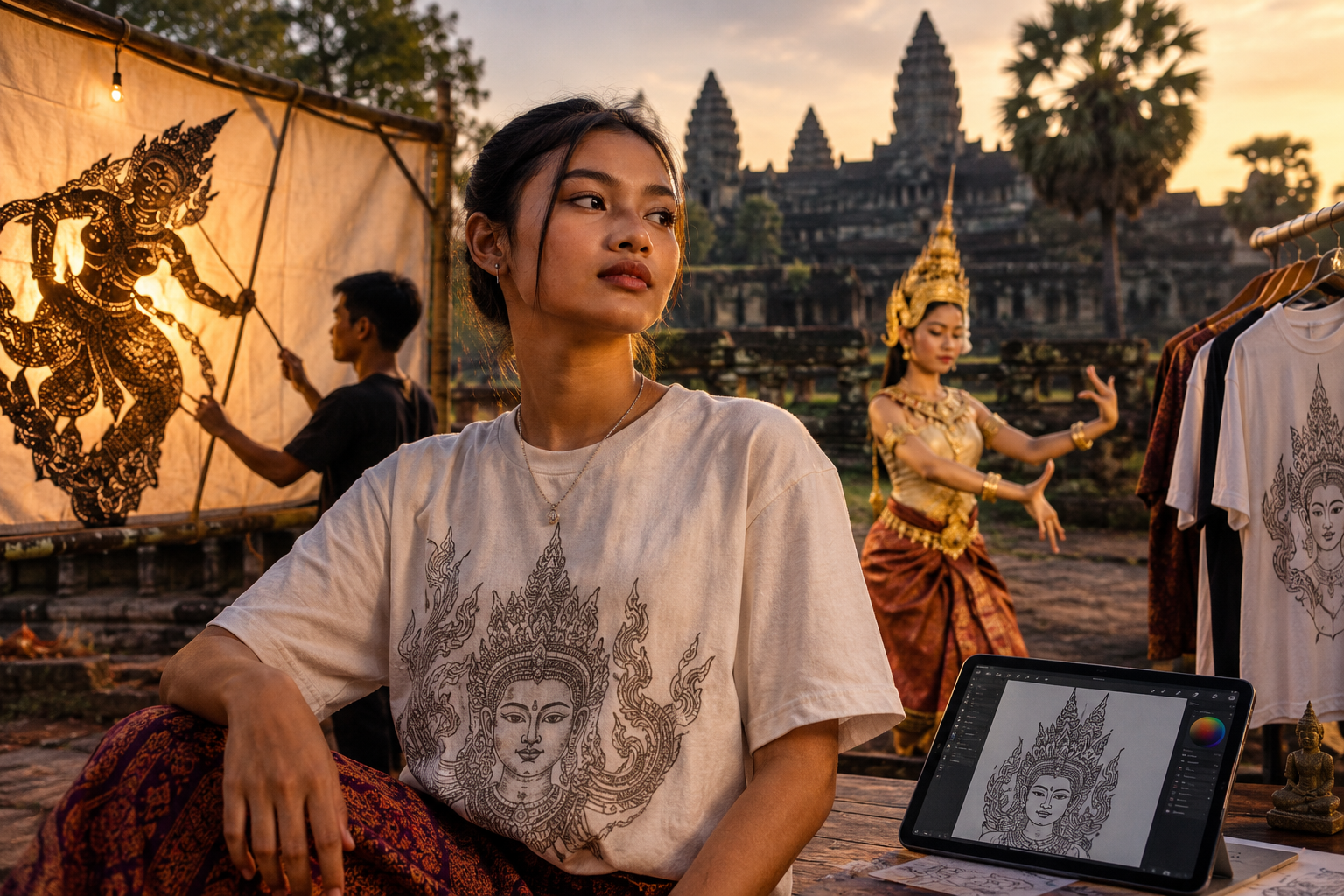
Cambodia’s young generation is not merely preserving its culture. It is beginning to play with it again.
Standing before the carved walls of an ancient temple, Cambodian designer Sok Porcheang studies the curves of celestial figures, ornaments and sacred symbols. Then he does something that would once have seemed unusual: he takes those forms back to Phnom Penh and puts them on T-shirts, bags and other objects made for everyday life.
It is a small scene, but it says something larger about contemporary Cambodia. For decades, the country’s cultural story has largely been told internationally through two overwhelming chapters: the grandeur of Angkor and the destruction of the Khmer Rouge period. A younger generation is beginning to add a third. It is asking what Khmer identity can look like when it is neither frozen in antiquity nor defined primarily by trauma.
“I design art on clothing that they can wear daily because it is a form of mobile art.”
Sok Porcheang, designer, Ahsora World
That question is increasingly visible in fashion. At Phnom Penh Designers Week 2026, Cambodian designers presented contemporary collections in a capital whose creative scene is becoming noticeably more confident and locally driven. Elsewhere, young designers are drawing directly on temple sculpture, traditional patterns and Khmer symbols — turning cultural references into clothes intended to be worn rather than simply admired.
The idea is deceptively simple. Heritage does not have to remain behind glass. It can walk down the street.
When tradition moves
Cambodia has unusually rich performing traditions. The Royal Ballet of Cambodia, also known as Khmer Classical Dance, uses graceful but highly codified hand gestures, elaborate costumes and controlled movements to communicate characters, emotions and stories. Those hand positions are not merely decorative: they form part of a symbolic performance language refined and transmitted across generations.
Then there is Sbek Thom, the great Khmer shadow theatre. Performers manipulate intricately cut leather figures that can reach around two metres in height, traditionally performing stories from the Reamker — Cambodia’s own version of the ancient Indian Ramayana epic. The tradition dates from before the Angkorian period and historically had a sacred role, with performances reserved for particular ceremonial occasions.
A culture becomes truly contemporary when younger generations no longer feel they have to choose between inheritance and invention.
These traditions survived a rupture that could easily have ended them. Cambodian Living Arts estimates that around 90 percent of the country’s musicians, dancers, teachers and instrument makers were lost during the genocide. Because much artistic knowledge had been passed from teacher to student through demonstration and oral transmission, the destruction also severed chains of cultural memory.
Yet preservation is now only part of the story.
Cambodian Living Arts increasingly supports artists who combine contemporary expression with older Khmer forms. Its commissioned dance work Root, for example, brought six forms of traditional Cambodian movement into a contemporary choreography. The intention was not simply to reproduce the past, but to demonstrate continuity: new artistic languages can emerge without erasing where they came from.
From refugee-camp pencils to digital styluses
Battambang offers perhaps the clearest example of that transition. Phare Ponleu Selpak traces its origins to Cambodian children learning to draw in a refugee camp on the Thai border in the 1980s. Art was used as a way of processing the experiences of war. In 1994, former students and their teacher began creating an arts centre near Battambang.
For Cambodia, cultural recovery is increasingly giving way to cultural confidence.
Today, Phare teaches circus, theatre, music and dance — but also graphic design, animation, photography and digital visual arts. Its creative ecosystem now extends into professional animation, connecting a story that began with pencils in a refugee camp to young artists working with digital tools.
That evolution is striking. An institution born partly from the need to recover from war has become a place where young Cambodians learn to imagine things that did not exist before.
And something similar is happening in Phnom Penh. New Cambodian-led fashion labels, galleries, restaurants, design spaces and cultural venues are helping reshape a capital that foreign visitors long treated mainly as a stop between Angkor Wat and Cambodia’s traumatic twentieth-century history.
The most powerful form of preservation may be the freedom to reinterpret what previous generations worked so hard to protect.
Perhaps that is the most interesting part of Cambodia’s cultural moment. A society does not keep its culture alive by repeating it perfectly. It keeps it alive when a new generation feels sufficiently at home in that culture to question it, remix it, wear it — and occasionally make something from it that their grandparents would never have imagined.
Angkor still tells the world something extraordinary about what Cambodia once built.
The young designers, dancers and artists of Phnom Penh and Battambang are beginning to answer a different question:
What does Cambodia want to create next?
Credit
AI-generated illustration for Altair Media
Caption
From shadow theatre and classical dance to fashion and digital design, a younger generation is bringing Khmer culture into contemporary Cambodian life — not simply preserving the past, but making it their own.
