The Philippines’ AI Gamble

From Call-Center Superpower to Strategic Tech State
At 2:17 a.m. in Quezon City, the floor lights never dim. Rows of cubicles glow electric blue, reflecting off headsets, coffee cups and laminated scripts that few agents consult anymore. For two decades, this nocturnal machinery powered one of the most successful service economies in the developing world. While the West slept, the Philippines spoke — soothing angry customers, troubleshooting routers, resetting passwords, processing insurance claims. The country became, quite literally, the voice of global capitalism after dark.
Tonight, the phones still ring, but less often. Many calls are intercepted upstream by conversational AI, resolved in seconds by software trained on millions of past interactions. Agents now monitor dashboards instead of conversations, stepping in only when the algorithm hesitates or a customer demands a human. Between calls, some workers complete online modules on data annotation or prompt engineering — skills that did not exist when they were hired.
A few hours north, beyond the traffic-choked arteries of Metro Manila, survey markers outline a different future. New Clark City — envisioned as a clean, climate-resilient metropolis — is being wired for hyperscale connectivity, automated logistics and energy systems designed to power data centers rather than office towers. The Philippines is attempting something audacious: to transform itself from the world’s back office into a node of the AI economy.
Read MoreLight as Power

China’s Photonic Leap and the Next Infrastructure Race
In the public imagination, artificial intelligence still lives in the cloud — an ethereal realm of models, data and algorithms unconstrained by geography. Yet the systems that produce AI are among the most material constructs ever built: warehouses of processors drawing gigawatts of electricity, cooled by rivers of water, bound together by copper traces that now operate at the edge of physics. The more intelligence we demand, the more the underlying infrastructure resembles heavy industry rather than software.
A growing number of engineers argue that we are approaching an “electron wall”. In modern AI clusters, performance is no longer limited primarily by how fast transistors can switch, but by how quickly data can move between them without melting the hardware that carries it. Electricity generates heat, resistance and delay. At scale, those constraints compound into a systemic bottleneck — a data movement tax that consumes vast amounts of energy before a single useful calculation is completed.
“The dirty secret of AI is that we are running out of power and thermal headroom. Moving data with electrons is simply too expensive in terms of energy. To keep scaling, we must move from computing with electricity to computing with light.”
— Dr. Keren Bergman, Faculty Executive Director & Professor of Electrical Engineering, Columbia University
Light, by contrast, moves without electrical resistance and with minimal heat loss. Optical signals can carry far more information per unit of energy, across greater distances, at higher speeds. What began as a solution for long-distance telecommunications is now emerging as a candidate for the internal wiring of machines themselves. In effect, the architecture of computing may be shifting from electrons to photons — from current to illumination.
Read MoreSingapore: The Neutral Node of the Global Photonics Network
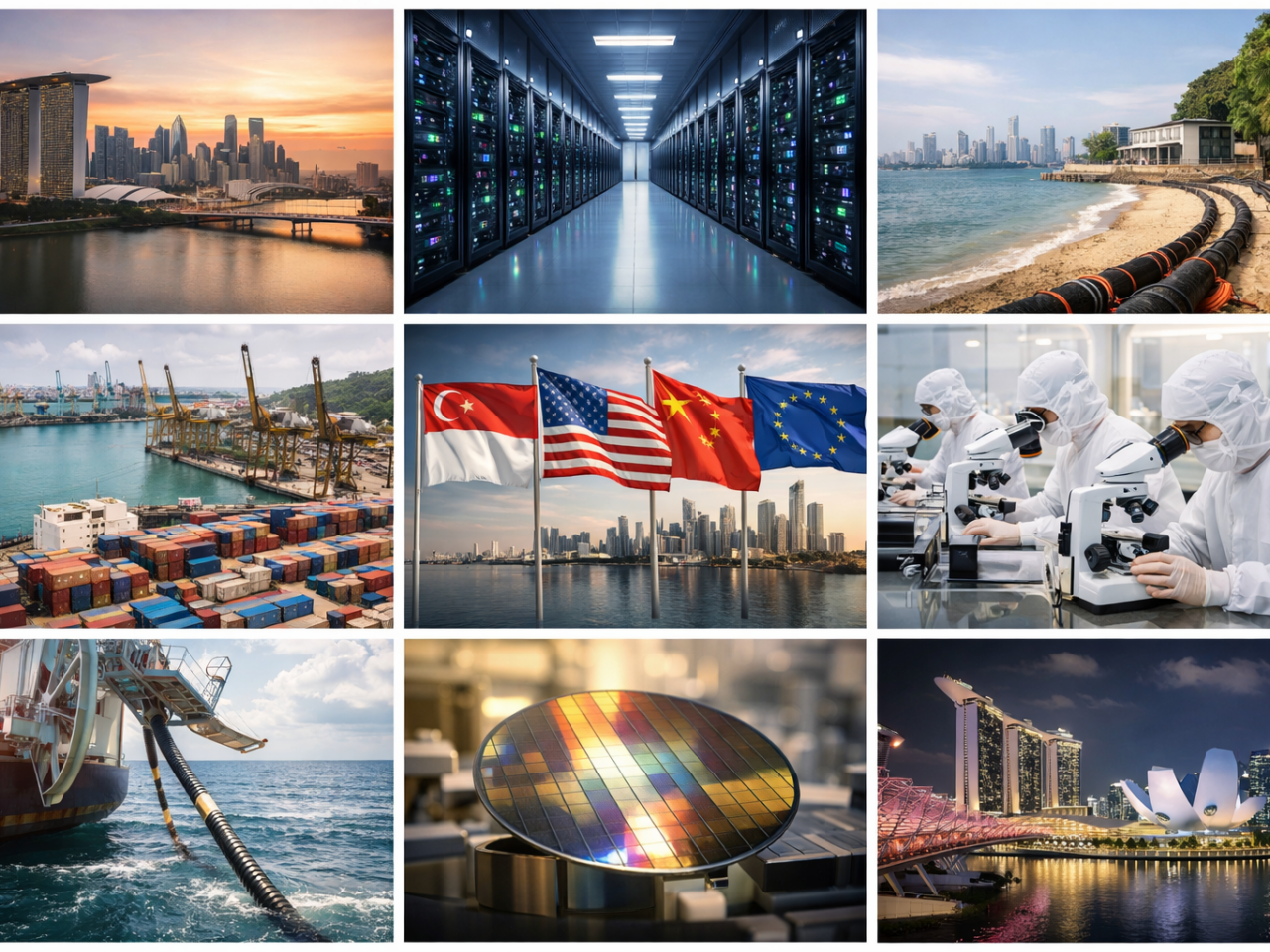
How a city-state engineered itself into the switching point of 21st-century infrastructure power
In the industrial age, power belonged to those who controlled territory, resources and sea lanes. In the digital age, it belongs increasingly to those who control connectivity. Geography still matters — but it matters differently. Not as mass, but as density. Not as land, but as linkage.
Singapore embodies this shift more clearly than almost any other state. Small in territory, limited in natural resources and surrounded by larger powers, it has redefined sovereignty not through scale but through centrality. It has engineered itself into a node — a place through which capital, data, technology and trust must pass.
“We are a little red dot in a vast ocean. If we are not exceptional, we are not relevant. If we are not relevant, we do not exist.”
— Lee Hsien Loong, Senior Minister of Singapore
This existential logic has shaped the city-state’s development for decades. But in the era of artificial intelligence, semiconductor geopolitics and photonics-driven infrastructure, it has taken on a new architectural dimension. Singapore is no longer merely a trading hub. It is designing itself as an operating system for global technological flows.
Read More