Nidec: The Motors Powering the Modern World

How a Japanese company quietly became indispensable to everything that moves.
In the modern economy, movement is so constant that it becomes invisible. Data flows through servers, air circulates through datacenters, vehicles glide across highways and robots assemble the devices that define daily life. Beneath all of this lies a simple but essential function: rotation.
Every system that moves, cools or converts energy depends on a motor. Yet few people consider where these motors come from. They are rarely branded, almost never visible and often measured in millimeters. But without them, the digital and industrial world would quite literally come to a standstill.
This is the domain of Nidec.
From its origins as a small startup in Kyoto to its current position as one of the world’s largest motor manufacturers, Nidec has built its influence not through visibility, but through ubiquity. Its products are embedded in systems ranging from hard disk drives to electric vehicles, quietly converting electricity into motion across the global economy.
Read MoreThe Great Tech Rebalance: Why ASML Is Scaling in Asia Without Leaving Europe
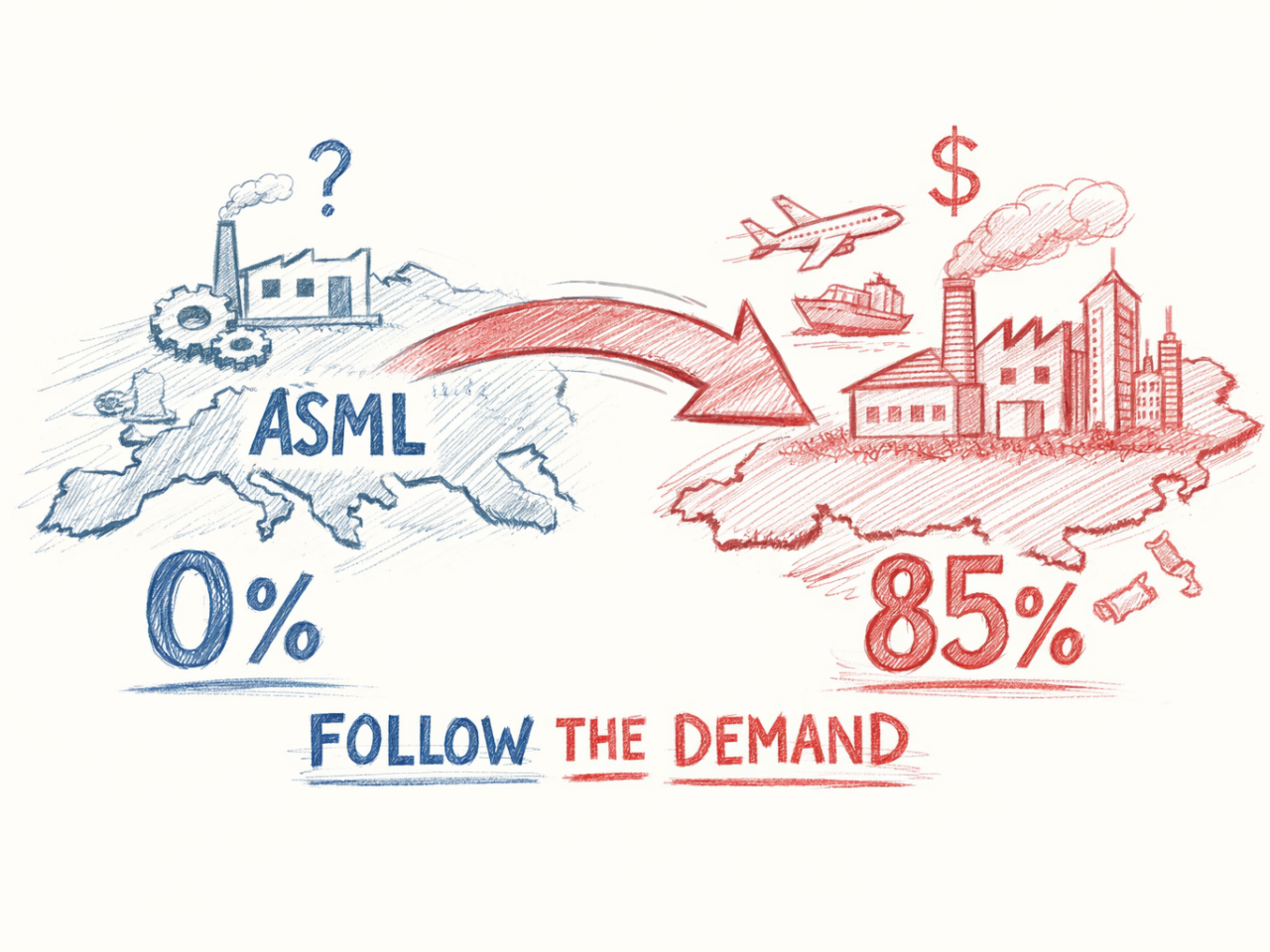
Europe builds. Asia buys. That balance is breaking.
In the past six months, Europe accounted for 0% of ASML’s sales. Not low. Not declining. Zero. At the same time, ASML is moving toward a projected €36–€40 billion in revenue for 2026, driven almost entirely by demand outside Europe. That contrast is striking, but it is also misleading if interpreted as a company-specific anomaly. What we are seeing here is not a shift in performance, but a shift in structure. This is not about one company expanding abroad. This is about how the global technology system is reorganising itself.
For decades, Europe’s strength lay in its ability to build deep, highly specialised innovation ecosystems. Brainport Eindhoven became one of the most successful examples of that model.
But that alignment between innovation, production and market is breaking down.
Artificial intelligence has accelerated demand at a global scale and that demand is increasingly concentrated in Asia. What used to be a regional ecosystem with global exports is turning into a system where innovation remains local, but execution follows demand.
Read MoreChina’s Population Story Is Quietly Shifting

Official stabilization narratives contrast with local indicators pointing toward faster structural decline
What changed
China’s official messaging increasingly frames population decline as manageable. The emphasis has subtly shifted from reversing the trend to adapting to it — reflected in the growing focus on the “silver economy” as a new source of demand.
Beneath that narrative, however, a different picture is emerging. Across provinces and cities, local indicators point toward a faster and more uneven contraction. Schools are closing, maternity wards are being consolidated and local governments are quietly revising population projections downward.
The shift is not dramatic at the national level. But it is becoming visible where demographics are most immediate: in local systems.
Read More