Monday, February 16, 2026
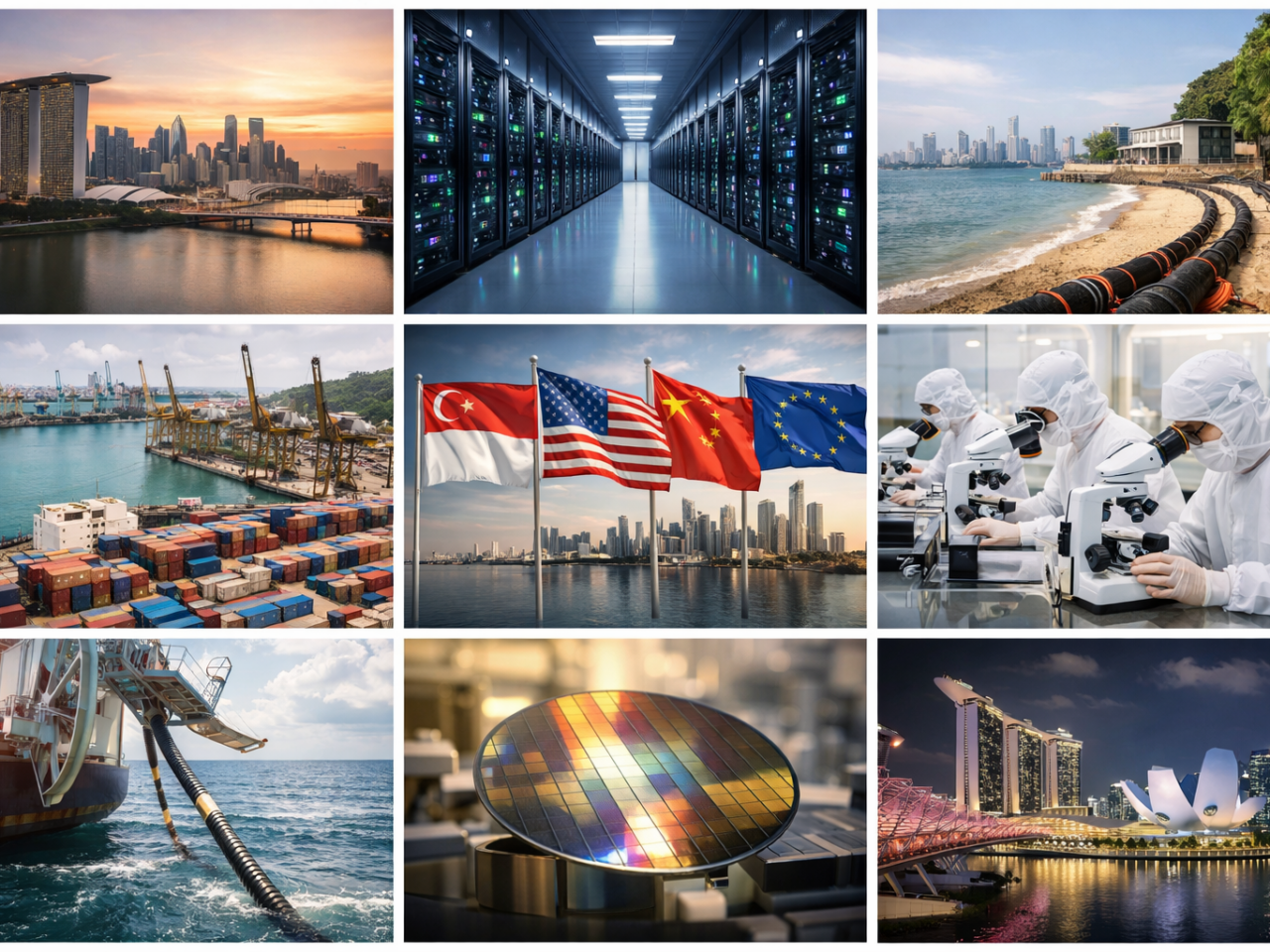
Singapore has transformed from maritime chokepoint to digital switching hub. By aligning policy, capital and advanced photonics infrastructure, the city-state positions itself as a neutral node in a fragmented world — where connectivity, density and trust increasingly define geopolitical power.
Read More
Sunday, February 15, 2026

What appeared to be a conventional industry expo in Singapore revealed something far more consequential: a region aligning industry, capital and state power around photonics — the physical backbone of artificial intelligence, data infrastructure and future economic competitiveness in the emerging global order.
Read More
Wednesday, February 11, 2026

Artificial intelligence is usually discussed as software. Faster models. Bigger datasets. Smarter algorithms. But what if the real shift is not in the code — but in the physics?
Read More
Wednesday, February 11, 2026

The quiet transition of Niranth Amogh from Huawei to Nokia may appear, at first glance, as an individual career decision within the global telecom industry. In reality, it signals a deeper geopolitical realignment taking shape inside the architecture of 6G. As standards become instruments of power rather than technical coordination, the Asia-Pacific region has emerged as the decisive battleground where influence is exercised not through markets or mandates, but through the control of protocols, procedures and technical language.
Read More
Monday, February 2, 2026

The global telecom industry is often portrayed as a competition between companies. Ericsson versus Nokia. Huawei versus the West. Vendors versus markets. Yet this framing increasingly fails to explain what is really unfolding beneath the surface.
Read More
Friday, January 30, 2026

In 2026, Asia’s telecommunications landscape has shifted dramatically. The conversation is no longer about who can deploy the most 5G towers, but about who controls the “brains” of the network. Autonomous AI-driven systems, massive data flows and the need for sovereign infrastructure have redefined the competitive arena. Governments and operators are not merely investing in connectivity; they are investing in control, resilience and intelligence at the edge.
Read More
Friday, January 16, 2026

Asia’s telecommunications landscape is vast, diverse and rapidly evolving. With billions of subscribers across countries with varying levels of digital infrastructure, the region has become a strategic laboratory for the future of telecom. Amid this complexity, five companies stand out—not only for their market share and revenue but also for their bold moves to transform networks into AI-driven platforms, reshaping the very nature of what it means to be a telecom operator.
Read More
Wednesday, January 14, 2026

For decades, artificial intelligence was defined by Silicon Valley: large models, venture capital, global hype. But the next phase of AI is different. The challenge is no longer invention alone—it is execution at scale, across diverse societies and infrastructures. Increasingly, the answer points to Bengaluru. Once India’s outsourcing hub, today it is where AI moves from laboratory experiments to operational systems with real-world impact.
Read More
Wednesday, January 7, 2026

For decades, Silicon Valley dominated the global technology narrative. Today, a more distributed and strategic configuration is emerging — a triangle connecting Bengaluru, the Netherlands and Dallas–Fort Worth. In this network, Bengaluru is not just an execution hub; its startups and engineering centers are innovating at the forefront of AI, robotics, 5G/6G and complex system integration. Together, the three regions form a globally connected ecosystem, combining design excellence, industrial scale and engineering talent to drive the next decade of deep technology.
Read More
Sunday, January 4, 2026

In the current geopolitical landscape, universities are no longer peripheral institutions devoted solely to education and abstract research. They have become strategic assets. Nowhere is this more visible than in Asia, where technology, state power and long-term national strategy are deeply intertwined. Rather than converging on a single model of excellence, Asia’s leading universities have specialised. Each reflects a different answer to the same underlying question: how should knowledge production serve national power, economic resilience and global positioning?
Read More
