Japan — A Society Built on Continuity
Why understanding Japan begins with its people rather than its economy
For many people outside Asia, Japan is synonymous with technological excellence. Images of high-speed trains, robotics, precision engineering and globally recognised companies have become part of the country’s international identity. Together they project an image of efficiency, innovation and modernity.
Yet technology explains surprisingly little about Japan. Behind its industrial achievements lies a society shaped by continuity, responsibility and an enduring commitment to craftsmanship.
Long before Japan became a technological power, it had developed social institutions that emphasised cooperation, discipline and the careful transmission of knowledge across generations. Modern industry did not replace these traditions. In many respects, it grew out of them.
Understanding Japan therefore requires looking beyond economics and technology. It means examining the values, relationships and institutions that have quietly shaped one of the world’s most resilient societies.
Technology is one of Japan’s achievements. Society is the foundation that made it possible.
Japan is often presented as a country where tradition and modernity coexist. While true, that observation barely scratches the surface. The more interesting question is why this coexistence has proven possible in the first place.
Unlike many societies where periods of rapid modernisation disrupted older social structures, Japan has generally preferred gradual adaptation over abrupt transformation. New ideas are often absorbed rather than imposed, allowing innovation to develop without entirely severing ties with the past.
This preference for continuity can be seen almost everywhere. Ancient shrines stand comfortably beside financial districts. Family-owned workshops produce components for advanced semiconductor equipment. Seasonal festivals continue alongside one of the world’s most sophisticated transport networks.
Modernity in Japan has rarely meant abandoning history. Instead, it has often meant finding new ways for history to remain relevant.
A Society Before an Economy
Japan is today one of the world’s largest advanced economies, with global strengths ranging from automotive engineering and industrial robotics to advanced materials, life sciences and precision manufacturing. Yet reducing Japan to its economic performance misses the deeper forces that make those achievements possible.
Economies do not emerge in isolation. They are built upon societies.
Japan’s economic success has long rested on institutions that cultivate trust, responsibility and long-term thinking. Families, schools, neighbourhoods and workplaces all contribute to a social environment in which individuals are encouraged to consider how their actions affect the wider community.
This does not mean Japan is culturally uniform. Contemporary Japanese society is increasingly diverse. Younger generations often have different ambitions from their parents. International influences are reshaping urban life and changing labour markets are altering traditional career paths.
Nevertheless, certain social patterns remain remarkably resilient.
Public transport illustrates this particularly well. The reliability of Japan’s railway system is not simply the product of engineering excellence. It also reflects millions of daily interactions built upon mutual expectations. Passengers queue patiently, trains depart with extraordinary punctuality and public spaces generally function through widespread cooperation rather than constant enforcement.
The same principle appears in countless aspects of everyday life. Streets remain clean not solely because municipalities employ cleaners, but because personal responsibility extends into public space. Customer service often exceeds international expectations because professional conduct reflects personal pride as much as organisational policy.
These practices may appear ordinary in isolation. Taken together, they form an invisible infrastructure of trust.
Japan’s infrastructure is not built solely from steel, concrete and digital networks. It is equally sustained by shared habits, mutual trust and everyday responsibility.
This social infrastructure helps explain why Japan’s visible infrastructure functions so effectively. Railways, cities and public institutions are supported not only by technology, but by widely shared expectations about responsibility and cooperation.
Harmony, Responsibility and Everyday Life
One of the concepts most frequently associated with Japan is wa, commonly translated as harmony. Yet harmony should not be mistaken for the absence of disagreement.
Japanese society is no stranger to competing interests, organisational politics or conflicting ambitions. The distinction lies less in whether disagreements exist than in how they are managed.
Consensus is often built gradually through consultation, informal discussion and careful relationship management before formal decisions are taken. To outside observers this process can appear slow, yet it frequently produces broad institutional support once agreement has been reached.
This approach has shaped government, business and local communities alike. It encourages stability and long-term coordination, qualities that have supported Japan’s remarkable industrial development over many decades.
The same qualities, however, can also create rigidity.
Organisations that excel at gradual improvement sometimes struggle when confronted with rapid technological disruption or structural change. Consensus can become caution. Stability can become inertia.
Japan’s greatest strengths therefore often contain the seeds of its greatest challenges.
The country has repeatedly demonstrated an extraordinary ability to refine existing systems. Reinventing them entirely has often proved more difficult.
Tradition as Living Infrastructure
To many visitors, Japan’s traditions appear timeless. Shrines, temples, seasonal festivals and carefully maintained rituals suggest a society deeply connected to its past.
Yet tradition in Japan is far from static.
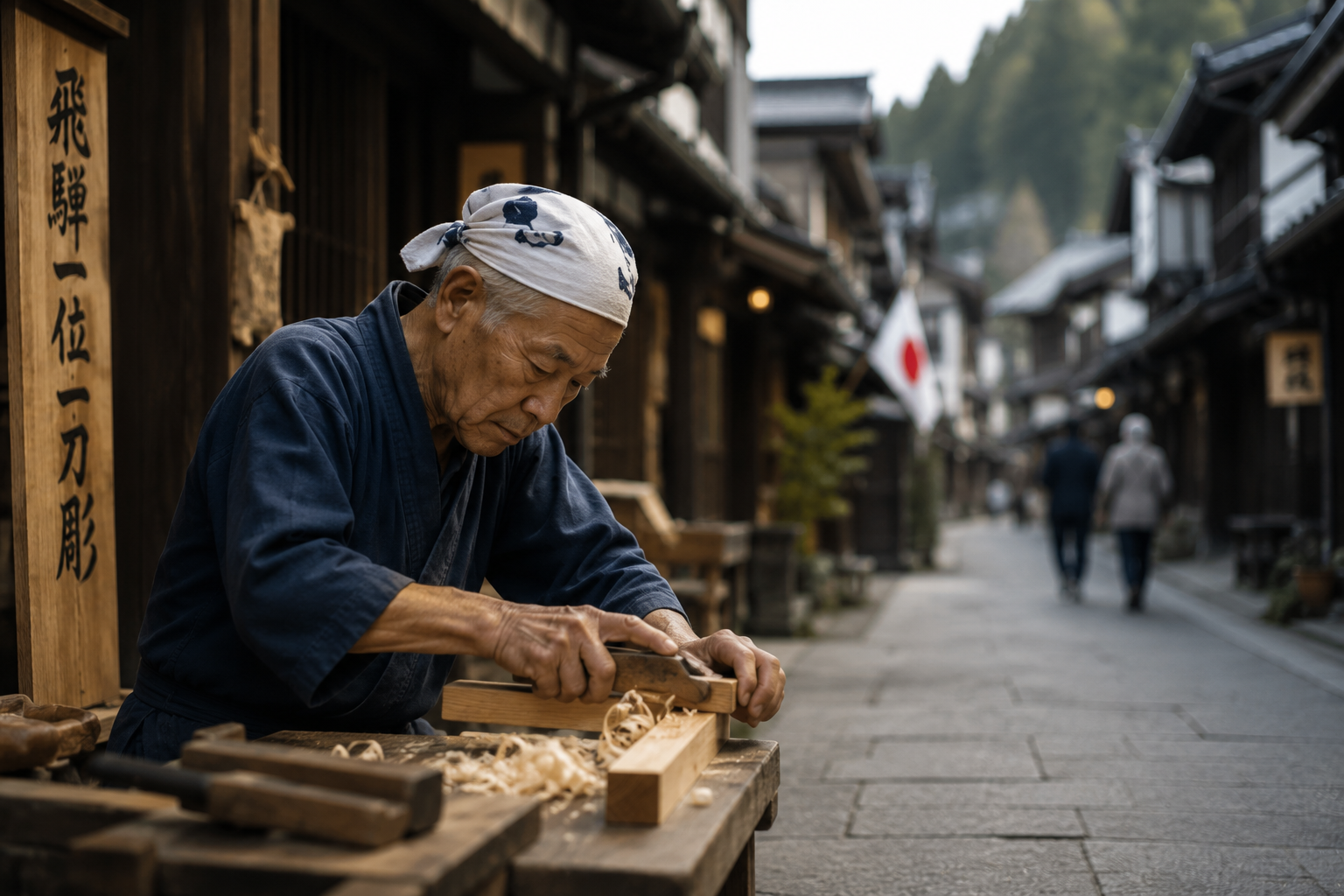
Rather than preserving history unchanged, Japanese society has consistently adapted inherited practices to contemporary life. Religious ceremonies continue even among people who do not consider themselves particularly religious. Traditional craftsmanship survives by supplying some of the world’s most advanced industries. Historic neighbourhoods increasingly coexist with digital economies rather than disappearing beneath them.
The past is therefore not simply remembered. It remains active.
This continuity is equally visible in Japanese business culture. Across the country, family-owned companies have survived for generations by balancing stability with gradual adaptation. Their longevity has rarely depended upon resisting change. Instead, it has depended upon recognising which values should remain constant while allowing products, technologies and markets to evolve.
The same principle extends far beyond individual companies. It shapes architecture, education, public administration and community life.
Continuity, in Japan, is less about preserving yesterday than about carrying accumulated knowledge into tomorrow.
This perspective helps explain why Japan rarely experiences innovation as a complete break with the past. New technologies are more often incorporated into existing social structures than allowed to replace them entirely.
Technology changes. The underlying social fabric evolves more slowly. It is this gradual relationship between continuity and adaptation that has given Japanese society much of its long-term resilience.
The Craftsmanship Economy
One of the most distinctive features of Japan’s economy cannot be measured in quarterly growth figures or stock market valuations. It is embedded in the way work itself is understood.
The Japanese concept of monozukuri is often translated simply as “making things.” In reality, it carries a much richer meaning. It reflects the pursuit of craftsmanship, continuous improvement and respect for the process through which something is created. Quality is not regarded as the final outcome alone, but as something built into every stage of production.
This philosophy has shaped Japanese manufacturing for decades.
Whether producing a ceramic bowl, a precision bearing, an industrial robot or a semiconductor material, the objective is remarkably similar: to make each product slightly better than the last.
The result has been an industrial culture built on accumulated knowledge rather than rapid disruption.
Japan rarely seeks the fastest breakthrough. More often, it seeks the better process.
This approach transformed companies such as Toyota, whose production system became one of the most influential management models of the twentieth century. Continuous improvement—kaizen—allowed manufacturers to reduce waste, improve quality and involve employees directly in solving operational problems.
Over time these principles spread far beyond the automotive industry.
They now underpin much of Japan’s strength in advanced manufacturing, robotics, machine tools, optics, specialised chemicals and precision engineering.
Yet perhaps Japan’s greatest industrial strength remains largely invisible.
Beneath globally recognised brands lies an extensive network of specialised suppliers. Thousands of medium-sized and family-owned companies manufacture highly specialised materials, sensors, machine components and production equipment that few consumers ever encounter directly.
Their names rarely appear on finished products. Their technologies often determine whether those products can be manufactured at all.
This position deep within global value chains explains why Japan continues to exercise considerable industrial influence, even as many consumer brands have shifted their manufacturing elsewhere in Asia.
Japan increasingly exports capability rather than visibility.
Improvement Rather Than Disruption
Innovation is often associated with dramatic breakthroughs.
Silicon Valley celebrates disruption. New technologies replace old business models, established companies disappear and entirely new industries emerge within remarkably short periods.
Japan has traditionally followed a different path. Rather than disrupting existing systems, Japanese organisations have frequently sought to improve them step by step. Thousands of incremental refinements, each relatively modest on its own, gradually produce significant advances in quality, efficiency and reliability.
This philosophy has served Japan exceptionally well in sectors where precision matters more than speed.
Industrial automation, advanced materials, semiconductor equipment, optical systems and robotics all reward organisations capable of accumulating expertise over decades.
Yet every model has its limitations.
As economic value increasingly shifted from hardware towards software, platforms and digital ecosystems, Japan discovered that excellence in manufacturing did not automatically translate into leadership in internet-based business models.
The country did not stop innovating. The architecture of innovation changed.
Today’s challenge therefore differs fundamentally from that of previous decades.
Japan no longer needs to prove that it can manufacture world-class technologies.
The question is whether it can combine its extraordinary manufacturing capabilities with artificial intelligence, software development and digital platforms that increasingly define global competitiveness.
Education, Responsibility and Social Trust
Economic success begins long before people enter the labour market.
Japanese schools have traditionally viewed education as more than academic instruction. Alongside mathematics, science and languages, children learn how communities function.
Students help clean classrooms, organise activities and share responsibility for their environment. These routines communicate a simple but powerful principle:
Communities depend upon participation.
Responsibility is practised before it is expected.
This helps explain why Japanese children often display a degree of independence that surprises many foreign visitors. Travelling to school, using public transport and moving through neighbourhoods independently are possible because they occur within a broader culture of mutual trust.
Education has therefore contributed not only to Japan’s skilled workforce but also to its social cohesion.
At the same time, the system places considerable pressure on young people.
Competitive entrance examinations, demanding educational pathways and expectations surrounding career success have long shaped family life.
The future of Japan’s education system may depend less on producing excellent students than on preparing resilient citizens.
While these institutions helped build one of the world’s most highly educated workforces, they have also generated increasing debate about wellbeing, creativity and the balance between achievement and personal fulfilment.
Japan’s younger generations continue to value education.
They are, however, asking different questions about what success should look like.
Work, Loyalty and a Changing Social Contract
For much of the post-war period, employment in Japan represented more than a source of income.
Large companies often provided long-term security, professional identity and social belonging. In return, employees demonstrated exceptional loyalty, commitment and perseverance.
This relationship became one of the defining characteristics of Japan’s economic rise. It also created considerable pressure.
Long working hours, rigid organisational hierarchies and limited labour mobility became deeply embedded in corporate culture. In its most extreme form, this culture produced karoshi—death associated with excessive overwork—which came to symbolise the human cost of an economic model built around absolute dedication.
Although such cases remain exceptional, they prompted a wider national conversation about work, health and quality of life.
Today that conversation is reshaping Japanese society.
Younger generations increasingly place greater emphasis on flexibility, personal wellbeing and work-life balance than previous generations. Companies are experimenting with new employment models, digital working practices and more inclusive organisational cultures.
Women are participating more actively in the labour market, while employers facing labour shortages are reconsidering long-established recruitment practices.
The traditional post-war employment model is therefore gradually giving way to a more flexible social contract.
The transition is far from complete. But Japan is no longer asking whether work should change.
It is asking how change can occur without losing the stability that helped build one of the world’s most successful industrial economies.
Living with Demographic Transition
Few developments will shape Japan’s future more profoundly than demographic change.
For decades, international commentary has presented Japan’s ageing population primarily as a crisis. Declining birth rates, labour shortages and shrinking rural communities are frequently portrayed as evidence of national decline.
The reality is more nuanced.
Japan’s demographic transition is also the consequence of remarkable success. Longer life expectancy, high-quality healthcare and decades of economic prosperity have created one of the world’s oldest populations. According to Japan’s Statistics Bureau, almost three in ten residents are now aged sixty-five or older, while children account for little more than one in ten of the population.
The challenge is therefore not simply that Japan is ageing. It is that nearly every institution was designed for a different demographic reality.
Schools merge as the number of children declines. Hospitals treat growing numbers of elderly patients. Companies compete for an increasingly limited workforce. Rural communities struggle to maintain public transport, healthcare and local services as younger generations migrate towards larger cities.
Demography is no longer merely a statistical trend. It has become an organising force within Japanese society.
Population ageing is changing more than Japan’s demographics. It is reshaping the relationship between work, care, family and the state.
Japan’s response has been characteristically pragmatic.
Automation, robotics and artificial intelligence increasingly compensate for labour shortages. Older citizens remain economically active for longer. More women participate in the labour market than in previous generations, while carefully managed immigration has gradually expanded in sectors experiencing severe labour shortages.
Technology undoubtedly forms part of the solution.
Yet it cannot answer every question.
A robot may assist an elderly patient, but it cannot replace human companionship. Digital public services may improve efficiency, yet they cannot by themselves preserve the social fabric of communities losing population year after year.
Ultimately, demographic change is not only an economic challenge. It is a societal one.
Hidden Strengths in a Changing Economy
Japan’s economy is often described through the lens of its “lost decades.”
Following the collapse of the asset bubble in the early 1990s, economic growth slowed and confidence weakened. For many outside observers, this period came to define contemporary Japan.
Yet that narrative tells only part of the story.
Beneath relatively modest economic growth, Japan quietly retained extraordinary industrial depth.
Today the country continues to occupy indispensable positions within global supply chains. Its companies remain world leaders in specialised chemicals, semiconductor materials, industrial robots, machine tools, optical systems, batteries and countless high-precision components that rarely carry a consumer-facing brand.
Many of the technologies shaping the global economy continue to rely upon Japanese expertise at critical stages of production.
Japan therefore exercises influence in a different way from many digital economies. Its strength often lies beneath the surface.
Rather than dominating consumer markets, it increasingly enables them.
This distinction has become even more important as geopolitical competition encourages governments to reconsider the resilience of global supply chains.
The question is no longer simply where products are assembled. It is where indispensable capabilities remain concentrated.
Japan continues to occupy a remarkably strong position within those hidden industrial ecosystems.
Society in Transition
While Japan’s technological capabilities remain widely admired, the country’s social transformation is receiving far less international attention.
Marriage occurs later than in previous generations. Fewer children are born. Career paths have become more diverse, while younger people increasingly question traditional assumptions about work, family and personal fulfilment.
None of these developments are unique to Japan.
What makes Japan distinctive is the way they interact with institutions originally designed during an era of rapid economic expansion and stable population growth.
The result is a society negotiating a new balance.
How should companies organise careers when lifetime employment becomes less common?
How should local communities function as populations decline?
How should responsibility for childcare and elderly care be shared between families, employers and government?
These questions extend far beyond economics.
They concern the very architecture of society.
Japan is therefore not simply adapting to demographic change.
It is gradually redefining the relationship between individuals, communities and public institutions.
Japan’s Next Modernisation
Japan has repeatedly demonstrated an extraordinary ability to reinvent itself.
During the Meiji Restoration it absorbed foreign science and industrial knowledge while preserving a distinct national identity.
Following the Second World War it rebuilt itself into one of the world’s leading industrial economies.
Today’s transformation is different.
Rather than rebuilding physical infrastructure, Japan is redesigning social infrastructure.
The country must adapt its labour market to an ageing workforce, strengthen digital government, expand artificial intelligence, maintain industrial leadership and sustain public services despite a shrinking population.
Japan’s next industrial revolution may not be technological. It may be institutional.
Unlike previous eras, success will depend less upon producing more and more upon organising existing resources more effectively.
Japan begins this transition from a position of considerable strength.
It possesses world-class infrastructure, deep technological expertise, trusted public institutions and one of the most sophisticated manufacturing ecosystems on earth.
Its challenge is therefore not whether it possesses capability.
It is whether those capabilities can evolve as rapidly as the society that increasingly depends upon them.
A Society Built on Continuity
For decades, Japan has fascinated the world through its technology.
Yet technology alone cannot explain why the country functions as it does.
Its railways are efficient because institutions and citizens reinforce one another.
Its industries remain globally competitive because generations of accumulated knowledge continue to shape manufacturing.
Its response to demographic change reflects not only engineering capability but also deeply rooted ideas about responsibility, care and social cohesion.
Japan’s greatest achievement may therefore be neither its companies nor its inventions. It may be its ability to preserve continuity while adapting to profound change.
That ability will be tested in the decades ahead.
The pressures of ageing, digital transformation and geopolitical competition are reshaping the foundations upon which post-war Japan was built.
The institutions that once drove extraordinary stability must now demonstrate equal capacity for renewal.
Whether Japan succeeds will matter far beyond its own borders.
Many advanced economies are beginning to confront similar demographic and economic challenges.
In that sense, Japan increasingly resembles less a unique exception than a preview of what other developed societies may eventually experience.
Understanding Japan is therefore about more than understanding one country. It is about understanding how societies adapt when continuity itself becomes their greatest strategic resource.
Japan’s future will not be determined by how quickly it abandons its past, but by how intelligently it carries its strongest traditions into a very different century.
About this Series
Series: Japan & South Korea
Part of: Portrait of Asia
Portrait of Asia is an ongoing editorial series by Altair Media Asia exploring the people, societies and economies shaping Asia. Each regional series examines how history, culture, demographics and institutions influence the development of individual countries and the continent as a whole.
Current regional series:
- Japan & South Korea
- Southeast Asia (coming soon)
- Greater China (coming soon)
- South Asia (coming soon)
- Central Asia (coming soon)
- The Middle East (coming soon)
Credit
AI-generated illustration / Altair Media Asia
Caption
An elderly Japanese craftsman passes knowledge from one generation to the next. Beyond technology and economic success, Japan’s enduring strength lies in the values, traditions and social institutions that quietly shape everyday life.
