Light as Power
China’s Photonic Leap and the Next Infrastructure Race
In the public imagination, artificial intelligence still lives in the cloud — an ethereal realm of models, data and algorithms unconstrained by geography. Yet the systems that produce AI are among the most material constructs ever built: warehouses of processors drawing gigawatts of electricity, cooled by rivers of water, bound together by copper traces that now operate at the edge of physics. The more intelligence we demand, the more the underlying infrastructure resembles heavy industry rather than software.
A growing number of engineers argue that we are approaching an “electron wall”. In modern AI clusters, performance is no longer limited primarily by how fast transistors can switch, but by how quickly data can move between them without melting the hardware that carries it. Electricity generates heat, resistance and delay. At scale, those constraints compound into a systemic bottleneck — a data movement tax that consumes vast amounts of energy before a single useful calculation is completed.
“The dirty secret of AI is that we are running out of power and thermal headroom. Moving data with electrons is simply too expensive in terms of energy. To keep scaling, we must move from computing with electricity to computing with light.”
— Dr. Keren Bergman, Faculty Executive Director & Professor of Electrical Engineering, Columbia University
Light, by contrast, moves without electrical resistance and with minimal heat loss. Optical signals can carry far more information per unit of energy, across greater distances, at higher speeds. What began as a solution for long-distance telecommunications is now emerging as a candidate for the internal wiring of machines themselves. In effect, the architecture of computing may be shifting from electrons to photons — from current to illumination.
From Chip Race to Infrastructure Race
For two decades, technological competition between major powers has been framed as a semiconductor contest: who can design the smallest transistors, manufacture the most advanced nodes and dominate the supply chain of silicon chips. Export controls, subsidy programs and industrial alliances have all revolved around this paradigm.
China, however, faces structural barriers in this race. The most advanced fabrication processes depend on extreme ultraviolet (EUV) lithography equipment that remains outside its reach. Rather than merely attempting to catch up, Beijing appears to be pursuing a different strategy: redefining the technological terrain itself.
“China understands that it may never catch up in traditional lithography for 2nm chips. Their strategic pivot to photonics is a deliberate attempt to ‘change the lane’ of the race. They aren’t just trying to run faster; they are trying to build a different track.”
— Paul Triolo, Senior Vice President for China & Technology Policy Lead, Albright Stonebridge Group
Integrated photonics — chips that process and transmit information using light instead of electricity — can often be fabricated using older lithography techniques that China already possesses. While not a universal replacement for electronic processors, photonic components excel at high-bandwidth communication, signal processing and certain classes of computation. For AI systems constrained by data movement, these are precisely the functions under greatest strain.
The implication is profound. If electronic chips are products, photonic networks are infrastructure. Whoever controls the optical pathways that connect processors, data centers and communication systems effectively controls the circulation of digital power.
Policy Engine: The 15th Five-Year Plan
The year 2026 marks the beginning of China’s 15th Five-Year Plan (2026–2030), in which photonics is designated as a “future industry” — a category reserved for technologies expected to shape national power decades ahead. Unlike market-driven innovation cycles, China’s industrial policy operates through coordinated investment across research institutes, manufacturing zones and regional development strategies.
Central to this effort is the construction of specialized clusters such as the “Photonics Valley” in Wuhan and the broader optical technology ecosystem across the Greater Bay Area linking Guangdong, Hong Kong and Macao. These initiatives aim to integrate the entire value chain, from raw materials to system deployment.
“In the traditional semiconductor track, it is difficult for us to catch up with the West’s decades of accumulation in lithography. However, in the photonic chip track, everyone is at the same starting line. This is China’s opportunity to ‘change lanes and overtake.’”
— Chen Daixing, Chairman, Shaanxi Photonics Industry Alliance
This concept — often summarized in Chinese policy discourse as huan dao chao che or “overtaking by switching lanes” — captures the strategic logic behind the pivot. Rather than competing head-on where disadvantages are entrenched, China seeks domains where the technological playing field is less mature and scale can confer decisive advantage.
Industrial Gravity: The World’s Photonics Factory
China already accounts for more than 30 percent of global photonics production by volume, significantly exceeding the shares of both Europe and the United States. Its dominance spans lasers for manufacturing, optical sensors, fiber-optic components and telecommunications equipment — sectors that form the industrial backbone of modern economies.
Unlike fragmented Western supply chains, China’s model emphasizes vertical integration. Raw material extraction, crystal growth, wafer processing, module assembly and system integration increasingly occur within national borders. This structure reduces vulnerability to external disruptions while enabling rapid scaling.
“Photonic integration is not just a laboratory curiosity in China; it is a national priority. By 2030, they aim to control the entire stack—from the raw lithium niobate crystals to the optical modules that power global data centers.”
— Dr. Sunny Bains, Editorial Director & Analyst, EngineeringHealth
Industrial scale itself becomes a strategic asset. Large domestic demand, state financing and manufacturing capacity allow Chinese firms to drive down costs and accelerate commercialization. Once deployed at scale, these technologies can shape global standards and supply chains — a dynamic previously observed in solar panels, batteries and telecommunications equipment.
Breakthrough Materials: The TFLN Revolution
Among the most consequential developments is the rise of thin-film lithium niobate (TFLN), a material capable of modulating light at extremely high speeds with low energy loss. Often described as the “gold” of photonics, TFLN enables ultra-fast optical switches and modulators essential for next-generation communication systems.
China holds a significant position in the supply chain for lithium niobate crystals, providing a potential advantage that extends beyond device fabrication to upstream resources. Control over materials can translate into control over production capacity and pricing — a familiar pattern in strategic industries.
Silicon photonics, meanwhile, integrates optical components directly onto semiconductor wafers, allowing photonic and electronic functions to coexist on a single chip. Pilot production lines in provinces such as Shaanxi are transitioning toward commercialization of active devices, including high-performance modulators for data transmission.
AI as the Demand Shock
The urgency of this transition is driven less by theoretical research than by practical necessity. Training large AI models requires enormous clusters of processors exchanging data continuously. As systems scale, the energy required to move information between chips increasingly dwarfs the energy required to compute.
Industry estimates suggest that in advanced AI architectures, up to 90 percent of energy consumption can be attributed to data movement rather than processing. Optical interconnects promise to alleviate this bottleneck by transmitting information at higher bandwidth with lower power requirements.
Chinese technology companies, including major cloud providers, are rapidly adopting optical transceivers operating at 800 gigabits per second and exploring 1.6 terabit systems. These components form the circulatory system of AI infrastructure.
“Computing power is the new oil, but electricity is the bottleneck. We are moving from the Electric Age to the Photonic Age. By 2030, the integration of light and silicon will be the foundation of China’s national computing power network.”
— Dr. Luo Junsheng, Chief Scientist, Institute of Microelectronics, Chinese Academy of Sciences
Whoever controls the optical gateways of data centers effectively governs the throughput of the global AI economy — a form of infrastructural power that operates largely behind the scenes.
Quantum Photonics: Security as Infrastructure
Photonics also underpins China’s advances in quantum communication, particularly quantum key distribution (QKD), which uses properties of photons to create theoretically secure encryption keys. China has already demonstrated long-distance quantum links via both fiber networks and satellites.
The Micius satellite project, for example, enabled quantum-encrypted communication across thousands of kilometers, illustrating the feasibility of a space-ground quantum network.
“The security of our national data cannot rely on Western encryption standards. Photonic quantum communication is the only way to build a truly ‘unhackable’ shield for the 21st century.”
— Pan Jianwei, Lead Scientist, Micius Quantum Satellite Project, University of Science and Technology of China
If deployed at scale, such systems could create parallel communication infrastructures resistant to conventional interception — a development with profound implications for finance, diplomacy and military operations.
Self-Sufficiency as Strategy
China’s photonics push is not limited to isolated technologies. The broader objective is a fully domestic ecosystem encompassing design tools, manufacturing equipment, materials, packaging and deployment. This mirrors the long-term strategy pursued in semiconductors but may be more achievable given the relative maturity of photonic manufacturing techniques.
“Our goal is not just to design chips, but to build the world’s first photonic industrial ecosystem. From raw materials to final packaging, China must achieve self-sufficiency to ensure our digital infrastructure remains unbreakable.”
— Mao Junfa, President, Shenzhen University; Academician, Chinese Academy of Sciences
Self-sufficiency reduces exposure to sanctions while enabling independent technological trajectories. It also positions China as a potential exporter of infrastructure to countries seeking alternatives to Western supply chains.
Global Implications
For the United States, China’s photonic expansion represents both a technological challenge and a strategic concern. Export controls designed for semiconductor equipment may be less effective if key photonic capabilities rely on different tools and materials.
Europe faces a more nuanced dilemma. The continent hosts world-class research clusters — notably the Eindhoven-Leuven axis — but often struggles to translate scientific leadership into industrial scale. Without large-scale manufacturing, intellectual property advantages can erode over time.
“Europe has world-class photonics research, particularly in the Eindhoven-Leuven region. But our challenge remains the same: China is building the factories while we are still refining the formulas.”
— Ecosystem leadership perspective, PhotonDelta network
For developing nations, Chinese photonic infrastructure could offer affordable connectivity and computing capacity, extending digital influence while creating new dependencies.
Not a Chip War — An Infrastructure Transformation
The emerging competition is therefore less about individual components than about the physical architecture of information itself. Optical interconnects, photonic chips and quantum networks form a layered system that could underpin future communications, computing and security.
“The battle for 5G was about the edge of the network. The battle for photonics is about the heart of the machine. If China sets the standards for optical interconnects, they control the plumbing of the global AI economy.”
— Martijn Rasser, Managing Director, Datenna; former CNAS analyst
Unlike consumer technologies, infrastructure once deployed tends to persist for decades. Standards, supply chains and installed base create inertia that shapes technological trajectories long after initial adoption.
The Photonic Century?
History suggests that shifts in foundational technologies rarely occur gradually. The transition from steam to electricity, from telegraph to radio or from vacuum tubes to semiconductors each reorganized industrial systems and geopolitical balances.
Photonics may represent a comparable inflection point — not because it replaces electronics entirely, but because it changes the constraints under which digital systems operate. By reducing the energy cost of information movement, optical technologies could enable scales of computation and communication previously unattainable.
Whether China ultimately leads this transition remains uncertain. Technical hurdles, integration challenges and international responses could alter the trajectory. Yet the direction of travel is unmistakable: intelligence is becoming a physical infrastructure and light is emerging as one of its primary carriers.
The defining question of the coming decade may therefore not be who builds the most powerful AI models, but who controls the pathways through which information flows.
Photo credit:
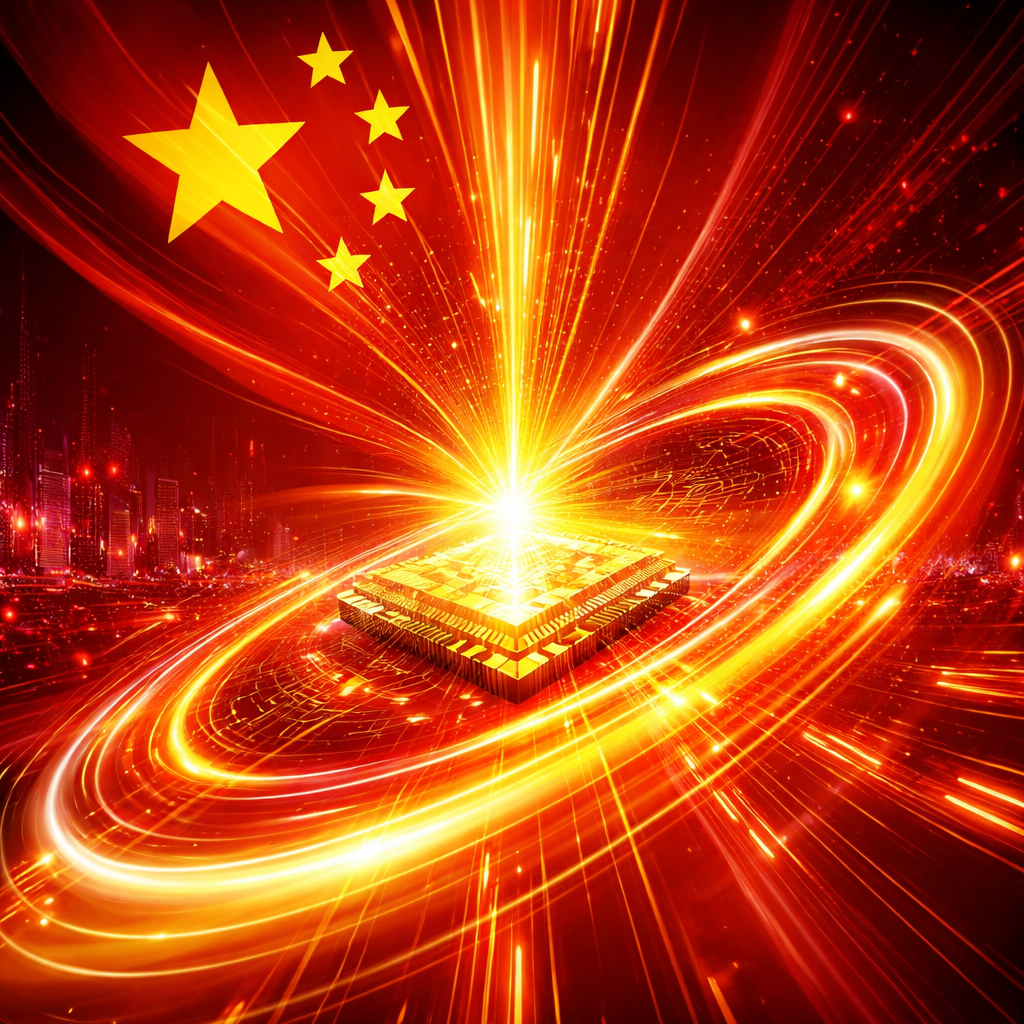
Image generated by AI / conceptual illustration — Altair Media
Caption:
A conceptual visualization of China’s strategic push into photonic technologies, where light-based computing, optical networks and quantum communication converge as foundations of next-generation digital infrastructure.
This article is the Flagship Long Read Background Analysis for Altair Media’s Asia Edition.
